Art Madrid'26 – GALERÍA MARITA SEGOVIA: FIELDS OF COLOUR, GEOMETRY AND ABSTRACTION

The gallery from Madrid Marita Segovia will exhibit in Art Madrid, a selection of the art work by four artists with different identities and artistic discourses but with clear aesthetic, formal and symbolic connections. Abstraction and geometry define the work of these four contemporary creators: Anke Blaue, Eduardo Martín del Pozo, Lourdes García O'Neill and Manolo Ballesteros.

The colour field paintings is one of the many movements of the American abstract expressionism, its greatest exponent being Mark Rothko. The compositions in the "colour field paintings" are characterized by large flat surfaces combined with colour which different shades of light are played with. The artist Anke Blaue (Germany, 1967), goes beyond the chromatic game and creates, without impediment, a spontaneous communication through the visual effect produced by the inherent characteristic of the material used.

The blues, greens, reds and yellows chosen by Blaue become more solemn as they are embodied on pieces of antique linen, patiently superimposed one on the other, creating compositional lines of extreme subtlety that, together with the granulate characteristic of the fabric, produce a special agitation and sensation of abyss.
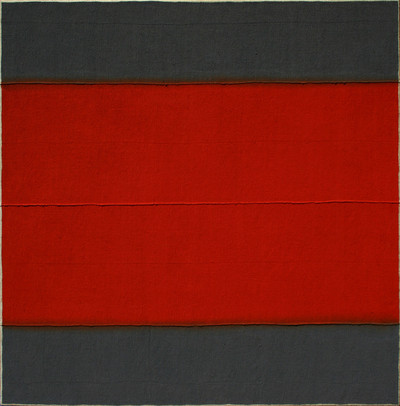
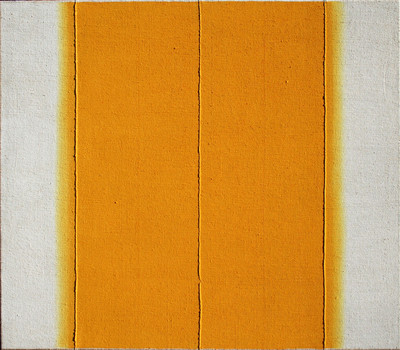
Anke Blaue

AB479, 2018

Tela sobre tela

160 x 160cm

Anke Blaue

AB476, 2018

Óleo sobre lino antiguo

130 x 150cm

The colour planes are also a constant in the art work of Manolo Ballesteros (Barcelona, 1965), who usually combines a maximum of two colours in his works. Ballesteros tries to find himself. For him "painting is a way of thinking, it never has a concrete meaning. What it does have is musicality, it tends to spirituality because of the rhythm, the spaces and the tones of colour".

In his gouaches on paper he creates geometric shapes that subtly take over the canvas, creating capricious forms. During the last few years his art work has experimented in the domain of abstraction, playing with geometric complexity through the uniformity of pigments and the reduction of profiles. As a result of these investigations his most recent work reflects the convergence of rounded shapes on monochromatic backgrounds where the viewer is trapped in an energetic and dynamic art.
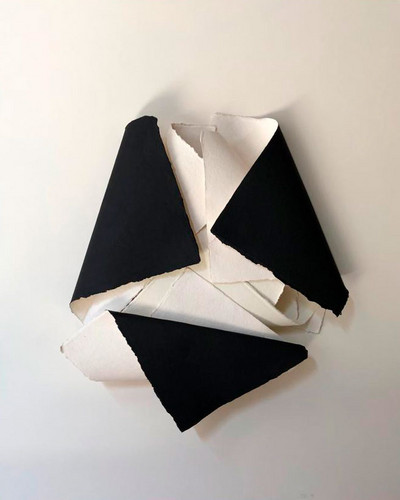
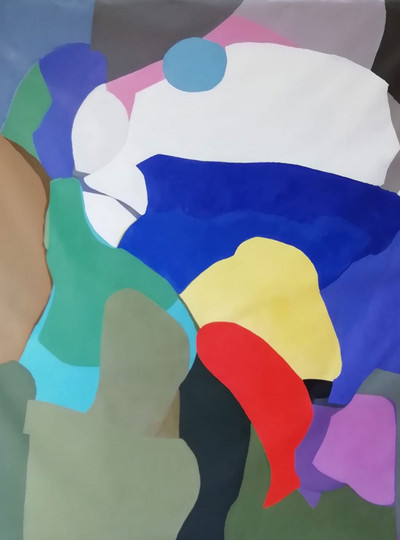
Manolo Ballesteros

Pajarita, 2019

Gouache on paper

111 x 91cm

Lourdes García O'Neill

Sin Título, 2019

Oil on canvas

192 x 178cm

In the compositions of Lourdes García O'Neil, we see again reminiscences of some artistic tendencies belonging to the American expressionist movement. The artist from Seville, combines in her large format canvases, abstract forms of different colours. Through colour and form, and letting herself be carried away by feeling, in her most recent work she achieves a synthesis that discards any insubstantial element previously contained in it.

In some of García O'Neil's works, the forms are diluted in the plane, moving us to the "blocks of colour" of the American artist Helen Frankenthaler. Without falling into their geometry, her production can suggest Equipo 57 because of the loose and fragmented line.
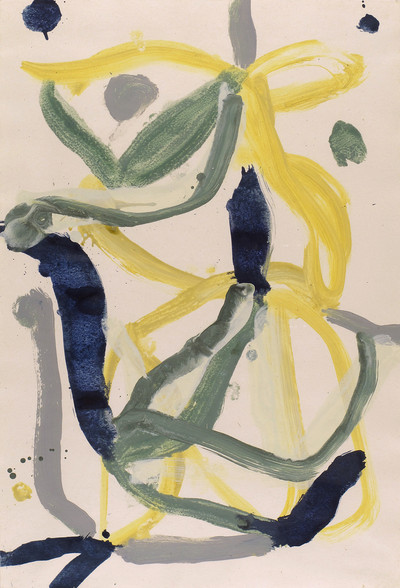
Eduardo Martín del Pozo

2017.53, 2017

Pigmentos en emulsión acrílica y vinílica sobre papel

94 x 64cm

Eduardo Martín del Pozo (Madrid, 1974) is perhaps the most figurative of the four artists. In some of his works, we find simulated spaces, while in others, such as "2017.53", these spaces fade away and become weightless and imprecise. "2018.24" shows us how Martín del Pozo accentuates the indetermination of the configuration of his work, accentuating the purity and definition of his gesture, which causes it to originate a framework hanging on the surface of the support.

Martín del Pozo's research is based on the relationships that can be established between the plastic arts and other manifestations, specifically music. The artist plays with rhythm, repetition and symmetry as if his works were musical structures.



ART MADRID’26 INTERVIEW PROGRAM. CONVERSATIONS WITH ADONAY BERMÚDEZ


The painting of Daniel Bum (Villena, Alicante, 1994) takes shape as a space for subjective elaboration, where the figure emerges not so much as a representational motif but as a vital necessity. The repetition of this frontal, silent character responds to an intimate process: painting becomes a strategy for navigating difficult emotional experiences—an insistent gesture that accompanies and alleviates feelings of loneliness. In this sense, the figure acts as a mediator between the artist and a complex emotional state, linking the practice of painting to a reconnection with childhood and to a vulnerable dimension of the self.

The strong autobiographical dimension of his work coexists with a formal distance that is not the result of conscious planning, but rather functions as a protective mechanism. Visual restraint, an apparent compositional coolness, and an economy of means do not neutralize emotion; instead, they contain it, avoiding the direct exposure of the traumatic. In this way, the tension between affect and restraint becomes a structural feature of his artistic language. Likewise, the naïve and the disturbing coexist in his painting as inseparable poles, reflecting a subjectivity permeated by mystery and unconscious processes. Many images emerge without a clearly defined prior meaning and only reveal themselves over time, when temporal distance allows for the recognition of the emotional states from which they arose.


The Long Night. Oil, acrylic, and charcoal on canvas. 160 × 200 cm. 2024.


The human figure appears frequently in your work: frontal, silent, suspended. What interests you about this presence that seems both affirmative and absent?

I wouldn’t say that anything in particular interests me. I began painting this figure because there were emotions I couldn’t understand and a feeling that was very difficult for me to process. This character emerged during a very complicated moment in my life, and the act of making it—and remaking it, repeating it again and again—meant that, during the process, I didn’t feel quite so alone. At the same time, it kept me fresh and connected me to an inner child who was broken at that moment, helping me get through the experience in a slightly less bitter way.


Santito. Acrylic and oil on canvas. 81 × 65 cm. 2025.


There is a strong affective dimension in your work, but also a calculated distance, a kind of formal coldness. What role does this tension between emotion and restraint play?

I couldn’t say exactly what role that tension plays. My painting is rooted in the autobiographical, in memory, and in situations I have lived through that were quite traumatic for me. Perhaps, as a protective mechanism—to prevent direct access to that vulnerability, or to keep it from becoming harmful—that distance appears unconsciously. It is not something planned or controlled; it simply emerges and remains there.


Night Painter. Acrylic on canvas. 35 × 27 cm. 2025.


Your visual language oscillates between the naïve and the unsettling, the familiar and the strange. How do these tensions coexist for you, and what function do they serve in your visual exploration?

I think it reflects who I am. One could not exist without the other. The naïve could not exist without the unsettling; for me, they necessarily go hand in hand. I am deeply drawn to mystery and to the act of painting things that even I do not fully understand. Many of the expressions or portraits I create emerge from the unconscious; they are not planned. It is only afterwards that I begin to understand them—and almost never immediately. A considerable amount of time always passes before I can recognize how I was feeling at the moment I made them.


Qi. Acrylic on canvas. 81 × 65 cm. 2025.


The formal simplicity of your images does not seem to be a matter of economy, but of concentration. What kind of aesthetic truth do you believe painting can reach when it strips itself of everything superfluous?

I couldn’t say what aesthetic truth lies behind that simplicity. What I do know is that it is something I need in order to feel calm. I feel overwhelmed when there are too many elements in a painting, and I have always been drawn to the minimal—to moments when there is little, when there is almost nothing. I believe that this stripping away allows me to approach painting from a different state: more focused, more silent. I can’t fully explain it, but it is there that I feel able to work with greater clarity.


Crucifixion. Acrylic on canvas. 41 × 33 cm. 2025.


To what extent do you plan your work, and how much space do you leave for the unexpected—or even for mistakes?

I usually feel more comfortable leaving space for the unexpected. I am interested in uncertainty; having everything under control strikes me as rather boring. I have tried it on some occasions, especially when I set out to work on a highly planned series, with fixed sketches that I then wanted to translate into painting, but it was not something I identified with. I felt that a fundamental part of the process disappeared: play—that space in which painting can surprise even myself. For that reason, I do not tend to plan too much, and when I do, it is in a very simple way: a few lines, a plane of color. I prefer everything to happen within the painting itself.