Art Madrid'26 – POP CULTURE, CONCEPTUAL ART AND STREET ART. GALERÍA HISPÁNICA CONTEMPORÁNEA

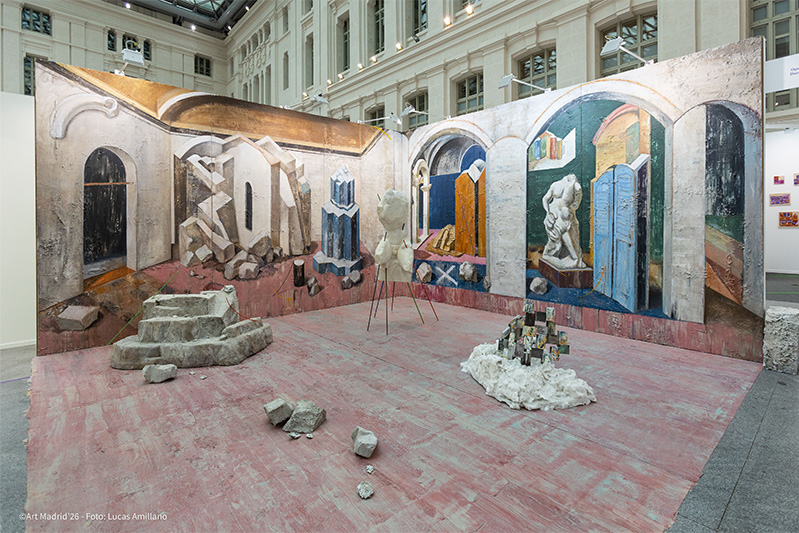
Hispánica Contemporánea (based in Madrid and Mexico), one of the veteran galleries in Art Madrid, proposes for this edition a proposal with national and international artists that could be framed within trends such as Pop Art, Conceptual Art, Activism and Neo-Pop in contrast and interaction with other more current artistic trends such as kinetic art, neo-figurative art and street art. Hispánica Contemporánea proposes in its stand a historical journey through purely contemporary discourses and aesthetics.

The pop culture will be very present at Hispánica's booth. We will see it in the pieces "Flat Depth " of the American artist Paul Rousso, who from a flat surface creates volumes, turning a flat object into a three-dimensional one. Rousso, using complex techniques and under a satirical and ironic approach, discards and wrinkles elements such as American dollar bills, candy wrappers and pages from magazines and newspapers, inflating them to extraordinary dimensions.
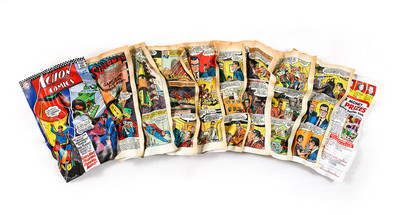
Paul Rousso

Action Comic Superman March, 2018

Mixed media

92 x 246cm

The artist (also American) Peter Anton, in the wake of Rousso, creates realistic and giant sculptures, but this time food is the protagonist, especially chocolate candies and other sweets. Anton exaggerates the size of food to give it a new meaning; his creative process begins by smelling, dissecting, feeling and deeply studying the food he is going to represent.

The Italian artist Fidias Falaschetti is concerned with other issues related to pop culture such as consumerism and the globalization of the media. Falaschetti, from an ironic and playful point of view, investigates in his work the relationship between digital and analog, appropriating materials and elements or characters from the past and transforming them into contemporary objects. An example of this is his iconic Disney characters in resin covered in aluminium.
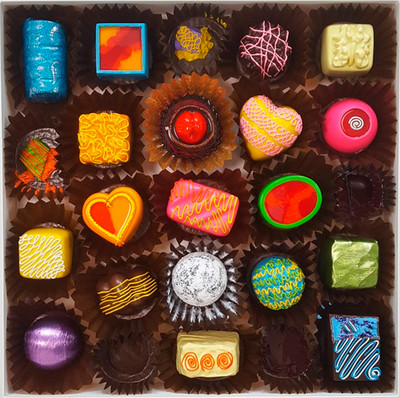
Peter Anton

Splendor Variety, 2017

Mixed technique

90 x 90cm

The sculptural installations by the American artist Rafael Barrios and the kinetic pieces in ceramics by Carlos Cruz Díez represent a turning point in the Hispánica booth. In the work of these two artists, both pioneers in their artistic tendencies although with different plastic discourses, color has a fundamental role.

Rafael Barrios plays with geometrical forms, volumes and colour, building his sculptures in a direction totally far from the orthodox, defying the laws of space and generating new perceptive alternatives with his "floating virtual works". Hispánica Contemporánea is the only gallery that represents Rafael Barrios in Spain.

The Venezuelan artist Cruz-Díez conceives color as an autonomous element, which evolves in space and time, without the help of form or support, in a continuous present. In his delicate ceramics of the series "Cromovela", works that we will be able to see in Art Madrid, we observe how the artist takes the kinetic art to its maximum expression in the land of the three-dimensionality.
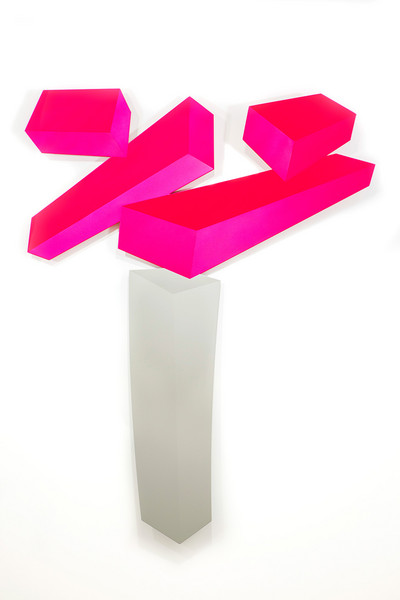
Rafael Barrios

Mural, 2015

Lacquered steel

160 x 126cm

Xavier Mascaró and Manolo Valdés, two artists with solid careers and with whom Hispánica has been working for years, will show at the Fair a selection of pieces that could be included within the neofigurative trend.

The pieces by Xavier Mascaró that Hispánica will present in Art Madrid, are a sample of the different lines of research with which the French artist has been working since his beginnings. It is worth mentioning that the artist has recently been included in the list of artists of the prestigious Opera gallery and we will be able to see in Art Madrid a selection of his famous sculptures in iron, bronze and corrugated copper combined with his pieces in enameled ceramics.

From the artist Manolo Valdés we will be able to see work on paper of his characteristic representations of elegant and sophisticated "Gentlemen " and "Ladies with pamela " accompanied by small format bronze sculptures.
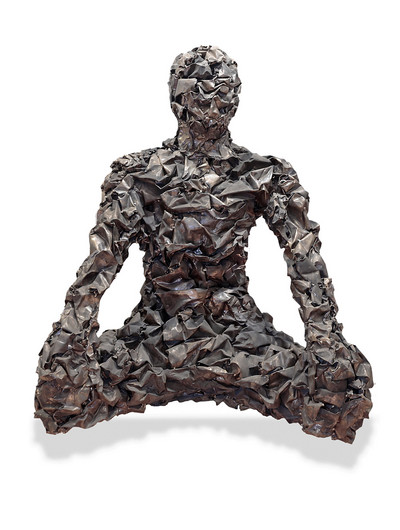
Xavier Mascaró

Guardián, 2012

Cobre corrugado

175 x 100cm

Mr.Brainwash, iconic street art artist, will bring "street art" to the stand walls. In his works we see again characteristic elements of the aesthetics of American pop culture fused with his personal style.

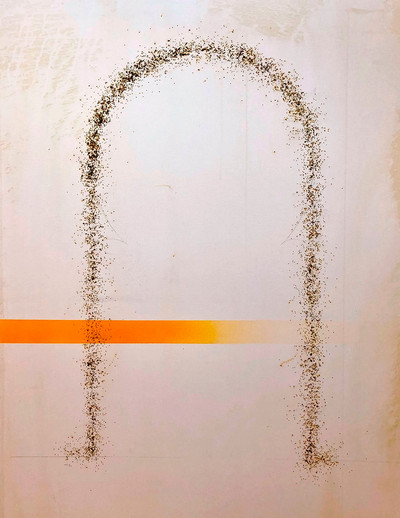
Exercising an absolute contrast with the work of the urban artist, we find the deep and symbolic paintings of the Basque artist Guillermo Fornés Through a very personal language, the artist wants to transmit "his expressive force, and at the same time, give the work the poetics and subtlety that make up his plastic identity. In this way, he always speaks of the emotion." His large canvases charged with symbolism, awaken timeless emotions and feelings.
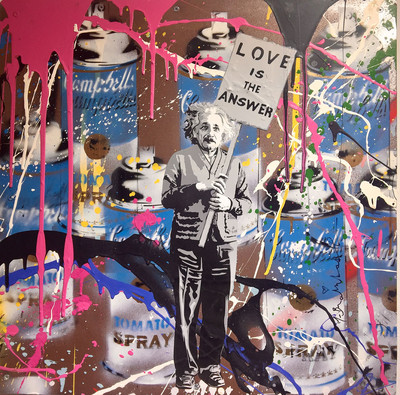
Mr. Brainwash

Einstein, 2016

Técnica Mixta sobre metal

50 x 50cm

Guillermo Fornés

Arch Light, 2018

Mixed media on canvas

146 x 114cm

Crowning the stand of Hispánica Contemporánea the monotypes of one of the most influential artists in contemporary conceptual art, the American Mel Bochner, who works exclusively with the gallery Hispánica in Spain and Mexico.

Bochner is, together with Joseph Kosuth, Art & Language, Lawrence Weiner, Douglas Houbler and Robert Barry, responsible for one of the artistic revolutions of the moment. Trained in an artistic environment (his father was an advertising sign painter), his interest has always been focused on the purely conceptual rather than the superficial. Influenced by his father, from an early age he became interested in strictly verbal information and the meaning of words. Little by little, Bochner begins to divest himself of the elements most closely linked to the pictorial (colour, plane, surface) in order to explore the possibilities of the linguistic universe. Later, he recovers colour in his works to make it an indispensable element in his work.
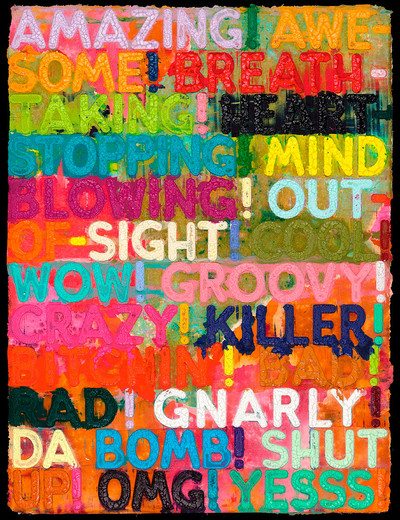
Mel Bochner

Amazing, 2018

Monotype with collage, engraving and reliefs on Twinrocker paper

158.8 x 119.4cm

In art works such as "Blah, Blah, Blah" or "Amazing", the semantics or meaning of the words, varies as we read them. The artist explores the duality between the solitary and private nature of writing and the way in which the final product is exposed openly to the public, bringing together an immense wealth of subjective gradations in language.




ART MADRID’26 INTERVIEW PROGRAM. CONVERSATIONS WITH ADONAY BERMÚDEZ


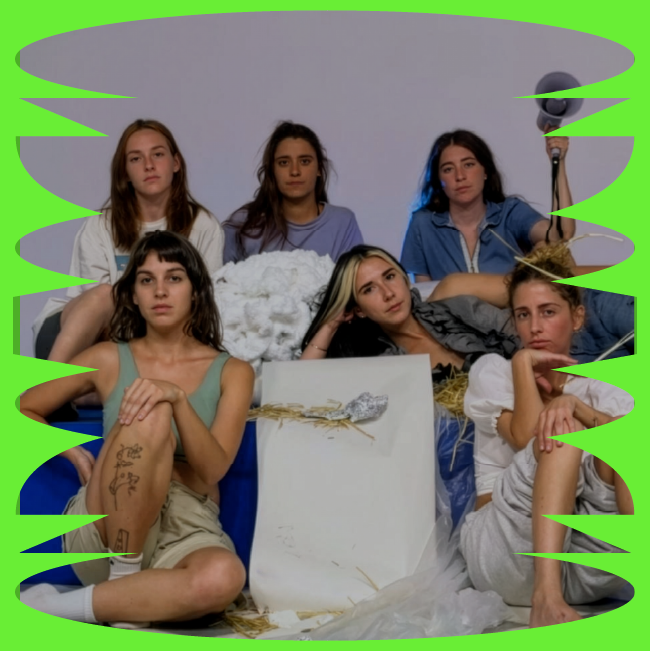
The practice of the collective DIMASLA (Diana + Álvaro) is situated at a fertile intersection between contemporary art, ecological thinking, and a philosophy of experience that shifts the emphasis from production to attention. Faced with the visual and material acceleration of the present, their work does not propose a head-on opposition, but rather a sensitive reconciliation with time, understood as lived duration rather than as a measure. The work thus emerges as an exercise in slowing down, a pedagogy of perception where contemplating and listening become modes of knowledge.

In the work of DIMASLA (Diana + Álvaro), the territory does not function as a framework but rather as an agent. The landscape actively participates in the process, establishing a dialogical relationship reminiscent of certain eco-critical currents, in which subjectivity is decentralized and recognized as part of a broader framework. This openness implies an ethic of exposure, which is defined as the act of exposing oneself to the climate, the elements, and the unpredictable, and this means accepting vulnerability as an epistemological condition.

The materials—fabrics, pigments, and footprints—serve as surfaces for temporary inscriptions and memories, bearing the marks of time. The initial planning is conceived as an open hypothesis, allowing chance and error to act as productive forces. In this way, the artistic practice of DIMASLA (Diana + Álvaro) articulates a poetics of care and being-with, where creating is, above all, a profound way of feeling and understanding nature.


In a historical moment marked by speed and the overproduction of images, your work seems to champion slowness and listening as forms of resistance. Could it be said that your practice proposes a way of relearning time through aesthetic experience?

Diana: Yes, but more than resistance or vindication, I would speak of reconciliation—of love. It may appear slow, but it is deliberation; it is reflection. Filling time with contemplation or listening is a way of feeling. Aesthetic experience leads us along a path of reflection on what lies outside us and what lies within.


The territory does not appear in your work as a backdrop or a setting, but as an interlocutor. How do you negotiate that conversation between the artist’s will and the voice of the place, when the landscape itself participates in the creative process?

Álvaro: For us, the landscape is like a life partner or a close friend, and naturally this intimate relationship extends into our practice. We go to visit it, to be with it, to co-create together. We engage in a dialogue that goes beyond aesthetics—conversations filled with action, contemplation, understanding, and respect.

Ultimately, in a way, the landscape expresses itself through the material. We respect all the questions it poses, while at the same time valuing what unsettles us, what shapes us, and what stimulates us within this relationship.


The Conquest of the Rabbits I & II. 2021. Process.


In your approach, one senses an ethic of exposure: exposing oneself to the environment, to the weather, to others, to the unpredictable. To what extent is this vulnerability also a form of knowledge?

Diana: For us, this vulnerability teaches us a great deal—above all, humility. When we are out there and feel the cold, the rain, or the sun, we become aware of how small and insignificant we are in comparison to the grandeur and power of nature.

So yes, we understand vulnerability as a profound source of knowledge—one that helps us, among many other things, to let go of our ego and to understand that we are only a small part of a far more complex web.


Sometimes mountains cry too. 2021. Limestone rockfall, sun, rain, wind, pine resin on acrylic on natural cotton canvas, exposed on a blanket of esparto grass and limestone for two months.. 195 cm x 130 cm x 3 cm.


Your works often emerge from prolonged processes of exposure to the environment. Could it be said that the material—the fabrics, the pigments, the traces of the environment—acts as a memory that time writes on you as much as you write on it?

Álvaro: This is a topic for a long conversation, sitting on a rock—it would be very stimulating. But if experiences shape people’s inner lives and define who we are in the present moment, then I would say yes, especially in that sense.

Leaving our comfort zone has led us to learn from the perseverance of plants and the geological calm of mountains. Through this process, we have reconciled ourselves with time, with the environment, with nature, with ourselves, and even with our own practice. Just as fabrics hold the memory of a place, we have relearned how to pay attention and how to understand. Ultimately, it is a way of deepening our capacity to feel.


The fox and his tricks. 2022. Detail.


To what extent do you plan your work, and how much space do you leave for the unexpected—or even for mistakes?

Diana: Our planning is limited to an initial hypothesis. We choose the materials, colours, places, and sometimes even the specific location, but we leave as much room as possible for the unexpected to occur. In the end, that is what it is really about: allowing nature to speak and life to unfold. For us, both the unexpected and mistakes are part of the world’s complexity, and within that complexity we find a form of natural beauty.