Art Madrid'26 – DANIEL BUM: PORTRAITS OF INTROSPECTION


ART MADRID’26 INTERVIEW PROGRAM. CONVERSATIONS WITH ADONAY BERMÚDEZ


The painting of Daniel Bum (Villena, Alicante, 1994) takes shape as a space for subjective elaboration, where the figure emerges not so much as a representational motif but as a vital necessity. The repetition of this frontal, silent character responds to an intimate process: painting becomes a strategy for navigating difficult emotional experiences—an insistent gesture that accompanies and alleviates feelings of loneliness. In this sense, the figure acts as a mediator between the artist and a complex emotional state, linking the practice of painting to a reconnection with childhood and to a vulnerable dimension of the self.

The strong autobiographical dimension of his work coexists with a formal distance that is not the result of conscious planning, but rather functions as a protective mechanism. Visual restraint, an apparent compositional coolness, and an economy of means do not neutralize emotion; instead, they contain it, avoiding the direct exposure of the traumatic. In this way, the tension between affect and restraint becomes a structural feature of his artistic language. Likewise, the naïve and the disturbing coexist in his painting as inseparable poles, reflecting a subjectivity permeated by mystery and unconscious processes. Many images emerge without a clearly defined prior meaning and only reveal themselves over time, when temporal distance allows for the recognition of the emotional states from which they arose.


The Long Night. Oil, acrylic, and charcoal on canvas. 160 × 200 cm. 2024.


The human figure appears frequently in your work: frontal, silent, suspended. What interests you about this presence that seems both affirmative and absent?

I wouldn’t say that anything in particular interests me. I began painting this figure because there were emotions I couldn’t understand and a feeling that was very difficult for me to process. This character emerged during a very complicated moment in my life, and the act of making it—and remaking it, repeating it again and again—meant that, during the process, I didn’t feel quite so alone. At the same time, it kept me fresh and connected me to an inner child who was broken at that moment, helping me get through the experience in a slightly less bitter way.


Santito. Acrylic and oil on canvas. 81 × 65 cm. 2025.


There is a strong affective dimension in your work, but also a calculated distance, a kind of formal coldness. What role does this tension between emotion and restraint play?

I couldn’t say exactly what role that tension plays. My painting is rooted in the autobiographical, in memory, and in situations I have lived through that were quite traumatic for me. Perhaps, as a protective mechanism—to prevent direct access to that vulnerability, or to keep it from becoming harmful—that distance appears unconsciously. It is not something planned or controlled; it simply emerges and remains there.


Night Painter. Acrylic on canvas. 35 × 27 cm. 2025.


Your visual language oscillates between the naïve and the unsettling, the familiar and the strange. How do these tensions coexist for you, and what function do they serve in your visual exploration?

I think it reflects who I am. One could not exist without the other. The naïve could not exist without the unsettling; for me, they necessarily go hand in hand. I am deeply drawn to mystery and to the act of painting things that even I do not fully understand. Many of the expressions or portraits I create emerge from the unconscious; they are not planned. It is only afterwards that I begin to understand them—and almost never immediately. A considerable amount of time always passes before I can recognize how I was feeling at the moment I made them.


Qi. Acrylic on canvas. 81 × 65 cm. 2025.


The formal simplicity of your images does not seem to be a matter of economy, but of concentration. What kind of aesthetic truth do you believe painting can reach when it strips itself of everything superfluous?

I couldn’t say what aesthetic truth lies behind that simplicity. What I do know is that it is something I need in order to feel calm. I feel overwhelmed when there are too many elements in a painting, and I have always been drawn to the minimal—to moments when there is little, when there is almost nothing. I believe that this stripping away allows me to approach painting from a different state: more focused, more silent. I can’t fully explain it, but it is there that I feel able to work with greater clarity.


Crucifixion. Acrylic on canvas. 41 × 33 cm. 2025.


To what extent do you plan your work, and how much space do you leave for the unexpected—or even for mistakes?

I usually feel more comfortable leaving space for the unexpected. I am interested in uncertainty; having everything under control strikes me as rather boring. I have tried it on some occasions, especially when I set out to work on a highly planned series, with fixed sketches that I then wanted to translate into painting, but it was not something I identified with. I felt that a fundamental part of the process disappeared: play—that space in which painting can surprise even myself. For that reason, I do not tend to plan too much, and when I do, it is in a very simple way: a few lines, a plane of color. I prefer everything to happen within the painting itself.

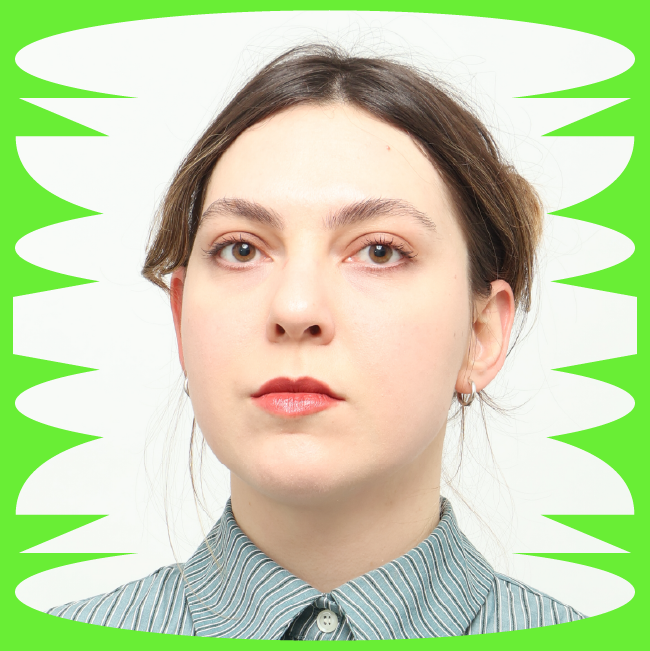
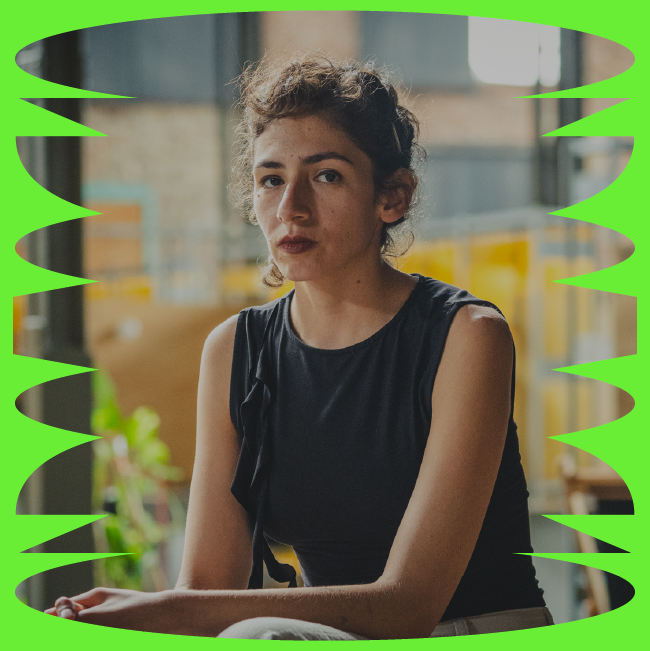
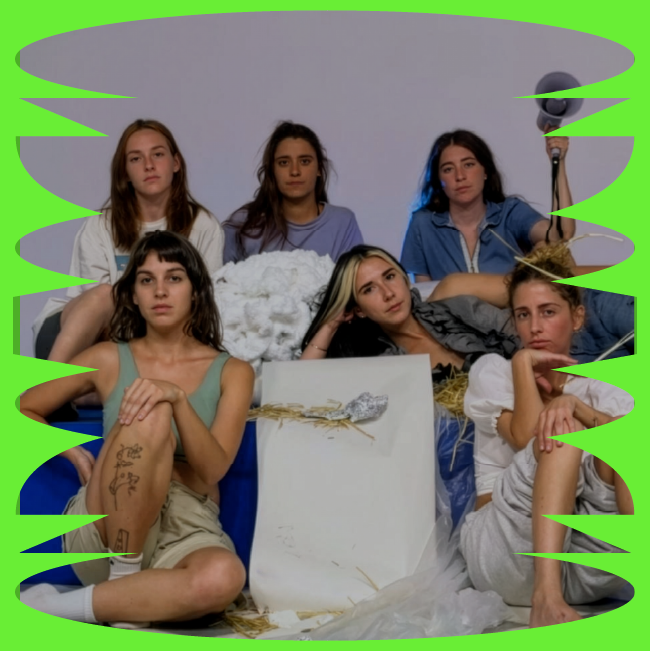
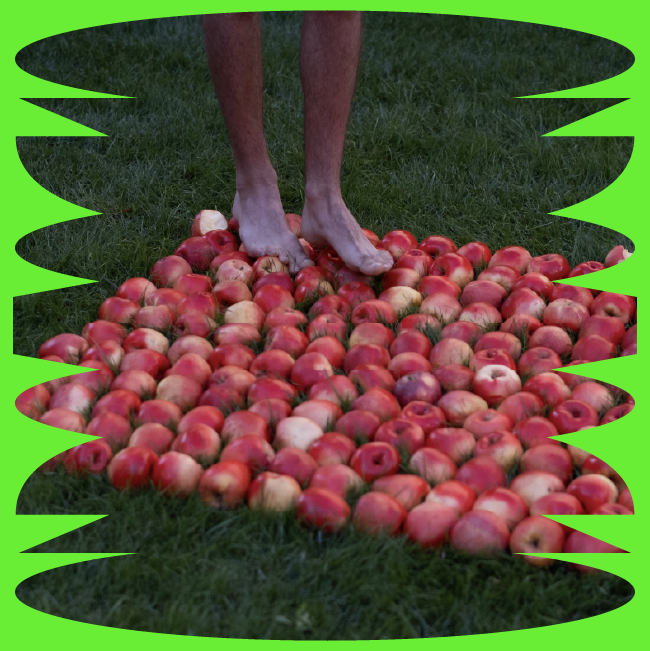
ABIERTO INFINITO. LO QUE EL CUERPO RECUERDA. CICLO DE PERFORMANCE X ART MADRID'26


Art Madrid, committed to creating a discursive platform for artists working within the field of performance and action art, presents Abierto Infinito: lo que el cuerpo recuerda, a proposal inspired by Erving Goffman’s ideas in The Presentation of Self in Everyday Life (Amorrortu Editores, Buenos Aires, 1997).

The project unfolds within a theoretical framework that directly engages with these premises, conceiving social interaction as a stage of carefully modulated performances designed to influence others’ perceptions. Goffman argues that individuals deploy both verbal and involuntary expressions to guide the interpretation of their behavior, sustaining roles and façades that define the situation for those who observe.

The body — the first territory of all representation — precedes both word and learned gesture. Human experience, conscious and unconscious alike, is inscribed within it. Abierto Infinito: lo que el cuerpo recuerda departs from this premise: representation inhabits existence itself, and life, understood as a succession of representations, transforms the body into a space of constant negotiation over who we are. In this passage, boundaries blur; the individual opens toward the collective, and the ephemeral acquires symbolic dimension. By inhabiting this interstice, performance simultaneously reveals the fragility of identity and the strength that emerges from encounter with others.


PERFORMANCE: TRAYECTORIA. BY AMANDA GATTI

March 6 | 7:00 PM. Galería de Cristal of the Palacio de Cibeles.


Amanda Gatti. Escaparate. 2023. DT-Espacio. Photograph by Pedro Mendes.


The proposal expands Amanda Gatti’s research initiated in La Plasti Ciudad del Cuerpo — an ongoing series of performance and installation presented since 2023 in spaces such as Fundación Antonio Pérez, Galería Nueva, CRUCE, and the Acción Spring(t)/UCM Congress — where she explores the relationship between her body and objects found in urban space. There, body and materials are articulated through a constant negotiation between functionality, weight, and support, generating temporary architectural compositions.

In Trayectoria, this research shifts toward the act of dragging: a gesture that makes visible the friction between body, objects, and space. The corridor ceases to be a neutrality to be crossed and becomes an operative intermediate zone, where form and content — veil and what is veiled, as Walter Benjamin points out — become confused. The space, saturated with objects turned into a mobile chain, clears and remakes itself with each step. Clearing, for Benjamin, is already an experience of space: each advance sustains this unfinished separation, always oriented toward a destination that may never be reached.


La Plasti Ciudad del Cuerpo #3. Amanda Gatti. Performance documentation. CRUCE 2054 exhibition, Galería CRUCE. Photograph by Pedro Mendes.


Displacement is not limited to material friction: it also becomes a symbolic inscription of that which every life trajectory drags along. The objects — remnants of past uses — function as metaphors for what remains attached to the body even when it no longer serves any function. The performance makes visible the condition of moving forward while carrying heterogeneous weights: material, affective, social. Thus, the gesture of walking linked to these objects turns the route into a writing in motion, where each step simultaneously activates a physical transit and a vital transit. Trayectoria proposes that every life is also a dragging: a continuous recomposing from what we insist on carrying with us.

The action operates objects as verbs: to push, to tense, to trip, to pull. From it emerges an operativity that involves the entire body and exceeds the visual. The image ceases to be representation and becomes gesture: a gesture that founds new spatial forms, that overflows, that produces an ephemeral mode of reappropriation of the corridor.

The trajectory thus becomes an affective map inscribed in the body, a way of merging with the environment by putting past and future, durability and wear, utility and obsolescence into friction. The action returns to public space what was taken from it, but now stripped of function: freed from meaning, freed from commodification, freed to be imagined otherwise.


ABOUT AMANDA GATTI

Amanda Gatti (1996, Porto Alegre, Brazil) is an artist and researcher whose practice unfolds across performance, video, photography, and installation. She explores the intersections of body, object, and space, investigating how we occupy — and are occupied by — the spaces around us. Drawing from experiences of displacement and the observation of domestic and urban environments, her work conceives the body as mediator and archive, transforming found objects, spatial arrangements, and everyday gestures into ephemeral architectures and relational situations.

She studied the Master’s in Scenic Practice and Visual Culture at Museo Reina Sofía/UCLM (Spain, 2023) and the Bachelor’s degree in Audiovisual Production at PUCRS (Brazil, 2018), where she received scholarships such as the Santander Universities grant. In Spain, her work has been presented in institutions and contexts such as Museo Reina Sofía, Fundación Antonio Pérez, Galería Nueva, CRUCE, and Teatro Pradillo, as well as in exhibitions and festivals in Brazil, Germany, Ireland, the United Kingdom, and the United States. She currently resides in Madrid, with secondary bases in Brazil and the United Kingdom.