Art Madrid'26 – PERFORMANCE: ENSAYOS DE DESPLAZAMIENTOS. BY JOSEFINA BARDI

RAÍCES AFUERA. PERFORMANCE CYCLE X ART MADRID'25

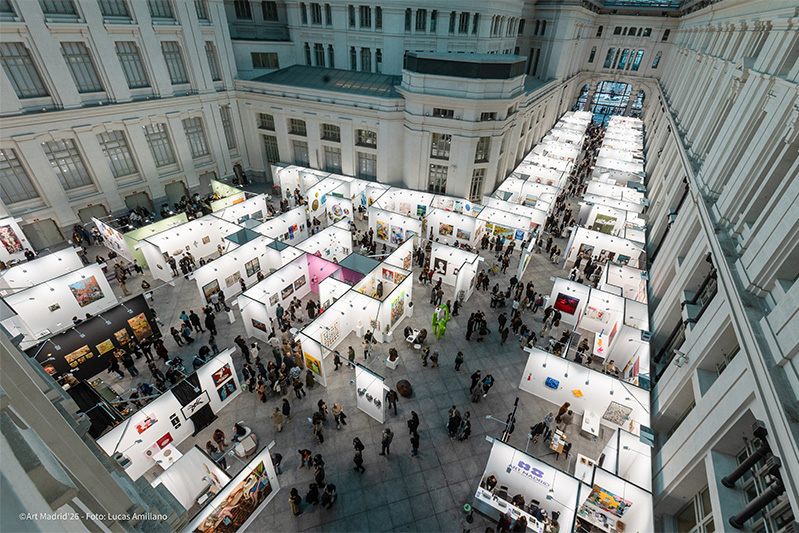
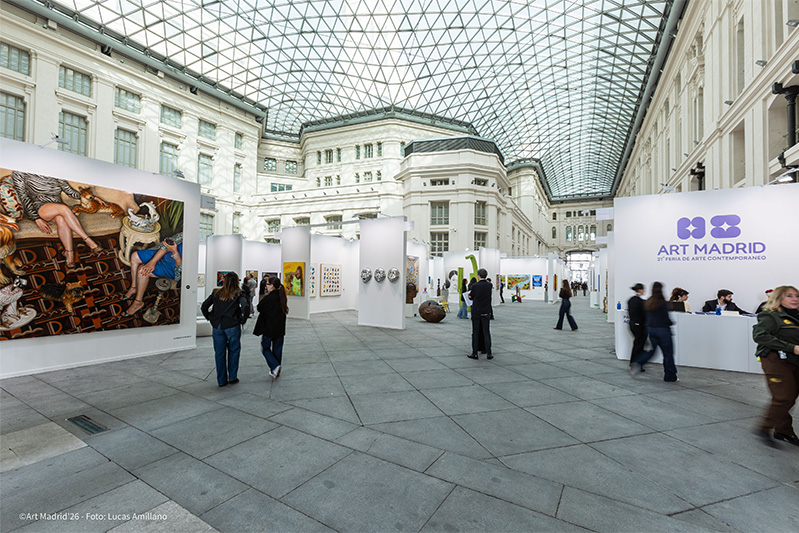
Art Madrid celebrates twenty years of contemporary art from March 5 to 9, 2025, at the Galería de Cristal of the Palacio de Cibeles. During Art Week, it becomes an exhibition platform for national and international galleries and artists. In this edition, with the aim of providing a space for artists working in the realm of performance art, the fair presents Raíces Afuera, a performance cycle that explores notions of belonging and the need for rootedness in a contemporary world marked by fragmentation, displacement, and disconnection. Positioned within the fair as a critical and reflective space, the project challenges the individual’s relationship with their environment, community, and sense of identity.


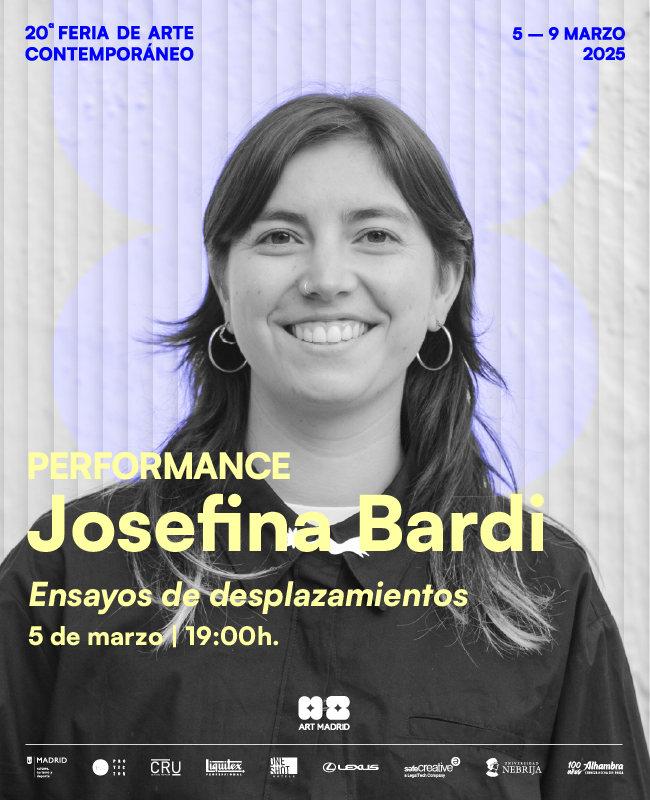
PERFORMANCE: ENSAYOS DE DESPLAZAMIENTOS. BY JOSEFINA BARDI

March 5 | 19:00h. Galería de Cristal of the Palacio de Cibeles.
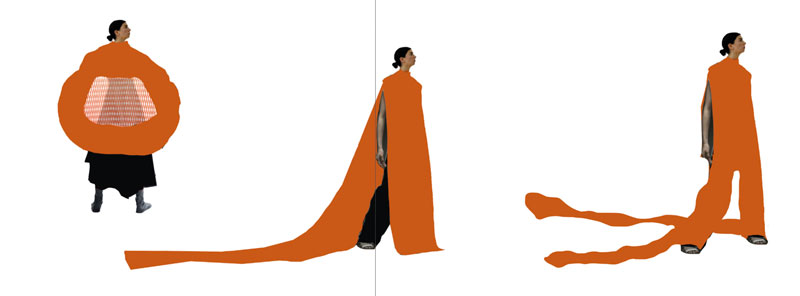

Ensayos de desplazamientos. 2025. Scketch. Josefina Bardi.


The project is framed within the artist's research on her relationship with her twin sister, a theme she has been exploring since 2018. Over this time, a series of live actions and visual experiences have been developed, linked to sculptural concepts such as weight, gravity, form, and space—all in tension with the notion of duplicity. This research examines how two twin bodies connect and interact with each other, as well as with the spaces/territories they inhabit. Within this context, "taking root" is approached through the displacement of bodies, exploring the theme of connection and its relationship with distance and territory.

The idea of duplicity is explored by inviting a questioning of personal connections through the positioning of twin bodies in situations of tension with suggestive architectural spaces. The concept of space is referenced, particularly in relation to the distance that has separated the artist from her sister since 2022, a distance that conditions and challenges the notions of physical territory, time, communication, emotions, and affections.

This project proposes a series of "encounter rehearsals." The idea of encounter is understood as a poetic conceptualization of bodies situated in a space-time-place, intertwining verbs—words—and actions to create a choreography of encounters. Through displacement, crossing, jumping, and traversing the space, these actions create micro-affective architectures.

VERB / ACTION

1 WALK - DRAG

2 SEE/HEAR/SPEAK - THROW

3 STAND - JUMP

Three micro-affective architectures will be built, each linked to an action—throw, launch, and drag—through the choice of three verbs: walk, stand, and see/hear/speak. These actions will allow the construction of the piece.
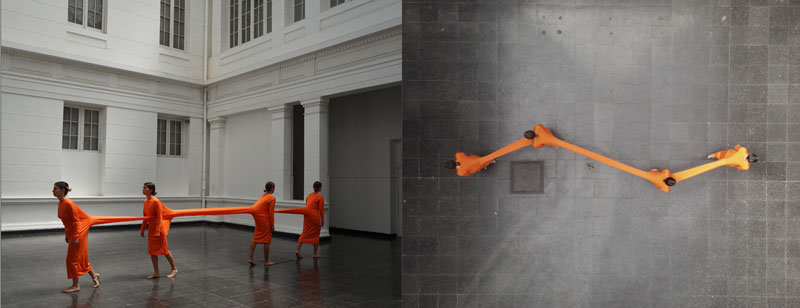

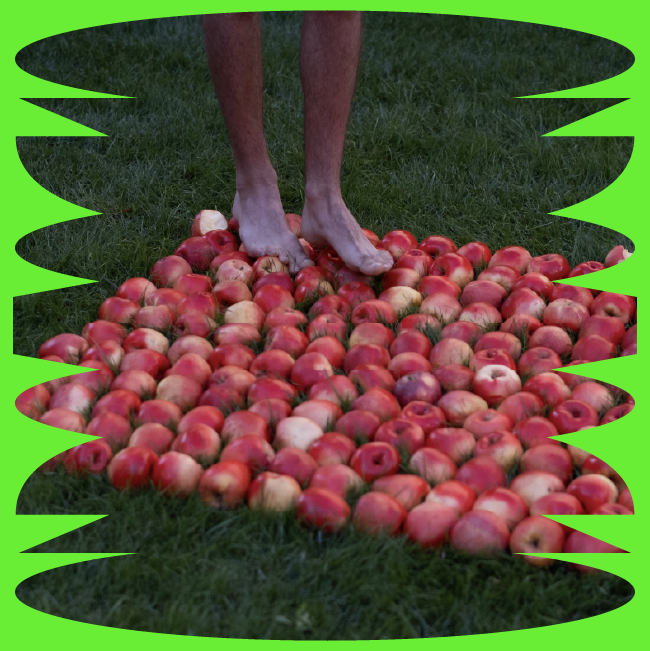
Remove from the Root. 2024. Performance Documentation. Josefina Bardi.


ABOUT JOSEFINA BARDI

Josefina Bardi Prida (Santiago, Chile, 1996) is a visual artist and educator, currently based in Madrid, Spain. She holds a degree in Visual Arts from the Universidad Diego Portales and has complemented her education with a Master's in Plastic, Artistic, and Visual Education from Universidad Nebrija and the Instituto Cervantes. Her teaching career spans institutions in Chile and Spain, where she has worked as an art teacher and collaborator in workshops with prominent artists.

In her professional career, she has been the head of the ceramics workshop at Brio Atelier, production and artwork assistant for artists such as Cristóbal Ochoa, Camila Ramírez, and Sebastián Mahaluf, and has also worked in graphic design.

Her work has been recognized with various awards, including First Place in the Municipal Award for Young Art of Santiago (2024) and the PAAL residency at Zapadores Ciudad del Arte (2023). She has held solo exhibitions in Santiago and Madrid, and participated in numerous collective shows across America and Europe, including the Biennial at the Museum of Memory and the MAC Quinta Normal.

ART MADRID’26 INTERVIEW PROGRAM. CONVERSATIONS WITH ADONAY BERMÚDEZ


The practice of the collective DIMASLA (Diana + Álvaro) is situated at a fertile intersection between contemporary art, ecological thinking, and a philosophy of experience that shifts the emphasis from production to attention. Faced with the visual and material acceleration of the present, their work does not propose a head-on opposition, but rather a sensitive reconciliation with time, understood as lived duration rather than as a measure. The work thus emerges as an exercise in slowing down, a pedagogy of perception where contemplating and listening become modes of knowledge.

In the work of DIMASLA (Diana + Álvaro), the territory does not function as a framework but rather as an agent. The landscape actively participates in the process, establishing a dialogical relationship reminiscent of certain eco-critical currents, in which subjectivity is decentralized and recognized as part of a broader framework. This openness implies an ethic of exposure, which is defined as the act of exposing oneself to the climate, the elements, and the unpredictable, and this means accepting vulnerability as an epistemological condition.

The materials—fabrics, pigments, and footprints—serve as surfaces for temporary inscriptions and memories, bearing the marks of time. The initial planning is conceived as an open hypothesis, allowing chance and error to act as productive forces. In this way, the artistic practice of DIMASLA (Diana + Álvaro) articulates a poetics of care and being-with, where creating is, above all, a profound way of feeling and understanding nature.


In a historical moment marked by speed and the overproduction of images, your work seems to champion slowness and listening as forms of resistance. Could it be said that your practice proposes a way of relearning time through aesthetic experience?

Diana: Yes, but more than resistance or vindication, I would speak of reconciliation—of love. It may appear slow, but it is deliberation; it is reflection. Filling time with contemplation or listening is a way of feeling. Aesthetic experience leads us along a path of reflection on what lies outside us and what lies within.


The territory does not appear in your work as a backdrop or a setting, but as an interlocutor. How do you negotiate that conversation between the artist’s will and the voice of the place, when the landscape itself participates in the creative process?

Álvaro: For us, the landscape is like a life partner or a close friend, and naturally this intimate relationship extends into our practice. We go to visit it, to be with it, to co-create together. We engage in a dialogue that goes beyond aesthetics—conversations filled with action, contemplation, understanding, and respect.

Ultimately, in a way, the landscape expresses itself through the material. We respect all the questions it poses, while at the same time valuing what unsettles us, what shapes us, and what stimulates us within this relationship.


The Conquest of the Rabbits I & II. 2021. Process.


In your approach, one senses an ethic of exposure: exposing oneself to the environment, to the weather, to others, to the unpredictable. To what extent is this vulnerability also a form of knowledge?

Diana: For us, this vulnerability teaches us a great deal—above all, humility. When we are out there and feel the cold, the rain, or the sun, we become aware of how small and insignificant we are in comparison to the grandeur and power of nature.

So yes, we understand vulnerability as a profound source of knowledge—one that helps us, among many other things, to let go of our ego and to understand that we are only a small part of a far more complex web.


Sometimes mountains cry too. 2021. Limestone rockfall, sun, rain, wind, pine resin on acrylic on natural cotton canvas, exposed on a blanket of esparto grass and limestone for two months.. 195 cm x 130 cm x 3 cm.


Your works often emerge from prolonged processes of exposure to the environment. Could it be said that the material—the fabrics, the pigments, the traces of the environment—acts as a memory that time writes on you as much as you write on it?

Álvaro: This is a topic for a long conversation, sitting on a rock—it would be very stimulating. But if experiences shape people’s inner lives and define who we are in the present moment, then I would say yes, especially in that sense.

Leaving our comfort zone has led us to learn from the perseverance of plants and the geological calm of mountains. Through this process, we have reconciled ourselves with time, with the environment, with nature, with ourselves, and even with our own practice. Just as fabrics hold the memory of a place, we have relearned how to pay attention and how to understand. Ultimately, it is a way of deepening our capacity to feel.


The fox and his tricks. 2022. Detail.


To what extent do you plan your work, and how much space do you leave for the unexpected—or even for mistakes?

Diana: Our planning is limited to an initial hypothesis. We choose the materials, colours, places, and sometimes even the specific location, but we leave as much room as possible for the unexpected to occur. In the end, that is what it is really about: allowing nature to speak and life to unfold. For us, both the unexpected and mistakes are part of the world’s complexity, and within that complexity we find a form of natural beauty.