Art Madrid'26 – LEXUS RZ BY MARTA DE LA FUENTE AT ART MADRID'25: ENJOY!

LEXUS RZ BY MARTA DE LA FUENTE AT ART MADRID'25: ENJOY!

Lexus participates for the second time in Art Madrid, joining the celebration of the fair’s twenty years of contemporary art from March 5 to 9 at the Galería de Cristal of the Palacio de Cibeles. This year, Lexus takes another step in its commitment to art and creativity by presenting an artistic installation that blurs the lines between design, technology, and visual expression. In collaboration with renowned artist Marta de la Fuente, Lexus transforms its RZ model into a moving work of art, merging two worlds that share philosophy, sensitivity, and passion: the gastronomy and culture of Spain and Japan.

Intervention by Marta de la Fuente. Lexus RZ. Art Madrid'25.


The piece titled Itadakimasu ('Enjoy your meal!' in Japanese) is a tribute to the experience of traveling through the senses. Marta de la Fuente brings to life a visual collage on the Lexus RZ that evokes iconic culinary moments from both countries, connecting landscapes, flavors, and emotions. After all, food is a universal language, a bridge between both cultures.

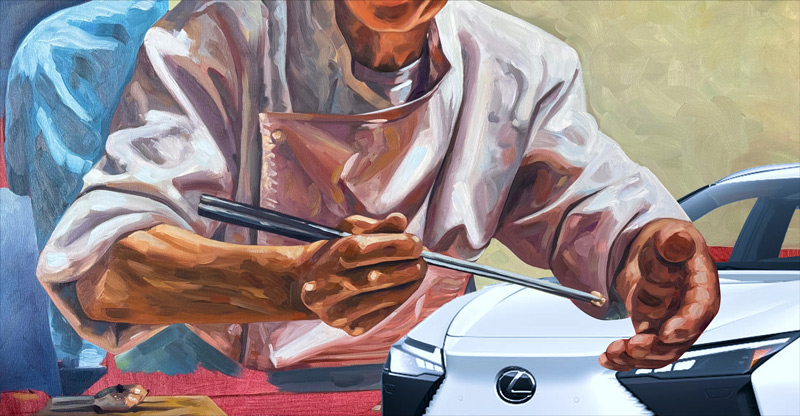
The concept of the installation transports us to those moments of pleasure that arise when discovering a new dish, a shared table, or a landscape unfolding before our eyes as we drive along the road. The images projected onto the vehicle and the walls of the stand recreate this visual travel journal. We see scenes of a green field with traditional houses in Shirakawa, an unforgettable bowl of ramen, salmon nigiri, a chef dedicated to his work, shrimp in a traditional Madrid tavern, gildas shared with friends, a glass of wine, a knowing smile. Each image, each flash of light on the surface of the Lexus RZ, is a fragment of memory, an invitation to rediscover the pleasure of travel and gastronomy as transformative experiences.
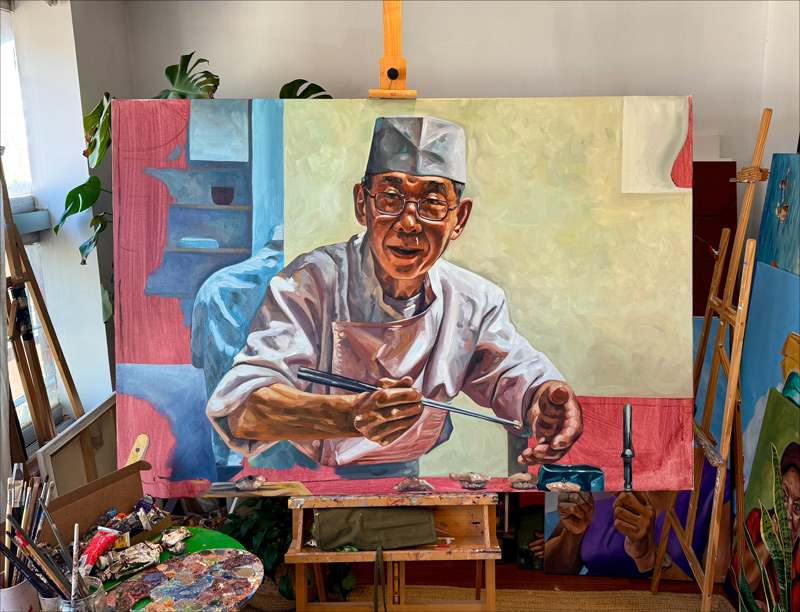

Shokunin. 160 x 110 cm. Oil on canvas. 2025.


But Itadakimasu is not only a tribute to cuisine and travel, but also an exploration of movement as an artistic expression. The Lexus RZ itself becomes a symbol of journey and discovery, integrating the sensation of speed, ever-changing landscapes, and the people we meet along the way. Through the use of moving projections, the installation plays with perception and distortion, creating a dynamic visual effect that reinforces the idea of travel as a succession of fleeting moments. This technique, known as anamorphosis, allows each viewer to experience the work from a unique perspective, reminding us that memories are not linear, but fragments that overlap and reconstruct themselves in our minds.


Lexus' participation in Art Madrid is part of the second edition of Lexus Art Month, an initiative that further strengthens its connection with the contemporary art scene. Since its founding in 1989, Lexus has been synonymous with luxury, technology, and innovation, but also with a vision that goes beyond the automotive sector to embrace creativity in all its forms.


With Marta de la Fuente's Itadakimasu, Lexus invites the viewer to immerse themselves in a sensory experience where travel and gastronomy merge into art. A celebration of tradition, movement, and memory, and the pleasure of savoring and discovering the world with every kilometer traveled.


Sponsor of ART MADRID'25



ART MADRID’26 INTERVIEW PROGRAM. CONVERSATIONS WITH ADONAY BERMÚDEZ


The painting of Daniel Bum (Villena, Alicante, 1994) takes shape as a space for subjective elaboration, where the figure emerges not so much as a representational motif but as a vital necessity. The repetition of this frontal, silent character responds to an intimate process: painting becomes a strategy for navigating difficult emotional experiences—an insistent gesture that accompanies and alleviates feelings of loneliness. In this sense, the figure acts as a mediator between the artist and a complex emotional state, linking the practice of painting to a reconnection with childhood and to a vulnerable dimension of the self.

The strong autobiographical dimension of his work coexists with a formal distance that is not the result of conscious planning, but rather functions as a protective mechanism. Visual restraint, an apparent compositional coolness, and an economy of means do not neutralize emotion; instead, they contain it, avoiding the direct exposure of the traumatic. In this way, the tension between affect and restraint becomes a structural feature of his artistic language. Likewise, the naïve and the disturbing coexist in his painting as inseparable poles, reflecting a subjectivity permeated by mystery and unconscious processes. Many images emerge without a clearly defined prior meaning and only reveal themselves over time, when temporal distance allows for the recognition of the emotional states from which they arose.


The Long Night. Oil, acrylic, and charcoal on canvas. 160 × 200 cm. 2024.


The human figure appears frequently in your work: frontal, silent, suspended. What interests you about this presence that seems both affirmative and absent?

I wouldn’t say that anything in particular interests me. I began painting this figure because there were emotions I couldn’t understand and a feeling that was very difficult for me to process. This character emerged during a very complicated moment in my life, and the act of making it—and remaking it, repeating it again and again—meant that, during the process, I didn’t feel quite so alone. At the same time, it kept me fresh and connected me to an inner child who was broken at that moment, helping me get through the experience in a slightly less bitter way.


Santito. Acrylic and oil on canvas. 81 × 65 cm. 2025.


There is a strong affective dimension in your work, but also a calculated distance, a kind of formal coldness. What role does this tension between emotion and restraint play?

I couldn’t say exactly what role that tension plays. My painting is rooted in the autobiographical, in memory, and in situations I have lived through that were quite traumatic for me. Perhaps, as a protective mechanism—to prevent direct access to that vulnerability, or to keep it from becoming harmful—that distance appears unconsciously. It is not something planned or controlled; it simply emerges and remains there.


Night Painter. Acrylic on canvas. 35 × 27 cm. 2025.


Your visual language oscillates between the naïve and the unsettling, the familiar and the strange. How do these tensions coexist for you, and what function do they serve in your visual exploration?

I think it reflects who I am. One could not exist without the other. The naïve could not exist without the unsettling; for me, they necessarily go hand in hand. I am deeply drawn to mystery and to the act of painting things that even I do not fully understand. Many of the expressions or portraits I create emerge from the unconscious; they are not planned. It is only afterwards that I begin to understand them—and almost never immediately. A considerable amount of time always passes before I can recognize how I was feeling at the moment I made them.


Qi. Acrylic on canvas. 81 × 65 cm. 2025.


The formal simplicity of your images does not seem to be a matter of economy, but of concentration. What kind of aesthetic truth do you believe painting can reach when it strips itself of everything superfluous?

I couldn’t say what aesthetic truth lies behind that simplicity. What I do know is that it is something I need in order to feel calm. I feel overwhelmed when there are too many elements in a painting, and I have always been drawn to the minimal—to moments when there is little, when there is almost nothing. I believe that this stripping away allows me to approach painting from a different state: more focused, more silent. I can’t fully explain it, but it is there that I feel able to work with greater clarity.


Crucifixion. Acrylic on canvas. 41 × 33 cm. 2025.


To what extent do you plan your work, and how much space do you leave for the unexpected—or even for mistakes?

I usually feel more comfortable leaving space for the unexpected. I am interested in uncertainty; having everything under control strikes me as rather boring. I have tried it on some occasions, especially when I set out to work on a highly planned series, with fixed sketches that I then wanted to translate into painting, but it was not something I identified with. I felt that a fundamental part of the process disappeared: play—that space in which painting can surprise even myself. For that reason, I do not tend to plan too much, and when I do, it is in a very simple way: a few lines, a plane of color. I prefer everything to happen within the painting itself.