Art Madrid'26 – WE PRESENT YOU THE PARTICIPATING GALLERIES OF ART MADRID 2022

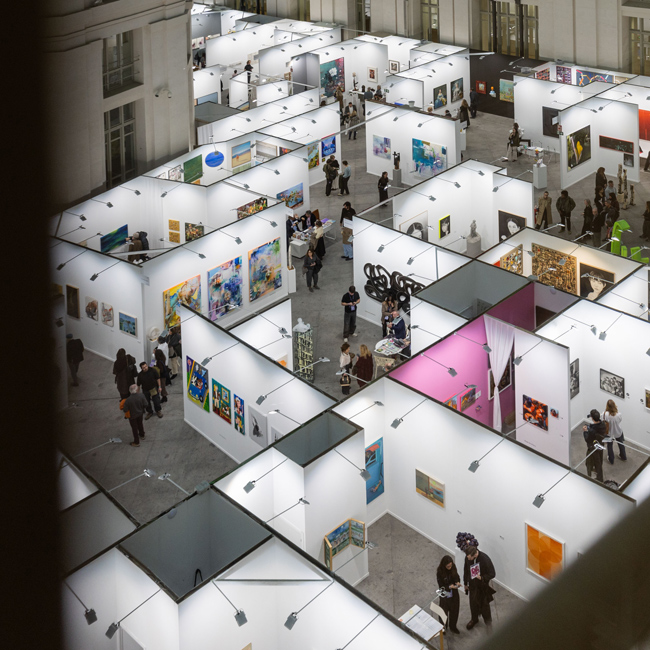
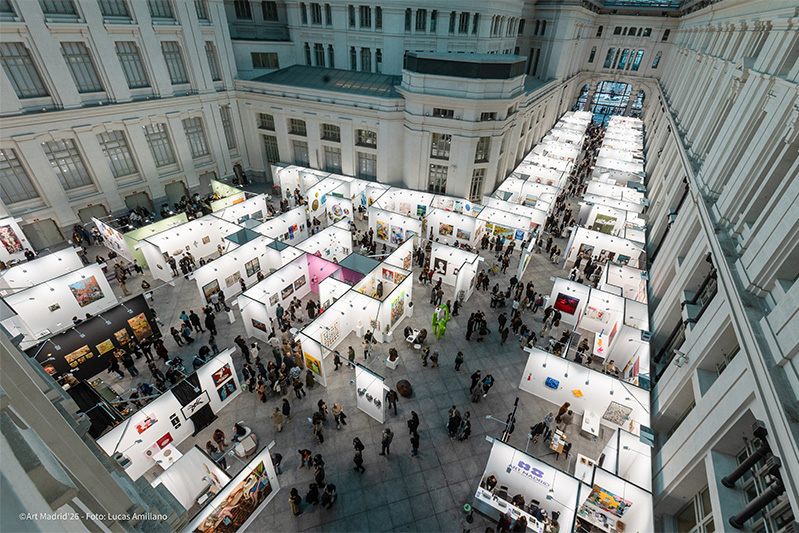
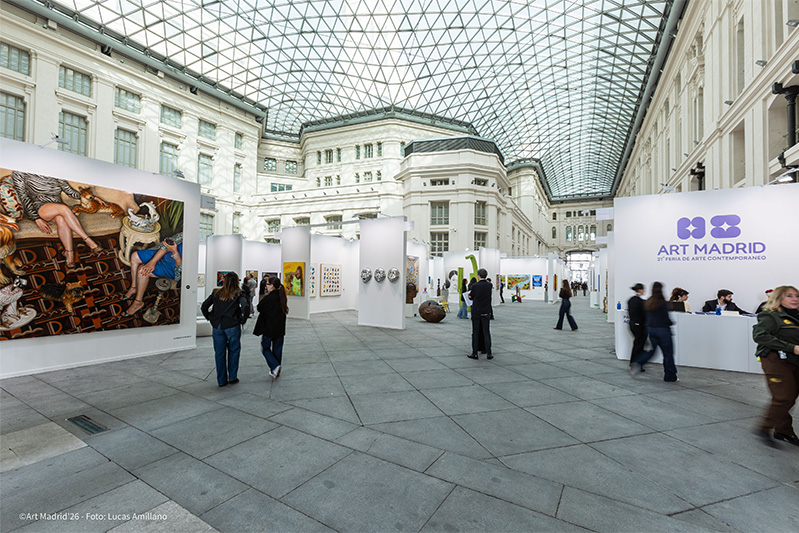
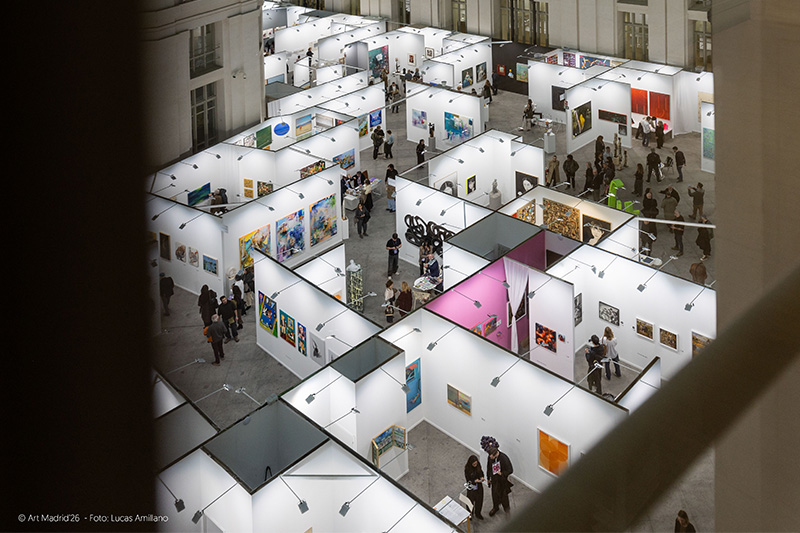
Art Madrid returns to Madrid Art Week and will celebrate its seventeenth edition from February 23 to 27 at the Crystal Gallery of Palacio de Cibeles. A unique, open-plan, and bright space located in the ‘Landscape of Light’: next to Prado Museum, Thyssen-Bornemisza Museum, and MNCARS - Museo Nacional Centro de Arte Reina Sofía.
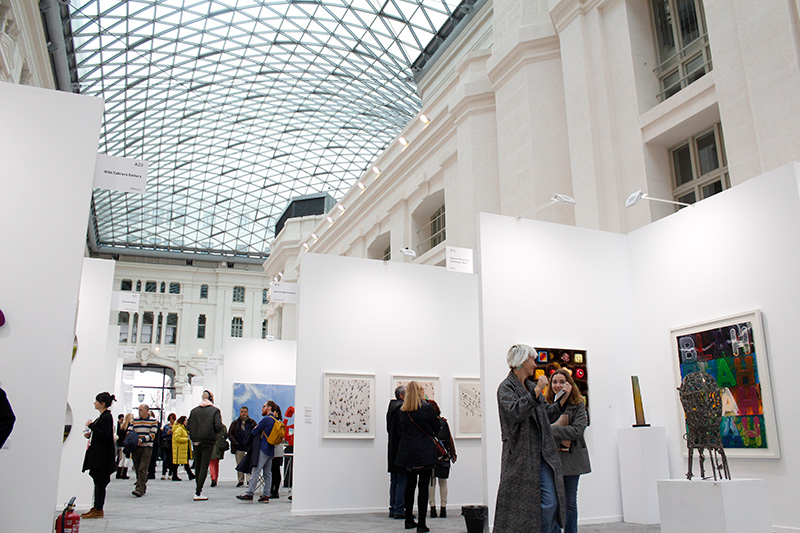
Art Madrid 2021

Art Madrid selection committee has once again been in charge of evaluating the applications of galleries interested in participating in the seventeenth edition of the fair. To guarantee a high level of artistic quality in the Art Madrid'22 programming, the committee has evaluated the applications based on the proposals submitted and the represented artists' careers. On this occasion the committee was integrated of Alfonso de la Torre (critic and curator), Aurora Vigil-Escalera (gallery owner), Natalia Alonso (critic and curator), Angel Samblancat (gallery owner and international fairs consultant), and Javier López (gallery owner) ).

For the first time, the galleries will participate in Art Madrid: Galerie Alex Serra (Köln, Germany), Arena Martínez Projects (Madrid, Spain), ARTITLEDcontemporary (Herpen, Netherlands), Dr. Robot Gallery (Valencia, Spain), GARNA Art Gallery ( Madrid, Spain) and Jackie Shor Arte (São Paulo, Brazil).
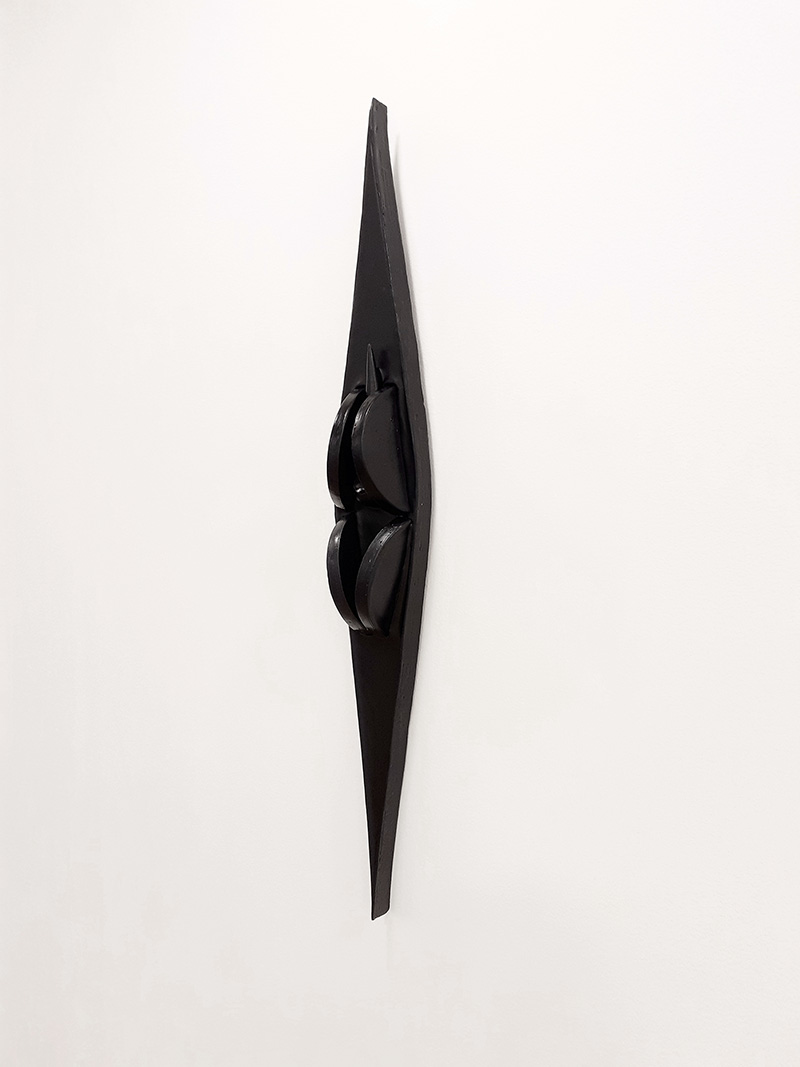
Carolina Serrano, “My nameless words II”, Paraffin, 91 x 12 x 8 cm (2021). Galerie Alex Serra ©

In the other hand, the international galleries at Art Madrid will be: Art Lounge Gallery (Lisbon, Portugal), ARTITLEDcontemporary (Herpen, Netherlands), Collage Habana (Havana, Cuba), Galeria São Mamede (Lisbon, Portugal), Galerie Alex Serra (Köln, Germany), Galerie LJ (Paris, France), Jackie Shor Arte (São Paulo, Brazil), Nuno Sacramento (Ílhavo, Portugal), Studija Mindiuzarte / Kaunas (Kaunas, Lithuania) and Yiri Arts (Taipei), Taiwan).

More than 160 artists will exhibit their work at the fair, dealing with different disciplines such as painting, sculpture, photography, and installation, and offering the visitor a unique experience enjoying contemporary art.

Among them are some of the most prominent emerging artists of the moment such as Mária Švarbová, Carmen Pastrana, Chang Teng-Yuan, Costa Gorelov and Camille Bonneau; mid-career as Carlos Cartaxo, Gerard Fernández Rico and Marcos Tamargo; along with established artists such as Chema Mádoz, David Rodríguez Caballero, Carmen Calvo, Uiso Alemany, Alberto Guerrero, Josecho López Llorens, Manolo Valdés, Rafael Barrios and Lars Zech, among others.
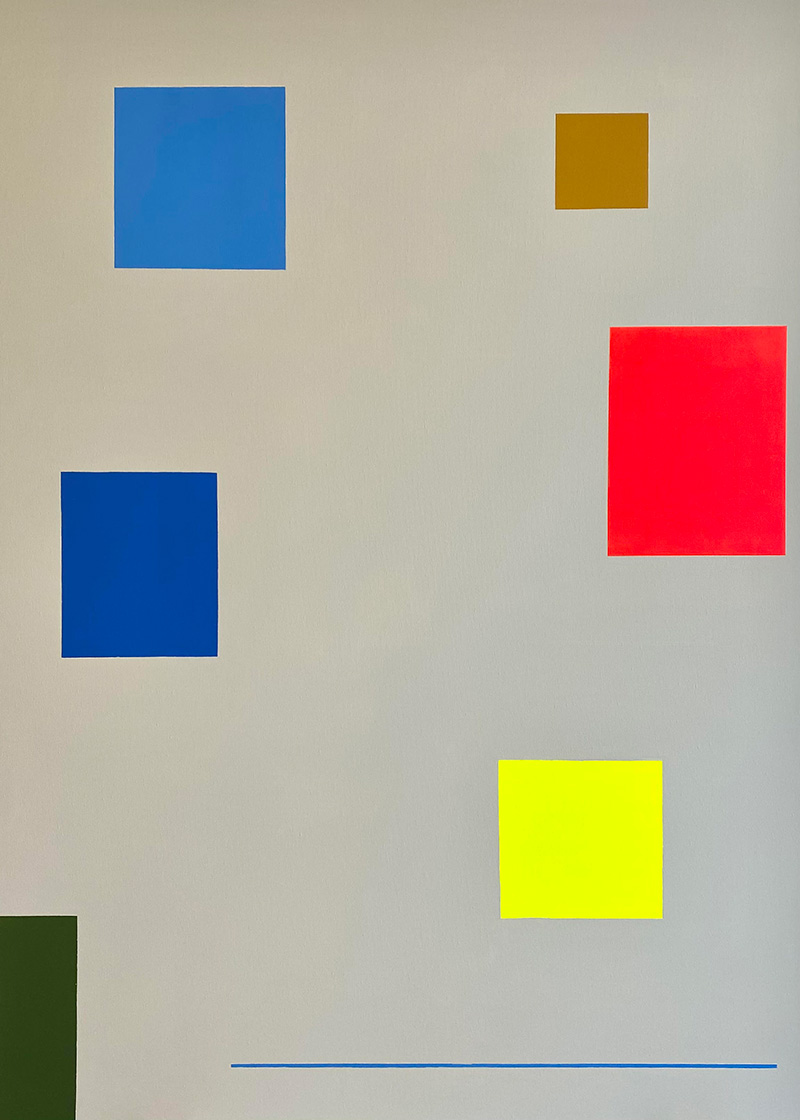
Carlos Cartaxo, “Several Windows VII”, Acrylic and enamel on canvas. 195x140cm (2021).Arena Martinez Projects ©

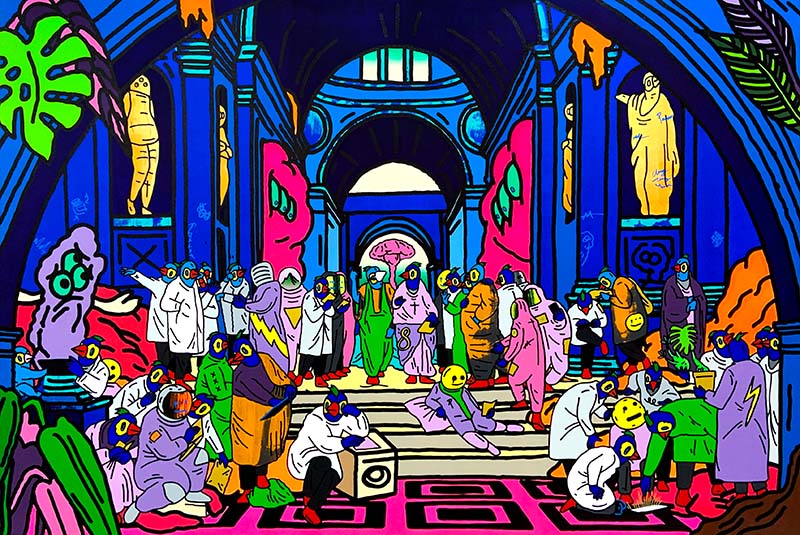
Chang Teng Yuan, “The School of Parrotman Athens” ,Acrylic on canvas, 130x193cm (2021). Yiri Arts ©

PROGRAMS

One Shot Hotels is once again the sponsor of Art Madrid and has prepared two initiatives with which it renews its faithful commitment to contemporary art. One is the curated program by Natalia Alonso, who will curate a tour of various artworks exhibited at Art Madrid'22 to introduce and bring the public closer to understanding the art market ecosystem. The other is the collectors' program by Pía Rubio, one of the most prestigious art consultants in our country. The service aims both to enhance the commercial work of the galleries and to offer advice on the acquisition of works of art for new buyers.

Finally, the fair co-organizes, together with the video art platform Proyector, a parallel program focused on video creation, action art, and performance, under the curatorship of Mario Gutiérrez. In this edition, Proyector will focus on investigating and rethinking the concept of “loop” through the pioneers of video art, both from the creation point of view, distribution and collecting. During the fair you will also be able to enjoy an installation by Gary Hill, considered the founder of New Media Art, and two live proposals by Hill himself; together with works by Llorenç Barber, a pioneer of sound art.


Below, we detail the list of galleries of Art Madrid 2022:

NATIONAL GALLERIES
3 Punts Galeria, Barcelona
Alba Cabrera Gallery, Valencia
Arena Martínez Projects, Madrid
Aurora Vigil-Escalera, Gijón
DDR Art Gallery, Madrid
Dr.Robot Gallery, Valencia
FLECHA, Madrid
Galería BAT alberto cornejo, Madrid
Galería Beatriz Bálgoma, Madrid
Galería Espiral, Noja
Galería Hispánica Contemporánea, Madrid-Mx DF
Galería Kreisler, Madrid
Galería La Aurora, Murcia
Galería Luisa Pita, Santiago de Compostela
GARNA Art Gallery, Madrid
Helarea, Madrid
Inéditad, Barcelona
Kur Art Gallery, San Sebastián
MA Arte Contemporáneo, Palma
Marita Segovia, Madrid
Moret Art, A Coruña
Rodrigo Juarranz, Aranda de Duero
Shiras Galería, Valencia
Víctor Lope Arte Contemporáneo, Barcelona

INTERNATIONAL GALLERIES
Art Lounge Gallery, Lisboa
ARTITLEDcontemporary, Herpen
Collage Habana, La Habana
Galeria São Mamede, Lisboa
Galerie Alex Serra, Köln
Galerie LJ, París
Jackie Shor Arte, São Paulo
Nuno Sacramento, Ílhavo,
Studija Mindiuzarte/Kaunas, Kaunas
Yiri Arts, Taipei


ART MADRID’26 INTERVIEW PROGRAM. CONVERSATIONS WITH ADONAY BERMÚDEZ


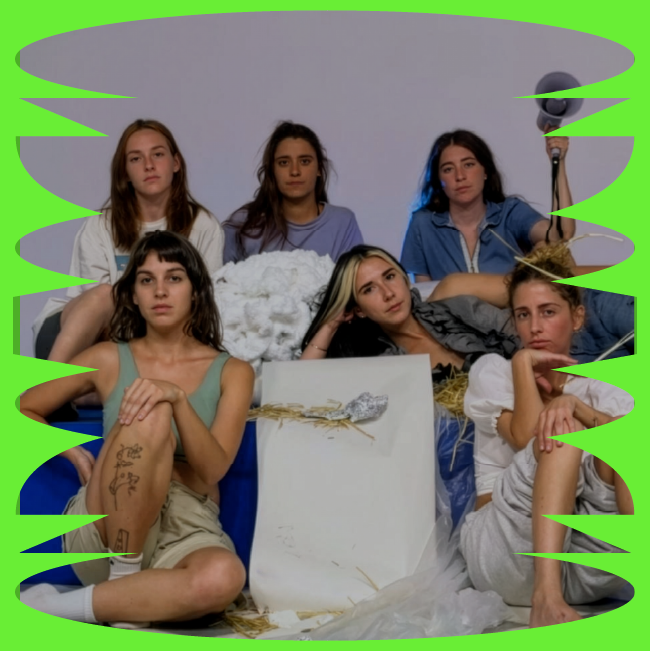
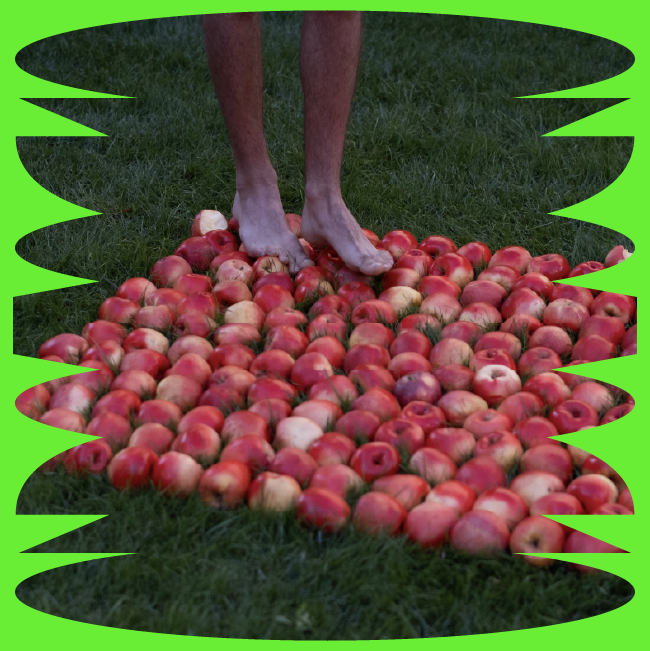
The practice of the collective DIMASLA (Diana + Álvaro) is situated at a fertile intersection between contemporary art, ecological thinking, and a philosophy of experience that shifts the emphasis from production to attention. Faced with the visual and material acceleration of the present, their work does not propose a head-on opposition, but rather a sensitive reconciliation with time, understood as lived duration rather than as a measure. The work thus emerges as an exercise in slowing down, a pedagogy of perception where contemplating and listening become modes of knowledge.

In the work of DIMASLA (Diana + Álvaro), the territory does not function as a framework but rather as an agent. The landscape actively participates in the process, establishing a dialogical relationship reminiscent of certain eco-critical currents, in which subjectivity is decentralized and recognized as part of a broader framework. This openness implies an ethic of exposure, which is defined as the act of exposing oneself to the climate, the elements, and the unpredictable, and this means accepting vulnerability as an epistemological condition.

The materials—fabrics, pigments, and footprints—serve as surfaces for temporary inscriptions and memories, bearing the marks of time. The initial planning is conceived as an open hypothesis, allowing chance and error to act as productive forces. In this way, the artistic practice of DIMASLA (Diana + Álvaro) articulates a poetics of care and being-with, where creating is, above all, a profound way of feeling and understanding nature.


In a historical moment marked by speed and the overproduction of images, your work seems to champion slowness and listening as forms of resistance. Could it be said that your practice proposes a way of relearning time through aesthetic experience?

Diana: Yes, but more than resistance or vindication, I would speak of reconciliation—of love. It may appear slow, but it is deliberation; it is reflection. Filling time with contemplation or listening is a way of feeling. Aesthetic experience leads us along a path of reflection on what lies outside us and what lies within.


The territory does not appear in your work as a backdrop or a setting, but as an interlocutor. How do you negotiate that conversation between the artist’s will and the voice of the place, when the landscape itself participates in the creative process?

Álvaro: For us, the landscape is like a life partner or a close friend, and naturally this intimate relationship extends into our practice. We go to visit it, to be with it, to co-create together. We engage in a dialogue that goes beyond aesthetics—conversations filled with action, contemplation, understanding, and respect.

Ultimately, in a way, the landscape expresses itself through the material. We respect all the questions it poses, while at the same time valuing what unsettles us, what shapes us, and what stimulates us within this relationship.


The Conquest of the Rabbits I & II. 2021. Process.


In your approach, one senses an ethic of exposure: exposing oneself to the environment, to the weather, to others, to the unpredictable. To what extent is this vulnerability also a form of knowledge?

Diana: For us, this vulnerability teaches us a great deal—above all, humility. When we are out there and feel the cold, the rain, or the sun, we become aware of how small and insignificant we are in comparison to the grandeur and power of nature.

So yes, we understand vulnerability as a profound source of knowledge—one that helps us, among many other things, to let go of our ego and to understand that we are only a small part of a far more complex web.


Sometimes mountains cry too. 2021. Limestone rockfall, sun, rain, wind, pine resin on acrylic on natural cotton canvas, exposed on a blanket of esparto grass and limestone for two months.. 195 cm x 130 cm x 3 cm.


Your works often emerge from prolonged processes of exposure to the environment. Could it be said that the material—the fabrics, the pigments, the traces of the environment—acts as a memory that time writes on you as much as you write on it?

Álvaro: This is a topic for a long conversation, sitting on a rock—it would be very stimulating. But if experiences shape people’s inner lives and define who we are in the present moment, then I would say yes, especially in that sense.

Leaving our comfort zone has led us to learn from the perseverance of plants and the geological calm of mountains. Through this process, we have reconciled ourselves with time, with the environment, with nature, with ourselves, and even with our own practice. Just as fabrics hold the memory of a place, we have relearned how to pay attention and how to understand. Ultimately, it is a way of deepening our capacity to feel.


The fox and his tricks. 2022. Detail.


To what extent do you plan your work, and how much space do you leave for the unexpected—or even for mistakes?

Diana: Our planning is limited to an initial hypothesis. We choose the materials, colours, places, and sometimes even the specific location, but we leave as much room as possible for the unexpected to occur. In the end, that is what it is really about: allowing nature to speak and life to unfold. For us, both the unexpected and mistakes are part of the world’s complexity, and within that complexity we find a form of natural beauty.