Art Madrid'26 – First Course on Collecting and Contemporary Art. Nebrija Institute

From July 7 to 9, 2025, the Balsera Palace will host the First Course on Collecting and Contemporary Art, an intensive 15-hour program that will explore the complex and fundamental question of taste in contemporary art. Organized by the Nebrija Institute of Arts and Humanities at Nebrija University and the Avilés City Council, in collaboration with 9915 — Association of Private Collectors of Contemporary Art and the Institute of Contemporary Art, the course offers a unique opportunity for analysis and debate on the dynamics that shape aesthetic and symbolic value in today’s art scene.
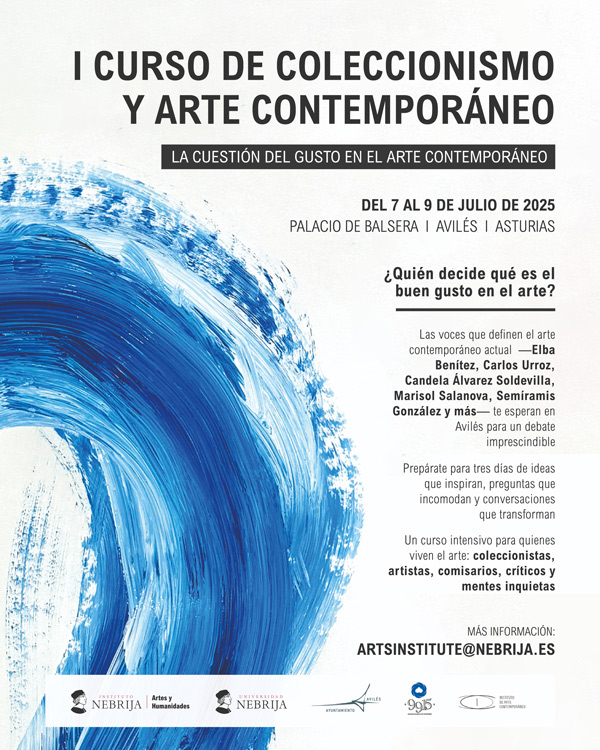

First Course on Collecting and Contemporary Art. Avilés, Asturias


The notion of taste, intrinsically tied to aesthetic judgments and power relations, has played a decisive role in the historical prominence of artists and artworks. However, contemporary art—marked by its breaking of conventions, diversity of media and techniques, and critical stance toward traditional canons—raises fundamental questions about the continued relevance of this concept.

This course will explore how the decisions made by key players in the art system—institutions, private collections, galleries, curators, and artists—continually redefine a field of taste shaped by aesthetic, symbolic, cultural, social, and political logics.


"¿But does it exist, and what is the prevailing taste of our time—so seemingly confused, fragmented, indecipherable?" - Omar Calabrese, The Neo-Baroque Era.


The academic program, directed by José Luis Guijarro Alonso, Director of the Master’s in Art Market and Related Business Management at Nebrija University, and Pablo Álvarez de Toledo, Head of the Department of Arts at Nebrija University and the Nebrija Institute of Arts and Humanities, will bring together a distinguished group of national experts—including collectors, critics, curators, gallery owners, and artists—whose contributions will address key issues in shaping aesthetic, symbolic, and market value in today’s art world.


PROGRAM

MONDAY, JULY 7

9:30 AM Registration.

10:00 AM Course Opening Nebrija University Avilés City Council Presented by Rosario López Meras – President of the Association of Contemporary Art Collectors, 9915, and Adrián Piera – President of the ICA, Institute of Contemporary Art.

10:30 AM Course Presentation By José Luis Guijarro Alonso – Art Historian and Anthropologist, Researcher, and Director of the Master’s in Art Market and Related Business Management at Nebrija University.

11:00 AM Coffee Break.

11:30 AM Panel Discussion The Taste of Private Collecting as a Prelude to History. Speakers: Candela Álvarez Soldevilla – Entrepreneur and Collector; Javier Quilis – INELCOM Collection; José Miguel Vegas Valle – Collector. Moderator: Luis Feás – Critic and Curator.

1:00 PM Lunch Break.

3:30 PM Individual Lecture On Good Taste in Contemporary Art. Speaker: Marisol Salanova – Curator and Art Critic, Director of Arteinformado.

4:45 PM Panel Discussion The Influence of Galleries in Shaping Contemporary Taste. Speakers: Elba Benítez – Gallerist; Ricardo Pernas – Gallerist (Arniches 26); Aurora Vigil-Escalera – Gallerist. Moderator: Rafael Martín – Coleccion@casamer.

6:00 PM End of Day.

6:30 PM Activity and Cocktail Visit to the Exhibition Asturian Artists in the Pérez Simón Collection – Avilés.

TUESDAY, JULY 8

10:00 AM Individual Lecture Contemporary (Bad) Taste: Kitsch, Camp, and Tacky. Speaker: Julio Pérez Manzanares – Autonomous University of Madrid.

11:00 AM Coffee Break.

11:30 AM Panel Discussion Institutions and the Formation of Contemporary Taste. Speakers: Virginia López – Artist, Founder of PACA_Proyectos Artísticos Casa Antonino; Julieta de Haro – Artistic Director of CentroCentro; Carlos Urroz – Director of Institutional Relations, Museo Nacional Centro de Arte Reina Sofía. Moderator: Laura Gutiérrez – Director, School of Art of Oviedo.

1:00 PM Lunch Break.

3:30 PM Panel Discussion Beyond the Eye: The Taste for Ethical, Ecological, Social, or Political Concerns in Contemporary Art. Speakers: Semíramis González – Independent Curator; Eugenio Ampudia – Artist; Claudia Rodríguez-Ponga – Independent Curator. Moderator: Bárbara Mur Borrás – PhD in Fine Arts.

5:00 PM End of Day.

5:30 PM Activity Visit to the Studiolo Exhibition – Candela Álvarez Soldevilla Collection.

WEDNESDAY, JULY 9

9:30 AM Meeting with Asturian Artists Speakers: María Castellanos – Artist; Avelino Sala – Artist; Consuelo Vallina – Artist. Moderator: Pablo Álvarez de Toledo – Nebrija University.

11:00 AM Activity Visit to the Niemeyer Center – Avilés.

Course Closing Ceremony.



This course is designed for art professionals, collectors, researchers, and students seeking an in-depth analysis of the dynamics that shape taste and collecting practices in contemporary art. Adopting a critical and multidisciplinary perspective, it provides a unique opportunity to rigorously examine the aesthetic, symbolic, and structural factors that underpin the legitimization of contemporary art.




ART MADRID’26 INTERVIEW PROGRAM. CONVERSATIONS WITH ADONAY BERMÚDEZ


The practice of the collective DIMASLA (Diana + Álvaro) is situated at a fertile intersection between contemporary art, ecological thinking, and a philosophy of experience that shifts the emphasis from production to attention. Faced with the visual and material acceleration of the present, their work does not propose a head-on opposition, but rather a sensitive reconciliation with time, understood as lived duration rather than as a measure. The work thus emerges as an exercise in slowing down, a pedagogy of perception where contemplating and listening become modes of knowledge.

In the work of DIMASLA (Diana + Álvaro), the territory does not function as a framework but rather as an agent. The landscape actively participates in the process, establishing a dialogical relationship reminiscent of certain eco-critical currents, in which subjectivity is decentralized and recognized as part of a broader framework. This openness implies an ethic of exposure, which is defined as the act of exposing oneself to the climate, the elements, and the unpredictable, and this means accepting vulnerability as an epistemological condition.

The materials—fabrics, pigments, and footprints—serve as surfaces for temporary inscriptions and memories, bearing the marks of time. The initial planning is conceived as an open hypothesis, allowing chance and error to act as productive forces. In this way, the artistic practice of DIMASLA (Diana + Álvaro) articulates a poetics of care and being-with, where creating is, above all, a profound way of feeling and understanding nature.


In a historical moment marked by speed and the overproduction of images, your work seems to champion slowness and listening as forms of resistance. Could it be said that your practice proposes a way of relearning time through aesthetic experience?

Diana: Yes, but more than resistance or vindication, I would speak of reconciliation—of love. It may appear slow, but it is deliberation; it is reflection. Filling time with contemplation or listening is a way of feeling. Aesthetic experience leads us along a path of reflection on what lies outside us and what lies within.


The territory does not appear in your work as a backdrop or a setting, but as an interlocutor. How do you negotiate that conversation between the artist’s will and the voice of the place, when the landscape itself participates in the creative process?

Álvaro: For us, the landscape is like a life partner or a close friend, and naturally this intimate relationship extends into our practice. We go to visit it, to be with it, to co-create together. We engage in a dialogue that goes beyond aesthetics—conversations filled with action, contemplation, understanding, and respect.

Ultimately, in a way, the landscape expresses itself through the material. We respect all the questions it poses, while at the same time valuing what unsettles us, what shapes us, and what stimulates us within this relationship.


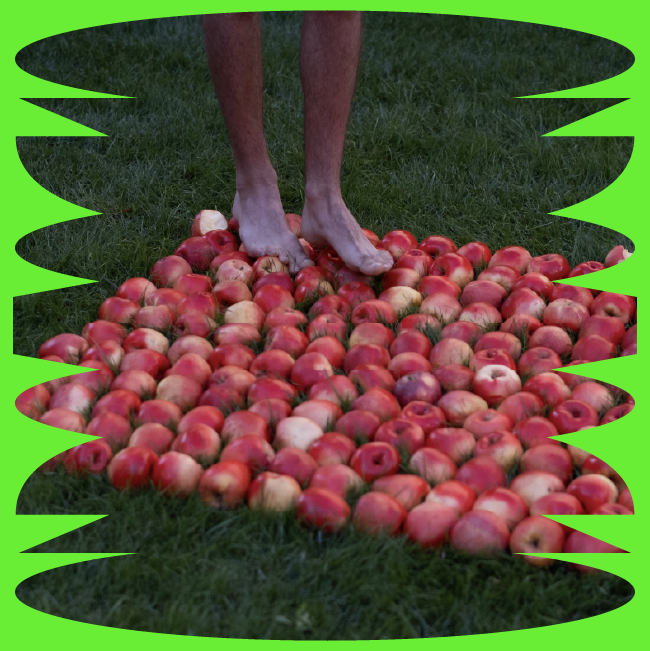
The Conquest of the Rabbits I & II. 2021. Process.


In your approach, one senses an ethic of exposure: exposing oneself to the environment, to the weather, to others, to the unpredictable. To what extent is this vulnerability also a form of knowledge?

Diana: For us, this vulnerability teaches us a great deal—above all, humility. When we are out there and feel the cold, the rain, or the sun, we become aware of how small and insignificant we are in comparison to the grandeur and power of nature.

So yes, we understand vulnerability as a profound source of knowledge—one that helps us, among many other things, to let go of our ego and to understand that we are only a small part of a far more complex web.


Sometimes mountains cry too. 2021. Limestone rockfall, sun, rain, wind, pine resin on acrylic on natural cotton canvas, exposed on a blanket of esparto grass and limestone for two months.. 195 cm x 130 cm x 3 cm.


Your works often emerge from prolonged processes of exposure to the environment. Could it be said that the material—the fabrics, the pigments, the traces of the environment—acts as a memory that time writes on you as much as you write on it?

Álvaro: This is a topic for a long conversation, sitting on a rock—it would be very stimulating. But if experiences shape people’s inner lives and define who we are in the present moment, then I would say yes, especially in that sense.

Leaving our comfort zone has led us to learn from the perseverance of plants and the geological calm of mountains. Through this process, we have reconciled ourselves with time, with the environment, with nature, with ourselves, and even with our own practice. Just as fabrics hold the memory of a place, we have relearned how to pay attention and how to understand. Ultimately, it is a way of deepening our capacity to feel.


The fox and his tricks. 2022. Detail.


To what extent do you plan your work, and how much space do you leave for the unexpected—or even for mistakes?

Diana: Our planning is limited to an initial hypothesis. We choose the materials, colours, places, and sometimes even the specific location, but we leave as much room as possible for the unexpected to occur. In the end, that is what it is really about: allowing nature to speak and life to unfold. For us, both the unexpected and mistakes are part of the world’s complexity, and within that complexity we find a form of natural beauty.