CONVERSATIONS WITH MARISOL SALANOVA
Jan 13, 2025
art madrid
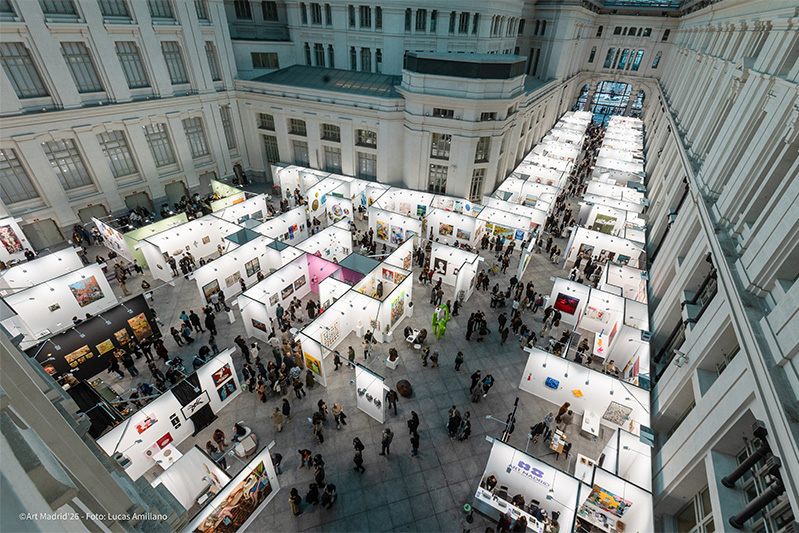
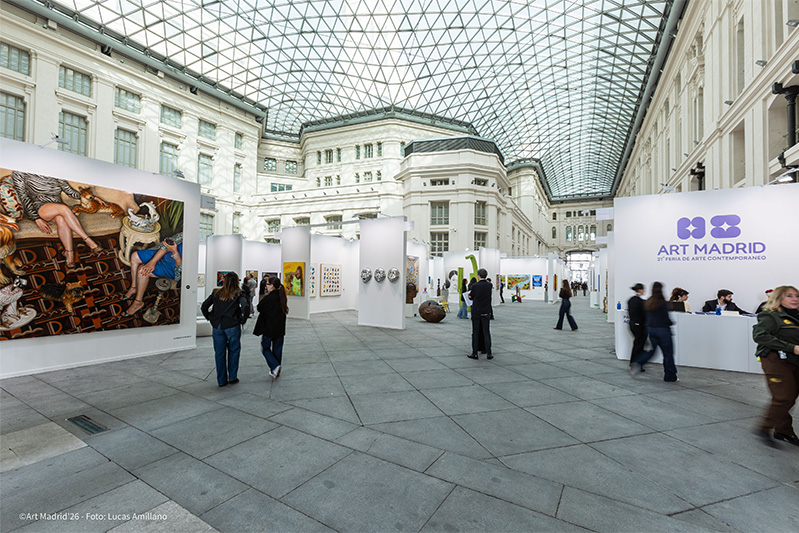
At Art Madrid, we are thrilled to present, for the fourth consecutive year, our curated interview program and thanks to Safe Creative. This time, we have the honor of hosting Marisol Salanova, art critic and curator, who will lead the series titled "Conversations with Marisol Salanova." Throughout these talks, we will delve into the fascinating creative world of eight outstanding artists featured in the 20th edition of the fair. This will be a unique opportunity to explore their processes, inspirations, and perspectives. With this program, we reaffirm our passion for bringing contemporary art closer to everyone, giving voice to the artists joining us for Art Week.
GUEST ARTISTS
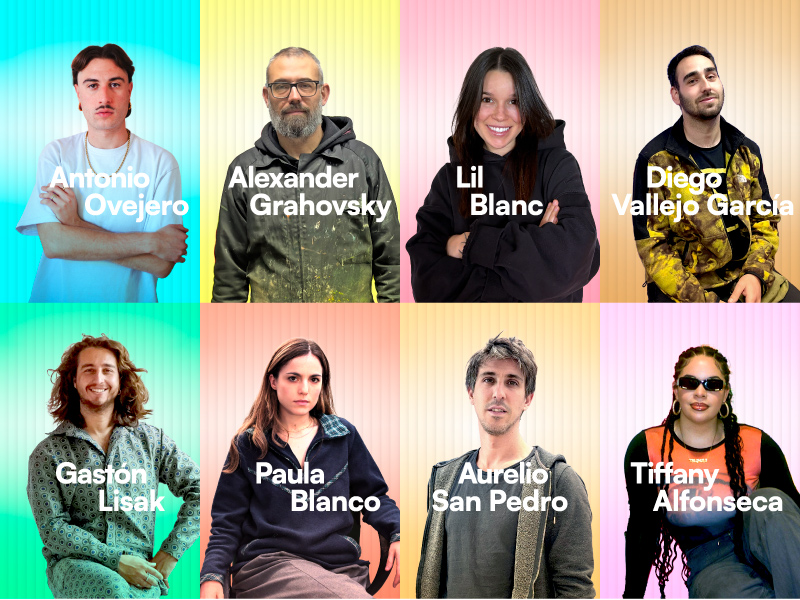
Alexander Grahovsky. Galería BAT; Lil Blanc. Galería Rodrigo Juarranz; Diego Vallejo García. Shiras Galería; Antonio Ovejero. CLC ARTE; Gastón Lisak. Inéditad Gallery; Paula Blanco. Galería Arancha Osoro; Aurelio San Pedro. Pigment Gallery; Tiffany Alfonseca. OOA Gallery.
The essence that connects the artists selected for the Art Madrid’25 Interview Program is their spirit of constant exploration. This creative quest transcends the boundaries of materials and formats, manifesting itself in the unique way they understand the artistic process. Each of them is at a crucial point of evolution, demonstrating that art, by nature, is a dynamic and ever-changing journey. With distinct styles and an unmistakable personal imprint, these creators challenge conventions and refuse to remain in their comfort zones, driven by an inexhaustible passion to innovate and redefine the limits of contemporary art. Their bold character transforms their work into an experience that directly engages the viewer, expanding artistic possibilities and questioning audience expectations.
In the realm of new figuration, it is particularly revealing how some artists choose to move away from traditional methods, such as the use of preliminary sketches. Instead, they approach painting with spontaneity, allowing the initial stroke to become an essential part of the work's development. This approach reflects a courageous attitude that celebrates accident and intuition as fundamental tools in the creative process. Conversely, those working in abstraction exhibit an equally daring will, rejecting techniques that guarantee a predictable finish. There is no fear of error—only a deep embrace of uncertainty, seen as a reflection of life itself. Even the most technically elaborate pieces conceal creation processes where free gestures and experimentation play a crucial role.
This spirit of innovation finds a perfect setting at Art Madrid’25, where it engages in dialogue with the general public, critics, and collectors. To delve deeper into the concerns and aspirations of these creators, we have prepared a selection of interviews that provide insight into their personal worlds. From a critical yet accessible perspective, these conversations offer tools for interpreting the works and understanding the intentions behind each artistic proposal.
Hearing the voices of the artists not only helps democratize access to art but also adds value—an additional dimension to how we interact with it. Each interview invites us to reflect on the motivations driving these creators, their influences, and the expectations they place on their work. Their words build bridges between the artwork and the viewer, transforming what might seem out of reach into something intimate and profoundly human.
In this context, the interviews presented here are not mere descriptions but an opportunity to understand the ideas and context shaping each project. Through them, readers can discover both technical talent and the emotional and conceptual depth that broadly defines Art Madrid’25. This carefully curated journey, designed to complement the fair experience, invites the audience to immerse themselves in the vision of creative professionals who transform the intangible into art and the personal into the universal.
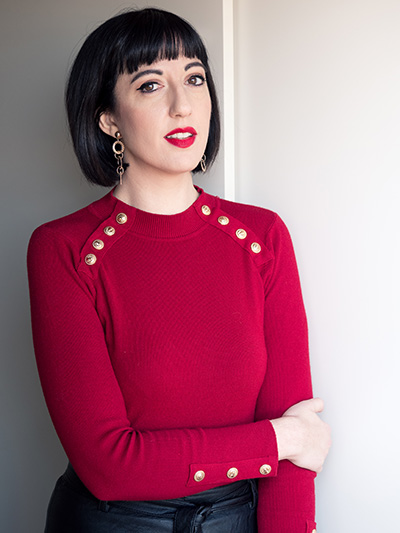
Marisol Salanova. Art critic and curator of the Interview Program at Art Madrid'25.
ABOUT THE ARTISTS
Lil Blanc (Madrid, 1993) began her professional journey by exploring textures, later evolving toward the study of gradients and transitions between colors. This pursuit culminated in an abstraction that conveys intense emotions. The soft gradations on her canvases evoke sunset skies, an attempt to capture the fleeting nature of those moments inspired by her personal experience of creative contemplation. Her perfectionist approach and "less is more" philosophy reflect her training as an architect. Without embellishments, Blanc creates works imbued with subtle stories and profound layers of meaning. Alexander Grahovsky (Alicante, 1980) adopts a chaotic and spontaneous approach, collecting images that he transforms into narrative collages. His painting is characterized by a strong surrealist component, with non-linear stories unfolding in overlapping scenes at different phases, inviting the viewer's gaze to wander across the composition. Influences from classical painting and cinema enrich his works, whose interpretation varies depending on the viewer’s background and mood. Diego Vallejo García (Ávila, 1991) blends a classical aesthetic with contemporary themes. His training in Art History and Restoration allows him to integrate both theoretical and practical approaches into his projects. Using oil paint and glazing techniques, he creates generational portraits that reflect the collective personality of his time, meticulously ensuring the conservation and durability of each piece. Antonio Ovejero (Valencia, 1999) investigates memory and scenes from the collective imagination, exploring beauty in the sublime everyday. His fascination with figures adorned with jewelry, geometric-patterned garments, and extravagant hairstyles connects different eras. Through a kitsch aesthetic, he merges the traditional with the ostentatious, crafting images that intertwine aging, elegance, and daily life. Ovejero describes his style as neo-pop costumbrismo. Gastón Lisak (Barcelona, 1989) moves toward conceptual art from his experience as a teacher and workshop facilitator. His work revolves around "mundane archaeology," examining the transformation of anachronistic objects. Influenced by industrial design, he critiques overproduction and finds beauty in discarded items, pausing to contemplate what often goes unnoticed. Paula Blanco (Oviedo, 1996) merges art and science to explore the relationship between nature, territory, and the environment. Drawing inspiration from the landscape, she uses clay, pigments, varnishes, and fiberglass to create structures reminiscent of natural organisms. Her abstract and ethereal approach sublimates matter, separating the concept from the object and expressing herself through the origins of raw materials. Tiffany Alfonseca (Dominican Republic, 1994) delves into her Afro-Latinx-American identity by depicting everyday scenes of empowered individuals and non-normative bodies. Combining painting, drawing, silkscreen, and embroidery, she draws inspiration from the vibrant colors of her childhood in the Dominican Republic. Her work blends vivid tones and rich textures to convey personal and collective narratives that resonate universally. Aurelio San Pedro (Barcelona, 1983) is known for his delicate black-and-white drawings focused on natural settings. Memory lies at the heart of his creative process, using recollection as a tool for visual expression. Paper plays a central role, balancing worked areas with untouched spaces. His style oscillates between abstraction and figuration while maintaining a distinctive artistic identity.
ABOUT MARISOL SALANOVA
An art critic, curator, and cultural manager, Marisol Salanova (Valencia, 1982) is a natural communicator. She holds a degree in Philosophy from the University of Valencia and specialized in Art and Technology through a master’s degree in Artistic Production. She has authored works for publishers such as Plataforma Editorial and Akal, among others, publishing several essays, numerous catalogs, and artist books. For nearly a decade, she directed the publishing house Micromegas, dedicated to contemporary art texts, a role she balanced with teaching.
Marisol Salanova regularly writes for ABC Cultural and participates in the Hoy por Hoy program on Cadena Ser. She also advises collectors and has pioneered curating crypto art through the platform Arteinformado. She curates exhibitions for internationally renowned artists, both solo and group shows, and has curated editorial sections of art fairs such as the now-defunct SUMMA Madrid and MARTE Castellón. She conducts in-depth research for each project and is currently working on her doctoral thesis on the work of sculptor Apel·les Fenosa.
She is recognized as one of the most visible critical voices in the Spanish art scene, known for her high media profile and outreach skills, which she actively employs on social media. Her best tools are listening and engaging in dialogue to understand and amplify the work of artists.
ABOUT SAFE CREATIVE
This Interview program of Art Madrid’25 features the collaboration of SAFE CREATIVE a platform allied with artists on the Internet to protect their rights. At present with new technological advancements, challenges have multiplied, and we provide solutions for creators and artists of all kinds. challenges have multiplied, and we provide solutions for creators and artists of all kinds. Safe Creative offers an online, user-friendly, and cost-effective system that enables any creator to obtain the necessary evidence to prove copyright ownership from the comfort of their home. By using their computer, they can instantly register all of their work.