Art Madrid'26 – DOMPAL: TRADITION AND EXPERIENCE

Tradition and experience are the terms that define DOMPAL. For almost 60 years, the company has been working for excellence in Jabugo (Huelva) and Guijuelo (Salamanca). From the beginning in 1962, the architect of the company, Francisco Martín Moreno, had a very clear objective: to obtain the recognition of its clients as the best supplier of each of its products.

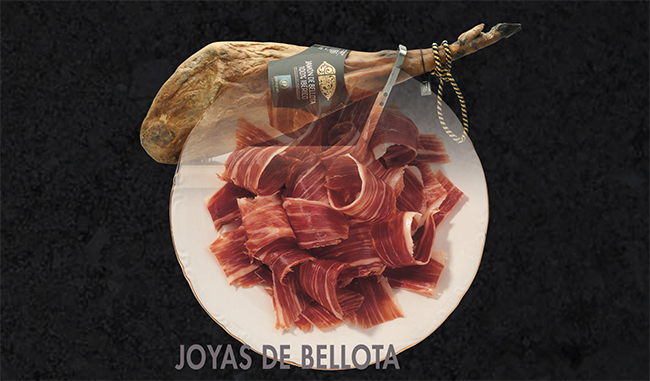
It is in Jabugo and Guijuelo where the holm and cork oaks become the ideal habitat for the Iberian pig, and it is in these areas that DOMPAL establishes its base of operations. DOMPAL's master ham makers are true artists, and in the manner of a goldsmith, they are capable of carving the Jewel of Bellota into exclusive pieces with unique flavours, using top quality raw materials.
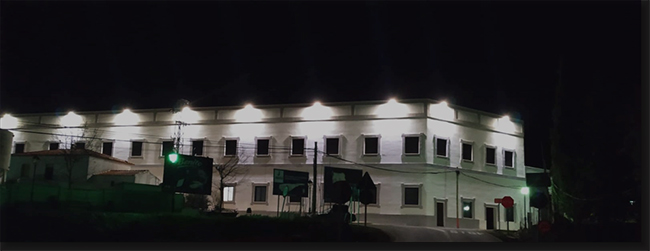
Currently, the company, under the General Management of Juan Carlos Tejero, has consolidated itself as a leader in the sector, projecting itself into the future with a new Production Centre in Jabugo equipped with IFS and BRC certification, which will allow it to satisfy the most demanding demands, setting itself the challenge for the near future of international trading of its excellent product.

DOMPAL has a large warehouse in Alcobendas (Madrid), where it stores more than 50,000 hams from all the protected designations of origin, as well as a variety of gourmet products to accompany the ham. DOMPAL's headquarters smells of "well-made, healthy, and wholesome product".
In 2017, in order to be able to cover the growing offer and expand the company nationally and internationally, DOMPAL built up a new dryer of about 5,000 square meters with facilities adapted to the latest technological advances, but honestly preserving the tradition of Jabugo’s hams. In the traditional way, the surface is distributed in three floors; with natural dryers in the upper part, elaboration in the ground floor and a lower part devoted to the wine cellar.

DOMPAL distributes its products in more than 2,000 establishments (restaurants, specialised and gourmet shops) in Spain and Europe, and has received numerous quality awards and national and international recognition. Although, as its team points out: "our best award is to have such emblematic clients as El Corte Inglés or Paradores Nacionales of Spain, who place their trust in us and our products to offer the highest quality to their customers".
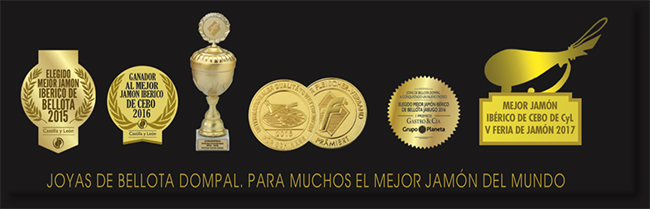
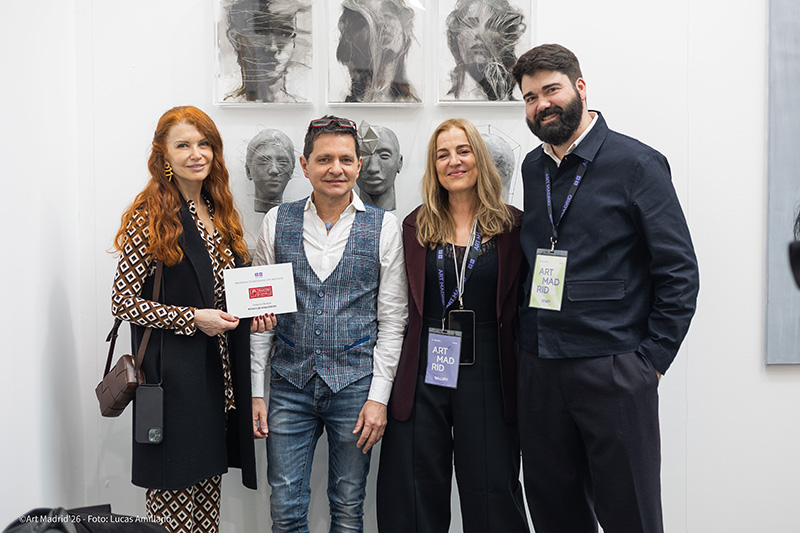
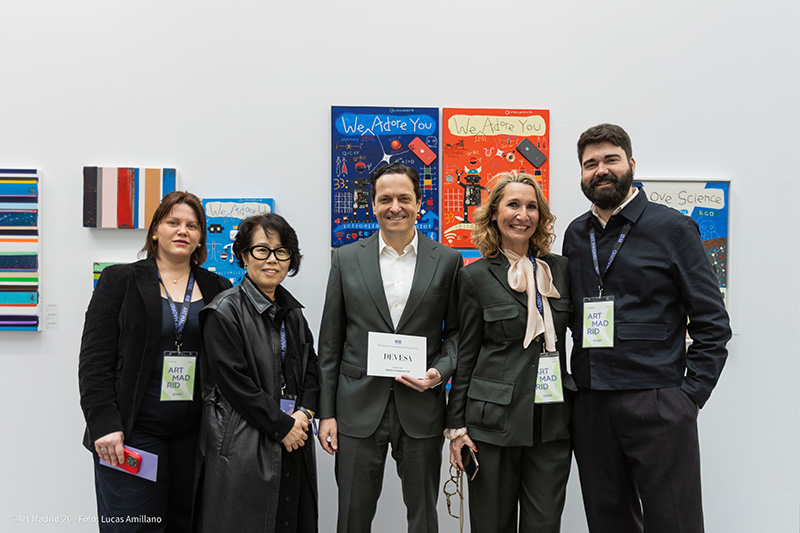
Some of the most outstanding awards that DOMPAL has received are: “Medalla de oro al Mejor Jamón de Bellota Calidad 5 Dompales” of the German Butchers Association (Stuttgart, 2006), “Trofeo al mejor jamón ibérico de bellota de Castilla y León 2015”, granted by the hoteliers' association of Castilla León, “Premio FES mejor empresario en el exterior, Francisco Martín Moreno, presidente de Domingo del Palacio S.A”, “Ganador al mejor jamón ibérico de Cebo de Castilla y León 2016”, granted by the hoteliers’ association of Castilla León and “Triple Medalla de Oro en la feria cárnica IFFA 2019 de Alemania”, among others.

ART MADRID’26 INTERVIEW PROGRAM. CONVERSATIONS WITH ADONAY BERMÚDEZ


The work of Carmen Baena (Benalúa de Guadix, Granada, 1967) is structured as a poetic investigation into the memory of territory and its material translation into forms, textures, and gestures. Her practice stems from a life experience deeply connected to a specific landscape in southern Spain, understood not only as a geographical space but also as an affective and symbolic sedimentation. In this sense, her pieces can be approached from a perspective centered on direct experience: the landscape not as representation, but as a lived trace that emerges through doing.

Baena activates unique dialogue between historically hierarchical materials. Marble, associated with permanence and monumental tradition, coexists with embroidery, a technique linked to domestic knowledge passed down through generations, historically relegated but here reactivated as a fully-fledged artistic language. This coexistence is not presented as confrontation, but as a field of resonances where the solid and the fragile, the enduring and the tactile, interpenetrate. From a perspective attentive to connections, embodied experience, and knowledge constructed from everyday life, thread becomes a tool for sensitive knowledge.

Color, particularly in her textile works, functions as vibrational energy rather than a purely formal attribute. In contrast to the chromatic restraint of marble, embroidery introduces an open temporality in which intuitive gestures and accidents acquire structural value. Thus, the process becomes a space for listening, where the unexpected does not interrupt the work but rather constitutes it. In Carmen Baena’s practice, creating means allowing the territory—both external and internal—to continue transforming itself.


The Garden Blooms X. 2025. Acrylic and embroidery thread on canvas. 50 x 70 cm.


Your works evoke landscapes, reliefs, and topographies. How does the relationship between physical territory and symbolic or emotional territory articulate itself in your practice?

The physical territory where I was born and spent my early childhood has shaped all my work. I was born in a cave in the Guadix region (Granada), home to the largest complex of troglodyte dwellings in Europe.

The landscape there is full of contrasts: alongside the greens of the vega—fruit trees and poplars—you find the reddish ochres of the eroded hills. And facing the white of Sierra Nevada, the white of snow that still lingers in spring, there are also the greens of the wheat fields and cereal plains. Thanks to erosion and the geological layers that have been exposed over time, the area contains a series of strata that preserve extremely important continental geological records.

For this reason, the area has been designated a UNESCO Global Geopark. I spent a happy, very simple childhood in this environment—living closely connected to nature—and that is the territory that surfaces throughout the symbolism of my work.


Circular Horizons XIV. 2023. Acrylic and embroidery thread on canvas. 72 x 72 cm.


You learned embroidery in a family context, and you draw on the landscapes of your childhood. When did you realise that your immediate world—people, gestures, everyday landscapes—was no longer just a memory, but an active driving force in the construction of your artistic language?

I realised that the universe of my childhood was an active driving force in the construction of my artistic language thanks to a friend, after she visited my cave-house. Through her perspective, she made me aware of what I had been doing intuitively up until that point. This happened more than twenty years ago, and since then—even though I’m aware of it—I continue working.

I like working intuitively, and most of the time I only discover what the landscape has been afterwards. What stays with me is the sensation that inspired the piece once I have finished it.


Sea Breeze III. 2025. Acrylic and embroidery thread on canvas. 60 x 80 cm.


Marble carries historical and symbolic weight linked to monumentality, while embroidery is often associated with traditions that have been overlooked or confined to the domestic sphere. How do you negotiate this clash of cultural status in your work?

For years, marble was the material I was most interested in, and the one I used for most of my sculptural work. It wasn’t until 2007–2008 that I felt the need to incorporate embroidery—a technique I had learned as a teenager.

I began experimenting on paper, using stitching to draw landscapes and trees directly connected to the sculptures I was making at the time, and also working on small scraps of different kinds of paper. I explored the technical and visual possibilities of thread, creating small works in which colour, texture, and the thread’s vibration became the protagonists.

Later, I moved on to larger formats on canvas, where I also incorporated acrylic. These two seemingly contradictory practices—marble and embroidery—have coexisted in my studio and my work without any difficulty. Today, embroidery has completely displaced marble.


Between Heaven and Earth III. 2020. Marble and wood. 25 x 14 x 14 cm.


In your marble pieces, white and gold create an almost meditative atmosphere; in contrast, embroidery and acrylic burst into colour, activating gesture and vibration. Is this a conscious choice, or do the materials reveal their own possible colour to you?

With marble, the choice of white and gold is a conscious decision: I want to convey the spiritual atmosphere of the landscape, and the relationship between human beings and nature. By contrast, the explosion of colour in the thread emerged gradually and more intuitively, and only later did I begin to understand and use the possibilities of this material in a more conscious way.


Whisper Between the Lines XIII. 2023. Acrylic and embroidery thread on canvas. 40 x 60 cm.


To what extent do you plan your work, and how much space do you leave for the unexpected—or even for mistakes?

When it comes to making my work, I don’t like to plan too much. With embroidered pieces, I do tests on small scraps of paper—trying out colour and the stitch I’m going to use—and with that I try to visualise the final result in my mind. This way of working leaves plenty of space for things to happen while I work. It allows me to discover, learn, and make use of the unexpected.

For example, in some pieces, while embroidering, tangles can occur because the thread tension isn’t right or the thread is too loose. At first, those tangles might seem like they could ruin the piece, but when I see them, I realise they’re visually very interesting. So later I have consciously reproduced that effect in other works.