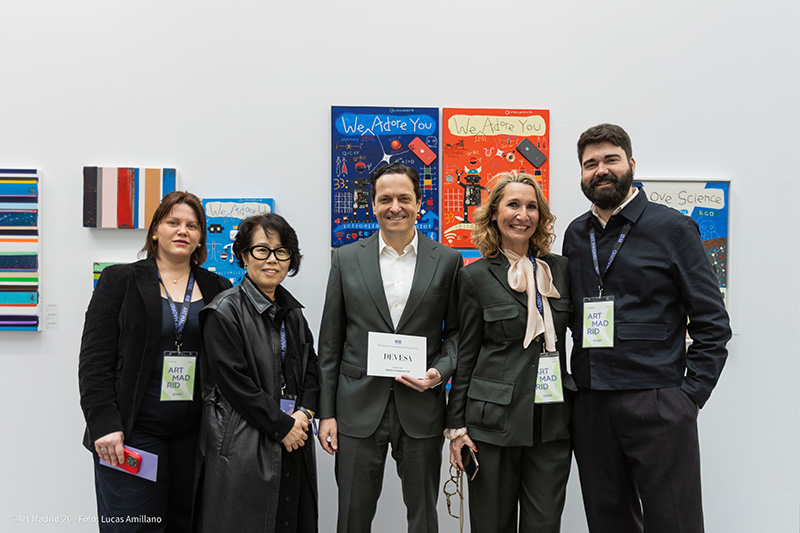
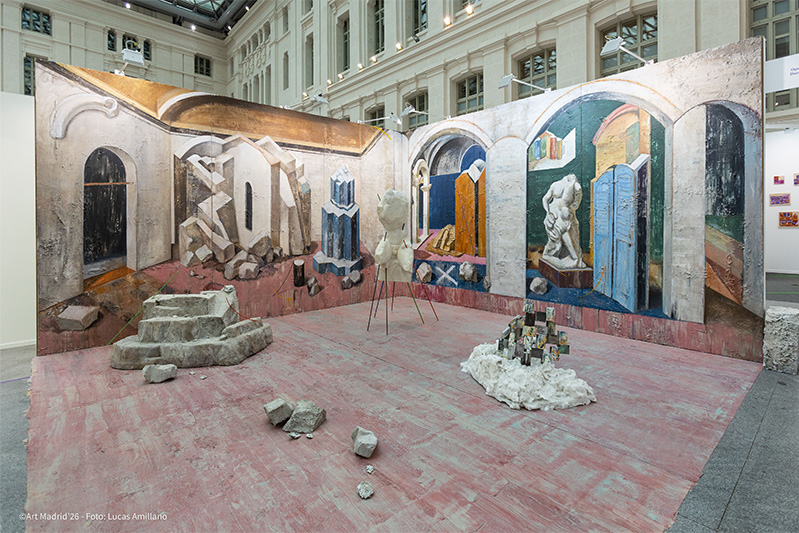
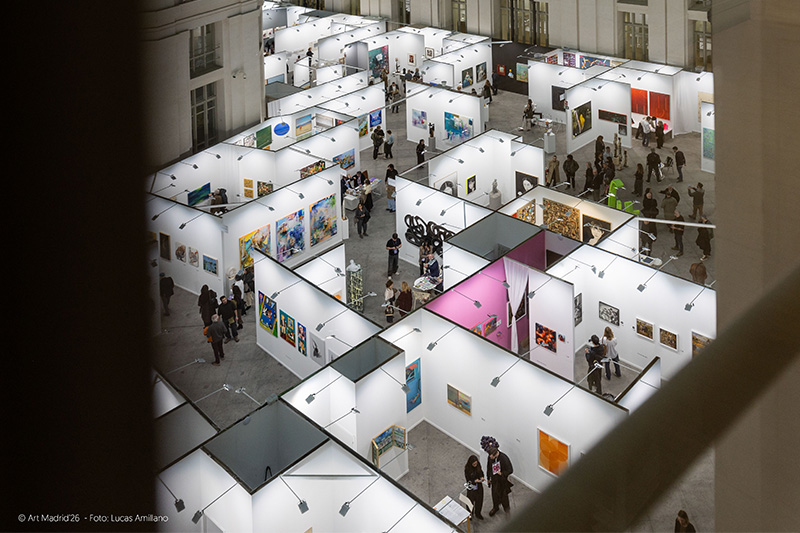
Art Madrid'26 – ALL READY FOR THE OPENING OF THE 13TH EDITION OF ART MADRID

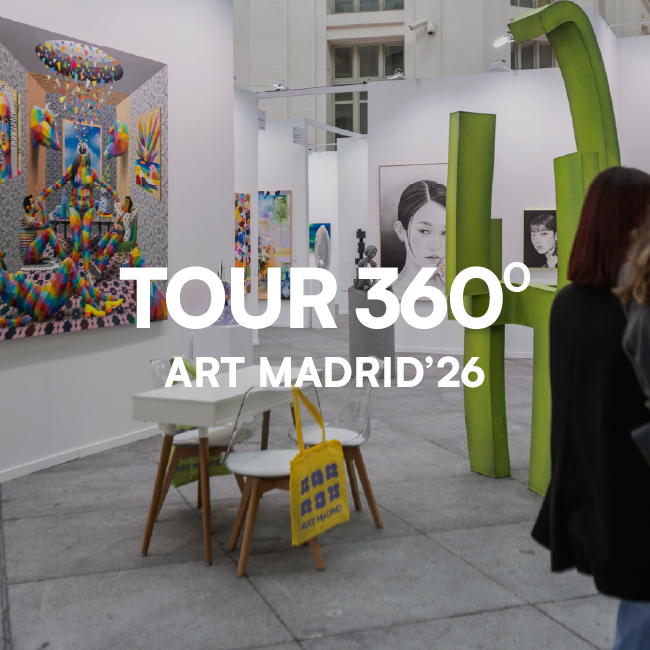
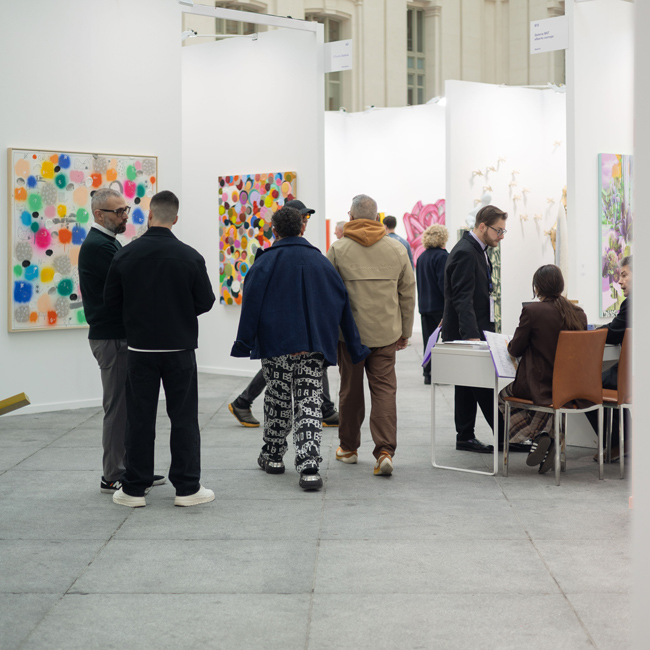
A few hours before the opening of doors - on Wednesday, February 21 - the atmosphere within one of the great fairs of the Week of Art is exciting. Come to Art Madrid'18 to enjoy art like never before!
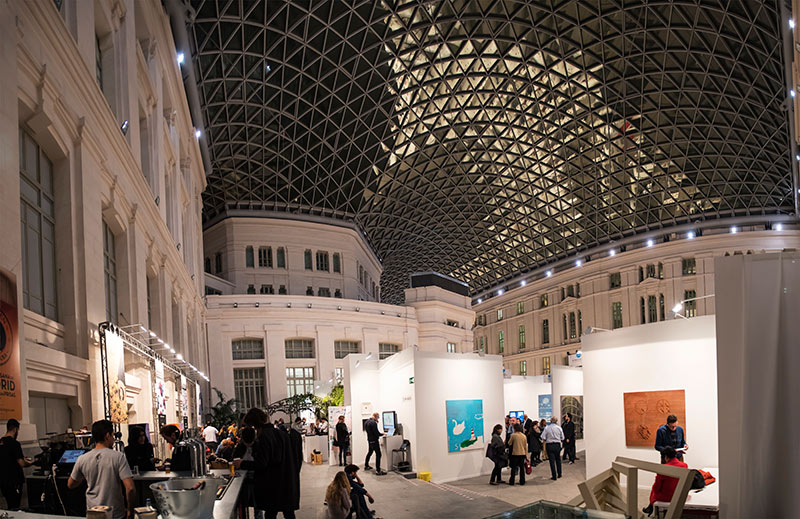
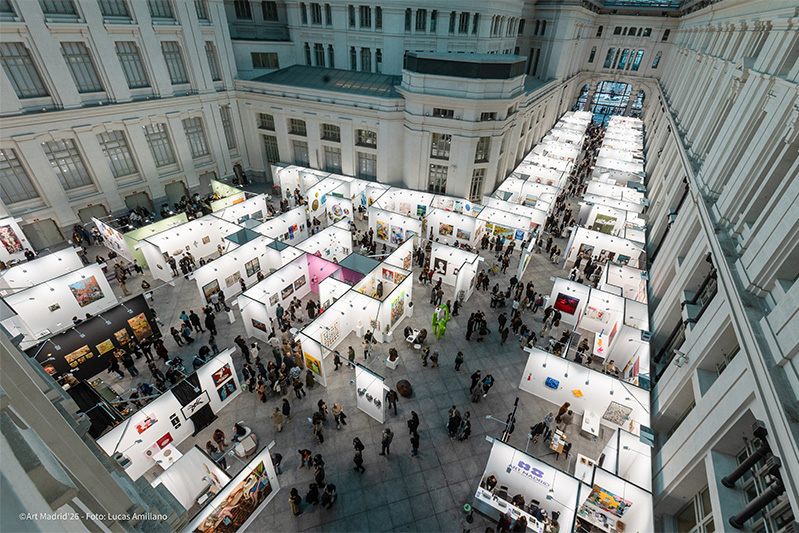
Foto de la pasada edición en Art Madrid'17

Carpet, cartels, paint, the staircase, be careful with that photograph... There are many months of work that precede the celebration of an event such as Art Madrid, one of the great fairs of the Art Week in Madrid, work of selection, contact and management of the participating galleries, the work of communication, the design of the graphic elements, the plan, the licenses, the technical sheets, the prices, the sending of invitations, the calendars, the parallel activities ... but at this point we would give our kingdom by a simple nail! A few hours before the opening of Art Madrid - tomorrow, Wednesday, February 21st at 11:00 am we open the doors of the CentroCentro Glass Gallery, and at 1:00 a wine will be served for the guests - all are nerves, but also an enormous confidence in the work done and in those who have helped us make it possible, our sponsors Suarez and Liquitex (who will have two spaces in the AM18 lounge area with activities that we will announce each day), our collaborator Ink and Movement, our media partner official Cultura Inquieta, or brands such as La Virgen brewery or the Pago de Cirsus winery that decided to ally with the fair for years and still accompany us.

At the official opening we will have the presence, among others, of the ambassadors of Germany, Brazil, Ukraine, France, Switzerland, Italy, Chile and the Ambassadors of Costa Rica and Jordan, example of the acceptance, Mr. Ryan Matheny Garrido, Aggregate Cultural Center of the Embassy of the United States, a good example of the importance that the fair already has among collectors and foreign professionals.
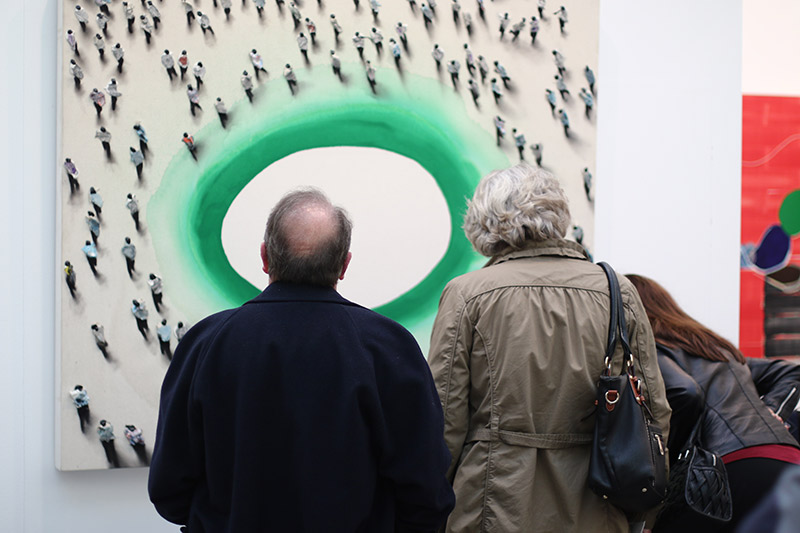
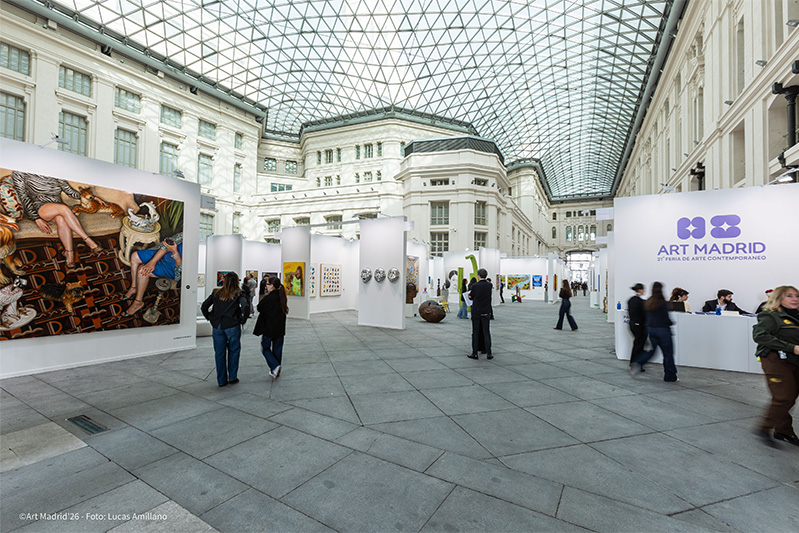
Foto de la pasada edición en Art Madrid'17

On the part of local institutions have confirmed their attendance D. Felipe Llamas, Chief of Staff of the Mayor's Office of Madrid and Dª. María Carmen Castell Díaz, Member of the Ordinary Permanent Commission of Culture and Sports of the Madrid City Council, as well as Dª. Alicia Durántez de Irezabal, D.G. of Cultural Heritage Community of Madrid. Subdirectorate General for Dissemination and Management and Dª. Elisa de Cabo de la Vega Deputy Director General for the Protection of the Historical Heritage of the Ministry of Culture MECD.

As a representation of cultural institutions and foundations we will have Juan Barja, Director of the Círculo de Bellas Artes, Javier del Campo of Fundación Caja de Burgos, with Dª. Fátima Sánchez Santiago, Director of Projects and Education Area of ​​the Botín Foundation, Dª. Leticia Martín, Manager Atlantic Center of Modern Art-CAAM, Mr. D. Michel Bertrand, Director of the Casa Velázquez, Dª. Laura Ramón Brogeras, manager of the Art Collection of the Fundación Telefónica or Dª. Elena Alonso, Director Carlos Amberes Foundation.

We are waiting for you all in # ArtMadrid18
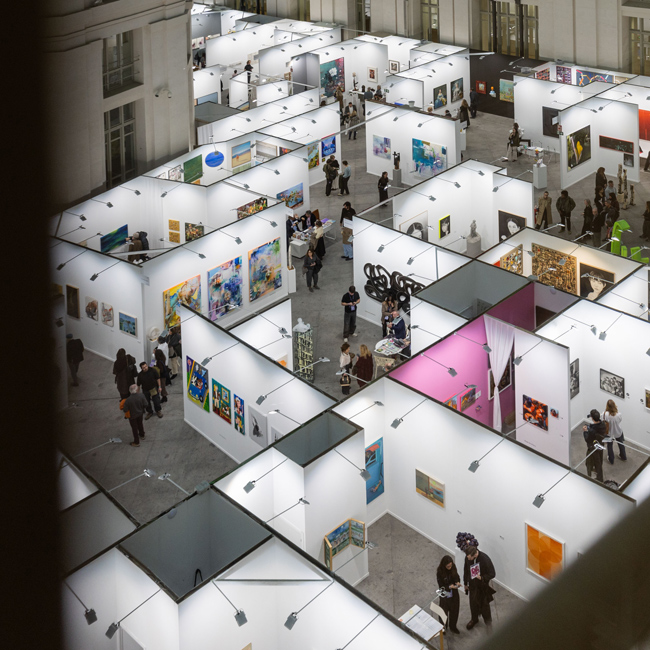

The circle as critical device and the marker as contemporary catalyst


POSCA, the Japanese brand of water-based paint markers, has established itself since the 1980s as a central instrument within contemporary artistic practices associated with urban art, illustration, graphic design, and interdisciplinary experimentation. Its opaque, highly pigmented, fast-drying formula—compatible with surfaces as diverse as paper, wood, metal, glass, and textiles—has enabled a technical expansion that extends beyond the traditional studio, engaging public space, objects, and installation practices alike.


In this context, POSCA operates as more than a working tool; it functions as a material infrastructure for contemporary creation. It is a technical device that enables immediacy of gesture without sacrificing chromatic density or formal precision. Its versatility has contributed to the democratization of languages historically associated with painting, fostering a more horizontal circulation between professional and amateur practices.

This expanded dimension of the medium finds a particularly compelling conceptual framework in The Rolling Collection, a traveling exhibition curated by ADDA Gallery. The project proposes a collective investigation of the circular format, understood not merely as a formal container but as a symbolic structure and a field of spatial tension.


Historically, the circle has operated as a figure of totality, continuity, and return. Within the framework of The Rolling Collection, the circular format shifts away from its classical symbolic charge toward an experimental dimension, becoming a support that challenges the hegemonic rectangular frontality of the Western pictorial tradition. The absence of angles demands a reconsideration of composition, balance, and directional flow.

Rather than functioning as a simple formal constraint, this condition generates a specific economy of visual decisions. The curved edge intensifies the relationship between center and periphery, dissolves internal hierarchies, and activates both centrifugal and centripetal dynamics. The resulting body of work interrogates the very processes through which images are constructed.


Following its 2025 tour through Barcelona, Ibiza, Paris, London, and Tokyo, a selection of the exhibition is presented at Art Madrid, reinforcing its international scope and its adaptability to diverse cultural contexts. The proposal for Art Madrid’26 brings together artists whose practices unfold at the intersection of urban art, contemporary illustration, and hybrid methodologies: Honet, Yu Maeda, Nicolas Villamizar, Fafi, Yoshi, and Cachetejack.

While their visual languages vary—ranging from graphic and narrative approaches to chromatic explorations charged with gestural intensity—the curatorial framework establishes a shared axis: a free, experimental, and distinctly color-driven attitude. In this sense, color functions as a conceptual structure that articulates the works while simultaneously connecting them to the specific materiality of POSCA.


The marker’s inherent chromatic vibrancy engages in dialogue with the formal assertiveness of the circle, generating surfaces in which saturation and contrast take center stage. The tool thus becomes embedded within the exhibition discourse, operating as a coherent extension of the participating artists’ aesthetic vocabularies.

One of the project’s most significant dimensions is the active incorporation of the public. Within the exhibition space—activated by POSCA during Art Madrid’26—visitors will be invited to intervene on circular supports installed on the wall using POSCA markers, thereby symbolically integrating themselves into The Rolling Collection during its presentation in Madrid.


This strategy introduces a relational dimension that destabilizes the notion of the closed artwork. Authorship becomes decentralized, and the exhibition space transforms into a dynamic surface for the accumulation of gestures. From a theoretical standpoint, the project may be understood as aligning with participatory practices that, without compromising formal coherence, open the artistic dispositif to contingency and multiplicity.

The selection of POSCA as the instrument for this collective intervention is deliberate. Its ease of use, line control, and compatibility with multiple surfaces ensure an accessible experience without diminishing the visual potency of the outcome. In this way, the marker operates as a mediator between professional practice and spontaneous experimentation, dissolving technical hierarchies.


The title itself, The Rolling Collection, suggests a collection in motion—unfixed to a single space or definitive configuration. Its itinerant nature, combined with the incorporation of local interventions, transforms the project into an organism in continuous evolution. Within this framework, POSCA positions itself as a material catalyst for a transnational creative community. Long associated with urban scenes and emerging practices, the brand reinforces its identity as an ally of open, experimental, and collaborative processes.

POSCA x The Rolling Collection should not be understood merely as a collaboration between a company and a curatorial initiative; rather, it constitutes a strategic convergence of tool, discourse, and community. The project proposes a reflection on format, the global circulation of contemporary art, and the expansion of authorship, while POSCA provides the technical infrastructure that makes both individual works and collective experience possible.