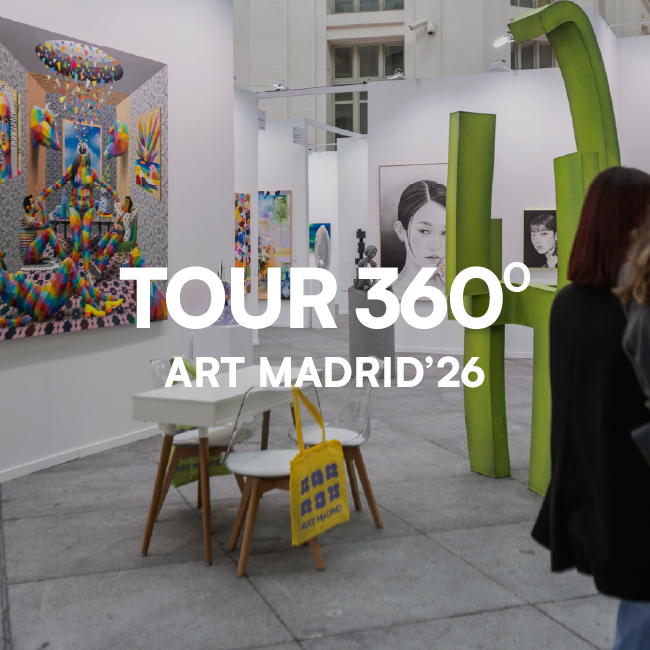
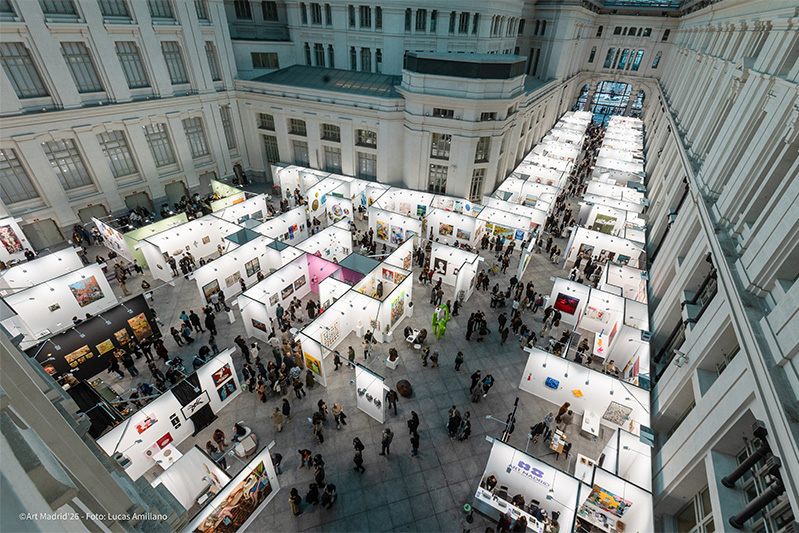
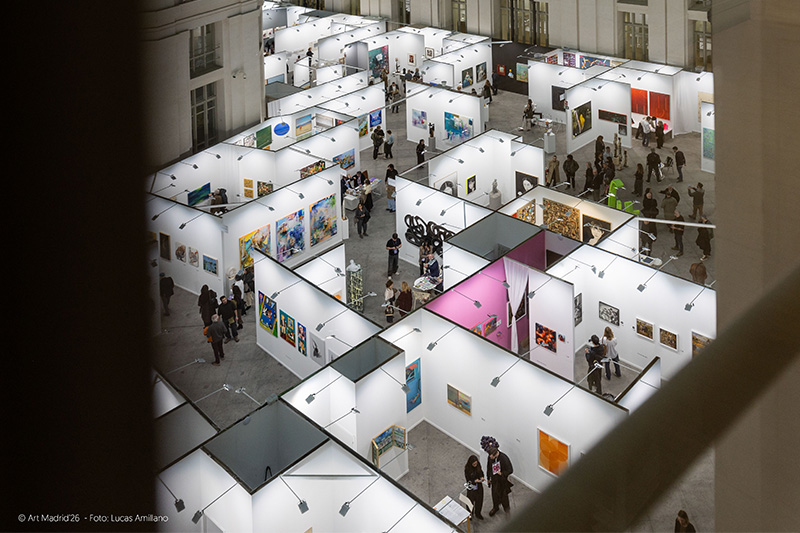
Art Madrid'26 – Art Marbella first edition in the very summer

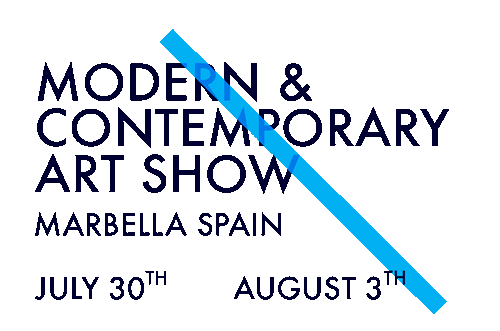
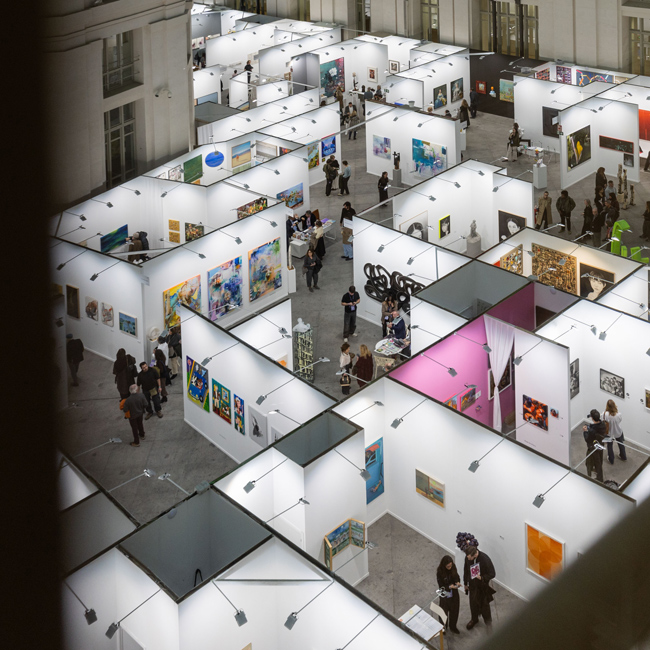
Art Marbella listed as "the first major art fair in the Mediterranean" and will involve 50 leading international galleries in addition to the sections dedicated to specific projects by guest artists, a VIP program for collectors and a space for research and education run by international curators.
Marbella, this summer, is a "hot spot" for art lovers, "one of the most important cities in the European summer and attracts many visitors with high purchasing power in Europe as well as Russia and the Middle East," explains his promoter Alejandro Zaia. "It's a great opportunity to establish an international fair of the highest level of quality aimed at this audience. We can help expand the frontiers of collectors, introducing new players and creating an environment in which artists, curators, gallery owners and collectors can communicate and share information on the latest trends in art, and with the work of the best artists exposed, "adds .
 
Zaia was co-founder of the fairs Pinta New York (2007) and Pinta London (2010), director of Mundus Novus collection dedicated to contemporary Latin American art, and member of the committee of international consultants Museum of Latin American Art of Los Angeles ( MOLAA) and the Art Museum for Private Collectors. Zaia is a recognized expert in communication and marketing. His idea is to "give the public a selection of art of exceptional quality, where the most innovative proposals coexist with great works of historical vanguards of the twentieth century."
Beside him, a committee of curators with big names in contemporary art as Omar Lopez-Chahoud, director of the Miami fair UNTITLED; Neri Torcello, in charge of the Masters section; and Maria Chiara Valacchi, director of Spazio Cabinet Foundation in Milan, in charge of special projects and Bruno Leitão, in charge of curating the Finistrella section. Its aim is to develop a contemporary art fair with some references to more established artists, giving meaning and context to young artists.
 
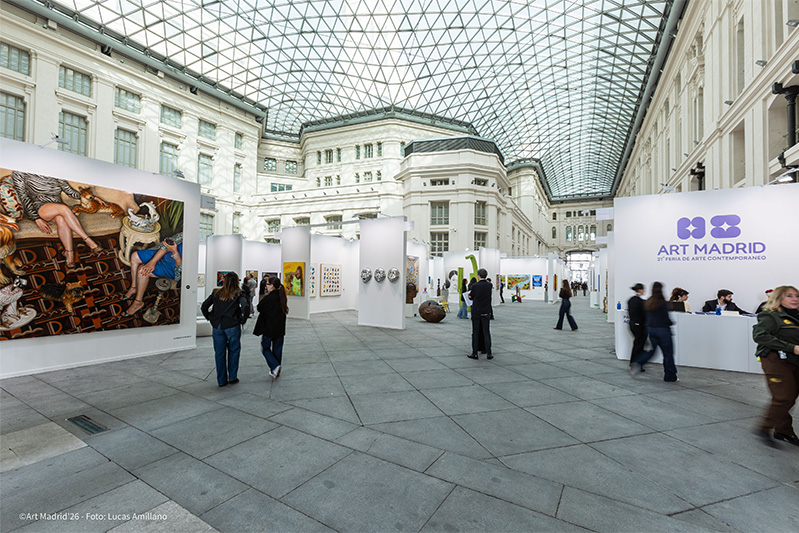
The fair is held at the Palace of Fairs, Exhibitions and Congresses of Marbella and it has a special guest: the actor and artista Jordi Molla.
 
 
List of participants:
 
Adhoc - Vigo, Spain
Alarcon Criado - Sevilla, Spain
Alimentacion 30 + Lounge - Madrid, Spain
APGallery - Madrid, Spain
Area 72 / Point - Valencia, Spain
Art Nine - Murcia, Spain
Bacelos - Vigo, Spain
Baro Gallery - Sao Paulo, Brazil
Carlos Carvalho - Lisbon, Portugal
Carreras Mugica - Bilbao, Spain
Daniel Cardani - Madrid, Spain
Elephant Kunsthall - Lillehammer, Norway
Minimum space - Madrid, Spain
F2 Gallery - Madrid, Spain
Fernando Pradilla - Madrid, Spain
Filomena Soares - Lisbon, Portugal
FL Gallery - Milan, Italy
Galeria de las Misiones - Montevideo, Uruguay
Galeria El Museo - Bogota, Colombia
Gallery Pelaires - Palma de Mallorca, Spain
Gema Llamazares - Gijon, Spain
L21 Gallery - Palma de Mallorca, Spain
Mark Hachem - Paris, France
Max Estrella - Madrid, Spain
Michel Mejuto - Bilbao, Spain
Narrative Projects - London, United Kingdom
Odalys Madrid - Spain Caracas, Venezuela
Operate Scelte - Turin, Italy
Red Penguin - San Pedro de Alcantara, Spain
Rodrigo Juarranz - Aranda de Duero, Spain
Rosa Santos - Valencia, Spain
Saro León - Las Palmas de Gran Canaria, Spain
September Espai D'Art - Valencia, Spain
STOA Gallery - Estepona, Spain
Twin Gallery - Madrid, Spain
Yusto / Giner - Marbella, Spain


ART MADRID’26 INTERVIEW PROGRAM. CONVERSATIONS WITH ADONAY BERMÚDEZ


The painting of Daniel Bum (Villena, Alicante, 1994) takes shape as a space for subjective elaboration, where the figure emerges not so much as a representational motif but as a vital necessity. The repetition of this frontal, silent character responds to an intimate process: painting becomes a strategy for navigating difficult emotional experiences—an insistent gesture that accompanies and alleviates feelings of loneliness. In this sense, the figure acts as a mediator between the artist and a complex emotional state, linking the practice of painting to a reconnection with childhood and to a vulnerable dimension of the self.

The strong autobiographical dimension of his work coexists with a formal distance that is not the result of conscious planning, but rather functions as a protective mechanism. Visual restraint, an apparent compositional coolness, and an economy of means do not neutralize emotion; instead, they contain it, avoiding the direct exposure of the traumatic. In this way, the tension between affect and restraint becomes a structural feature of his artistic language. Likewise, the naïve and the disturbing coexist in his painting as inseparable poles, reflecting a subjectivity permeated by mystery and unconscious processes. Many images emerge without a clearly defined prior meaning and only reveal themselves over time, when temporal distance allows for the recognition of the emotional states from which they arose.


The Long Night. Oil, acrylic, and charcoal on canvas. 160 × 200 cm. 2024.


The human figure appears frequently in your work: frontal, silent, suspended. What interests you about this presence that seems both affirmative and absent?

I wouldn’t say that anything in particular interests me. I began painting this figure because there were emotions I couldn’t understand and a feeling that was very difficult for me to process. This character emerged during a very complicated moment in my life, and the act of making it—and remaking it, repeating it again and again—meant that, during the process, I didn’t feel quite so alone. At the same time, it kept me fresh and connected me to an inner child who was broken at that moment, helping me get through the experience in a slightly less bitter way.


Santito. Acrylic and oil on canvas. 81 × 65 cm. 2025.


There is a strong affective dimension in your work, but also a calculated distance, a kind of formal coldness. What role does this tension between emotion and restraint play?

I couldn’t say exactly what role that tension plays. My painting is rooted in the autobiographical, in memory, and in situations I have lived through that were quite traumatic for me. Perhaps, as a protective mechanism—to prevent direct access to that vulnerability, or to keep it from becoming harmful—that distance appears unconsciously. It is not something planned or controlled; it simply emerges and remains there.


Night Painter. Acrylic on canvas. 35 × 27 cm. 2025.


Your visual language oscillates between the naïve and the unsettling, the familiar and the strange. How do these tensions coexist for you, and what function do they serve in your visual exploration?

I think it reflects who I am. One could not exist without the other. The naïve could not exist without the unsettling; for me, they necessarily go hand in hand. I am deeply drawn to mystery and to the act of painting things that even I do not fully understand. Many of the expressions or portraits I create emerge from the unconscious; they are not planned. It is only afterwards that I begin to understand them—and almost never immediately. A considerable amount of time always passes before I can recognize how I was feeling at the moment I made them.


Qi. Acrylic on canvas. 81 × 65 cm. 2025.


The formal simplicity of your images does not seem to be a matter of economy, but of concentration. What kind of aesthetic truth do you believe painting can reach when it strips itself of everything superfluous?

I couldn’t say what aesthetic truth lies behind that simplicity. What I do know is that it is something I need in order to feel calm. I feel overwhelmed when there are too many elements in a painting, and I have always been drawn to the minimal—to moments when there is little, when there is almost nothing. I believe that this stripping away allows me to approach painting from a different state: more focused, more silent. I can’t fully explain it, but it is there that I feel able to work with greater clarity.


Crucifixion. Acrylic on canvas. 41 × 33 cm. 2025.


To what extent do you plan your work, and how much space do you leave for the unexpected—or even for mistakes?

I usually feel more comfortable leaving space for the unexpected. I am interested in uncertainty; having everything under control strikes me as rather boring. I have tried it on some occasions, especially when I set out to work on a highly planned series, with fixed sketches that I then wanted to translate into painting, but it was not something I identified with. I felt that a fundamental part of the process disappeared: play—that space in which painting can surprise even myself. For that reason, I do not tend to plan too much, and when I do, it is in a very simple way: a few lines, a plane of color. I prefer everything to happen within the painting itself.