Art Madrid'26 – Jean-Michel Basquiat in Guggenheim Museum Bilbao

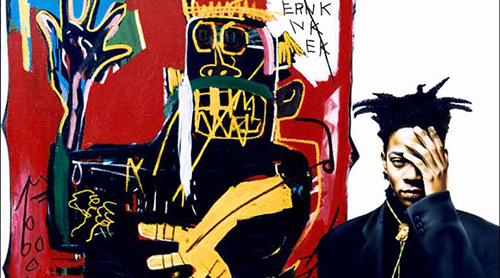
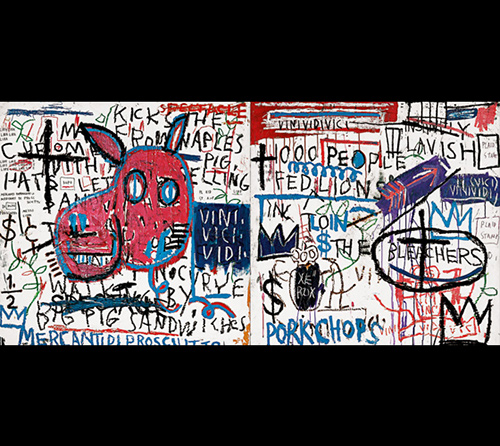
With an Haitian father and mother from Puerto Rico, Jean-Michel Basquiat (1960-1988) always defended its origins in the streets of Brooklyn, where he was born and raised, marking their facades, underground hydrants, their cars, walls, Dumpsters with paintings. He just turned 18, when he signed as SAMO (Same old shit, "the same old shit") and stood among teenagers in the neighborhood for his intellectual and artistic skills, skills that transformed their graffiti on allegations against social inequalities, by the defense of disadvantaged minorities, true graphic files on the harshness of the time in that city.
Panel de expertos, 1982.
 
 
His first solo exhibition, at age 21, showed those same lines, colors, this young and gifted nerve in dozens of large paintings, objects, papers, being the first graffiti artist (... with Keith Haring) on ??exhibit in a gallery Art, opening new doors to Fine Arts and all contemporary art. The show was a success and all the pieces were sold.
 
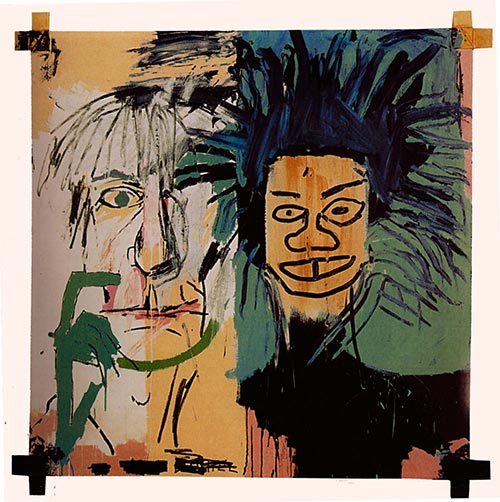
In 1982 he participated in Documenta VII and the Whitney Biennial and was in those years when the clever Andy Warlhol adopted him as fetish and they became inseparable, they portrayed each other and signed a friendship / admiration that transcends both. Basquiat's reputation grew as they performed exhibitions in North America and Europe; soon he became a prolific artist and media personality in the cultural field.
Andy Warhol y Basquiat.
 
 
Jean-Michel Basquiat: Now is the time, is an exhibition organized by the Art Gallery of Ontario in partnership with the Guggenheim Museum Bilbao, explores some of the most important issues of the innovative work of Basquiat over a hundred paintings and drawings by the artist, ordered for the first time from a thematic perspective.
 
The exhibition is articulated in 8 sections: The street as a studio, Heroes and saints (homage to the "black man"), Claiming stories, Reflex (dedicated to racist episodes of his time, slavery), Dualities and double identity, Playing to cheat: drawings and provocations, a seventh section with collaborations with Warhol, Francesco Clemente, Keith Haring and Kenny Scharf, and finally, Sampling and scratching. Music, words and collage, their sources of inspiration.

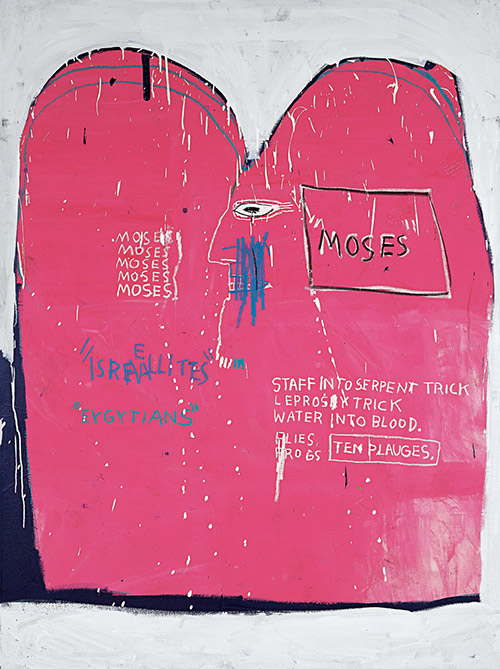
Moises y los egipcios, 1982.


His artistic perspective, in which Basquiat fit their entire universe, African-American history, his musical tastes, jazz, street drugs, friends, sports, news, through symbols, text, shapes and images Sometimes seemingly unrelated ... it continues to inspire many current artists and continues to pose to the viewer an invitation to think critically about the world around us.

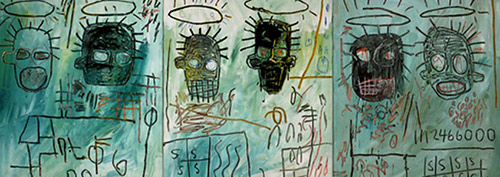
Los seis de Crimea, 1982.

El hombre de Nápoles, 1982.


ART MADRID’26 INTERVIEW PROGRAM. CONVERSATIONS WITH ADONAY BERMÚDEZ


The painting of Daniel Bum (Villena, Alicante, 1994) takes shape as a space for subjective elaboration, where the figure emerges not so much as a representational motif but as a vital necessity. The repetition of this frontal, silent character responds to an intimate process: painting becomes a strategy for navigating difficult emotional experiences—an insistent gesture that accompanies and alleviates feelings of loneliness. In this sense, the figure acts as a mediator between the artist and a complex emotional state, linking the practice of painting to a reconnection with childhood and to a vulnerable dimension of the self.

The strong autobiographical dimension of his work coexists with a formal distance that is not the result of conscious planning, but rather functions as a protective mechanism. Visual restraint, an apparent compositional coolness, and an economy of means do not neutralize emotion; instead, they contain it, avoiding the direct exposure of the traumatic. In this way, the tension between affect and restraint becomes a structural feature of his artistic language. Likewise, the naïve and the disturbing coexist in his painting as inseparable poles, reflecting a subjectivity permeated by mystery and unconscious processes. Many images emerge without a clearly defined prior meaning and only reveal themselves over time, when temporal distance allows for the recognition of the emotional states from which they arose.


The Long Night. Oil, acrylic, and charcoal on canvas. 160 × 200 cm. 2024.


The human figure appears frequently in your work: frontal, silent, suspended. What interests you about this presence that seems both affirmative and absent?

I wouldn’t say that anything in particular interests me. I began painting this figure because there were emotions I couldn’t understand and a feeling that was very difficult for me to process. This character emerged during a very complicated moment in my life, and the act of making it—and remaking it, repeating it again and again—meant that, during the process, I didn’t feel quite so alone. At the same time, it kept me fresh and connected me to an inner child who was broken at that moment, helping me get through the experience in a slightly less bitter way.


Santito. Acrylic and oil on canvas. 81 × 65 cm. 2025.


There is a strong affective dimension in your work, but also a calculated distance, a kind of formal coldness. What role does this tension between emotion and restraint play?

I couldn’t say exactly what role that tension plays. My painting is rooted in the autobiographical, in memory, and in situations I have lived through that were quite traumatic for me. Perhaps, as a protective mechanism—to prevent direct access to that vulnerability, or to keep it from becoming harmful—that distance appears unconsciously. It is not something planned or controlled; it simply emerges and remains there.


Night Painter. Acrylic on canvas. 35 × 27 cm. 2025.


Your visual language oscillates between the naïve and the unsettling, the familiar and the strange. How do these tensions coexist for you, and what function do they serve in your visual exploration?

I think it reflects who I am. One could not exist without the other. The naïve could not exist without the unsettling; for me, they necessarily go hand in hand. I am deeply drawn to mystery and to the act of painting things that even I do not fully understand. Many of the expressions or portraits I create emerge from the unconscious; they are not planned. It is only afterwards that I begin to understand them—and almost never immediately. A considerable amount of time always passes before I can recognize how I was feeling at the moment I made them.


Qi. Acrylic on canvas. 81 × 65 cm. 2025.


The formal simplicity of your images does not seem to be a matter of economy, but of concentration. What kind of aesthetic truth do you believe painting can reach when it strips itself of everything superfluous?

I couldn’t say what aesthetic truth lies behind that simplicity. What I do know is that it is something I need in order to feel calm. I feel overwhelmed when there are too many elements in a painting, and I have always been drawn to the minimal—to moments when there is little, when there is almost nothing. I believe that this stripping away allows me to approach painting from a different state: more focused, more silent. I can’t fully explain it, but it is there that I feel able to work with greater clarity.


Crucifixion. Acrylic on canvas. 41 × 33 cm. 2025.


To what extent do you plan your work, and how much space do you leave for the unexpected—or even for mistakes?

I usually feel more comfortable leaving space for the unexpected. I am interested in uncertainty; having everything under control strikes me as rather boring. I have tried it on some occasions, especially when I set out to work on a highly planned series, with fixed sketches that I then wanted to translate into painting, but it was not something I identified with. I felt that a fundamental part of the process disappeared: play—that space in which painting can surprise even myself. For that reason, I do not tend to plan too much, and when I do, it is in a very simple way: a few lines, a plane of color. I prefer everything to happen within the painting itself.