Art Madrid'26 – Carol Rama exhibition in Macba museum (Barcelona)

There are few things as rewarding for a museum as recover the work of a tangential art figure, veiled and forgotten by traditional historiography. It is the case of many women artists and the case of the Italian artist Carol Rama, essential B-Side of the XX century avant-garde, whose art can be enjoyed in the MACBA from 30 October until early 2015. 

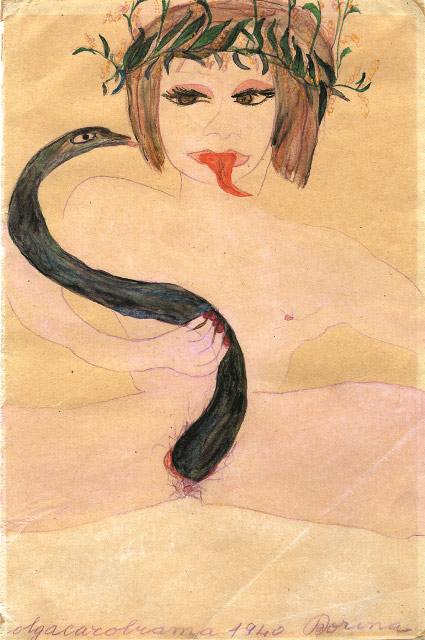
Dorina, 1940.


With an absolutely unique language, influenced by art brut, the informality, les Fauves, feminism and organic abstraction, Carol Rama (Turin, 1918) tries to challenge (with a long career of more than 70 years on active ) the traditional art narrative and the gender discourse itself, with a violent, subversive, sensual and polymorphic vision of art practice and of his own body. MACBA Museum it is not just "giving visibility to the work of Carol Rama" but joining her questions and doubts about the hegemonic concept of art and about the sensuality, the femenine symbol and the abjection. 

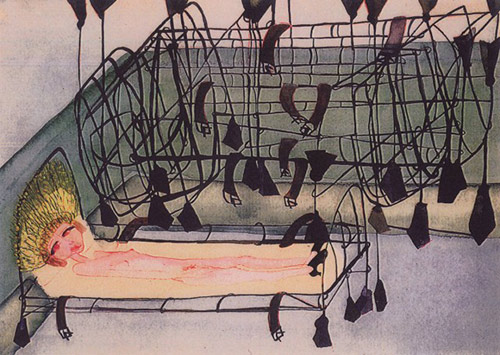
Apassionata, 1940.

In the 30s, Rama experiments with watercolors, lubricious, colors and stains to fill hundreds of papers with mutant nudes, tongues, genitals, eyes... with a work between psychoanalysis and the study the unconscious. After a long period, objects began to curdle in her work, ready mades, recycling, organic pieces, tires, nails, syringes, Arte Povera make her work even more pregnante ... more pornographic.

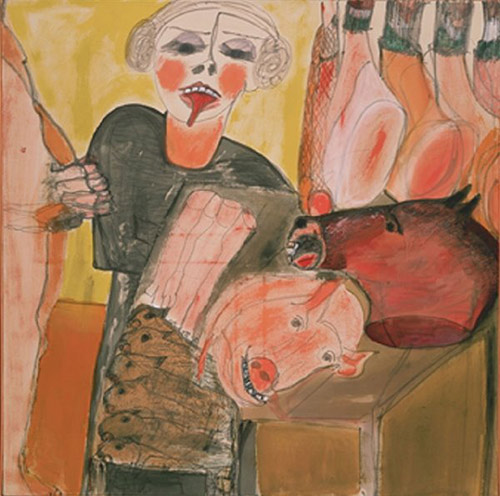
La Macelleria, 1980.


In the nineties, Carol Rama returns to figuration without losing their initial anger because, as she herself has stated on numerous occasions: "paint makes me free from the anguish suffered by what was happening to my family, transforming anguish in transgression... I was out. Contrary. Never lining up"

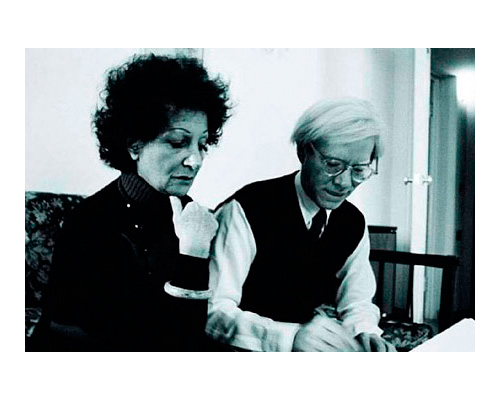
Carol Rama y Andy Warhol. Fotografía de Dino Petrali, 1975.

Curated by Teresa Grandas and Beatriz Preciado - feminist philosopher, specializing in Queer Theory and Philosophy of gender - the exhibition is an alternative file with wich you can correctly understand the history of art of the twentieth century as it is "an artist imperative to understand the mutations of representation in the twentieth century and the later work of artists like Cindy Sherman, Kara Walker, Sue Williams, Kiki Smith and Elly Strik ". 

Carol Rama has participated for several years in the Venice Biennale (1948, 1950, 1956, 1993) and in 2003 received the Golden Lion.


ART MADRID’26 INTERVIEW PROGRAM. CONVERSATIONS WITH ADONAY BERMÚDEZ


The work of Carmen Baena (Benalúa de Guadix, Granada, 1967) is structured as a poetic investigation into the memory of territory and its material translation into forms, textures, and gestures. Her practice stems from a life experience deeply connected to a specific landscape in southern Spain, understood not only as a geographical space but also as an affective and symbolic sedimentation. In this sense, her pieces can be approached from a perspective centered on direct experience: the landscape not as representation, but as a lived trace that emerges through doing.

Baena activates unique dialogue between historically hierarchical materials. Marble, associated with permanence and monumental tradition, coexists with embroidery, a technique linked to domestic knowledge passed down through generations, historically relegated but here reactivated as a fully-fledged artistic language. This coexistence is not presented as confrontation, but as a field of resonances where the solid and the fragile, the enduring and the tactile, interpenetrate. From a perspective attentive to connections, embodied experience, and knowledge constructed from everyday life, thread becomes a tool for sensitive knowledge.

Color, particularly in her textile works, functions as vibrational energy rather than a purely formal attribute. In contrast to the chromatic restraint of marble, embroidery introduces an open temporality in which intuitive gestures and accidents acquire structural value. Thus, the process becomes a space for listening, where the unexpected does not interrupt the work but rather constitutes it. In Carmen Baena’s practice, creating means allowing the territory—both external and internal—to continue transforming itself.


The Garden Blooms X. 2025. Acrylic and embroidery thread on canvas. 50 x 70 cm.


Your works evoke landscapes, reliefs, and topographies. How does the relationship between physical territory and symbolic or emotional territory articulate itself in your practice?

The physical territory where I was born and spent my early childhood has shaped all my work. I was born in a cave in the Guadix region (Granada), home to the largest complex of troglodyte dwellings in Europe.

The landscape there is full of contrasts: alongside the greens of the vega—fruit trees and poplars—you find the reddish ochres of the eroded hills. And facing the white of Sierra Nevada, the white of snow that still lingers in spring, there are also the greens of the wheat fields and cereal plains. Thanks to erosion and the geological layers that have been exposed over time, the area contains a series of strata that preserve extremely important continental geological records.

For this reason, the area has been designated a UNESCO Global Geopark. I spent a happy, very simple childhood in this environment—living closely connected to nature—and that is the territory that surfaces throughout the symbolism of my work.


Circular Horizons XIV. 2023. Acrylic and embroidery thread on canvas. 72 x 72 cm.


You learned embroidery in a family context, and you draw on the landscapes of your childhood. When did you realise that your immediate world—people, gestures, everyday landscapes—was no longer just a memory, but an active driving force in the construction of your artistic language?

I realised that the universe of my childhood was an active driving force in the construction of my artistic language thanks to a friend, after she visited my cave-house. Through her perspective, she made me aware of what I had been doing intuitively up until that point. This happened more than twenty years ago, and since then—even though I’m aware of it—I continue working.

I like working intuitively, and most of the time I only discover what the landscape has been afterwards. What stays with me is the sensation that inspired the piece once I have finished it.


Sea Breeze III. 2025. Acrylic and embroidery thread on canvas. 60 x 80 cm.


Marble carries historical and symbolic weight linked to monumentality, while embroidery is often associated with traditions that have been overlooked or confined to the domestic sphere. How do you negotiate this clash of cultural status in your work?

For years, marble was the material I was most interested in, and the one I used for most of my sculptural work. It wasn’t until 2007–2008 that I felt the need to incorporate embroidery—a technique I had learned as a teenager.

I began experimenting on paper, using stitching to draw landscapes and trees directly connected to the sculptures I was making at the time, and also working on small scraps of different kinds of paper. I explored the technical and visual possibilities of thread, creating small works in which colour, texture, and the thread’s vibration became the protagonists.

Later, I moved on to larger formats on canvas, where I also incorporated acrylic. These two seemingly contradictory practices—marble and embroidery—have coexisted in my studio and my work without any difficulty. Today, embroidery has completely displaced marble.


Between Heaven and Earth III. 2020. Marble and wood. 25 x 14 x 14 cm.


In your marble pieces, white and gold create an almost meditative atmosphere; in contrast, embroidery and acrylic burst into colour, activating gesture and vibration. Is this a conscious choice, or do the materials reveal their own possible colour to you?

With marble, the choice of white and gold is a conscious decision: I want to convey the spiritual atmosphere of the landscape, and the relationship between human beings and nature. By contrast, the explosion of colour in the thread emerged gradually and more intuitively, and only later did I begin to understand and use the possibilities of this material in a more conscious way.


Whisper Between the Lines XIII. 2023. Acrylic and embroidery thread on canvas. 40 x 60 cm.


To what extent do you plan your work, and how much space do you leave for the unexpected—or even for mistakes?

When it comes to making my work, I don’t like to plan too much. With embroidered pieces, I do tests on small scraps of paper—trying out colour and the stitch I’m going to use—and with that I try to visualise the final result in my mind. This way of working leaves plenty of space for things to happen while I work. It allows me to discover, learn, and make use of the unexpected.

For example, in some pieces, while embroidering, tangles can occur because the thread tension isn’t right or the thread is too loose. At first, those tangles might seem like they could ruin the piece, but when I see them, I realise they’re visually very interesting. So later I have consciously reproduced that effect in other works.