Art Madrid'26 – ART AGENDA FOR SUMMER’19: WHAT YOU CANNOT MISS THIS AUGUST

Summer is the ideal occasion to enjoy culture and art in a more relaxed way, outside the rush of the rest of the year. In addition to resting and regaining strength, it is good to take advantage of all the cultural activities scheduled at this time to help us stand the heat.

MADRID

Rogelio López Cuenca awaits us at the Reina Sofía Museum with the exhibition “Yendo leyendo, dando lugar”. This is the first monographic exhibition that the Centre dedicates to this creator of Nerja, obsessed with the power of language and plasticity that the message can adopt in its many forms and over time. From his beginnings in the 80s with collaborative works that merged different disciplines, until he changed direction in the mid-90s, becoming more reflective and critical with the system, López Cuenca shares his concern around essential topics for the individual of our time, such as the migratory flows, historical memory or urban speculation. Until August 26th.
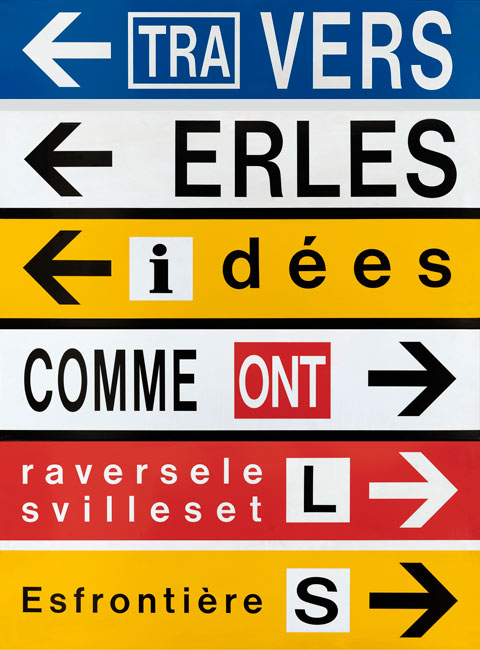
Rogelio López Cuenca, “Traverser”, 1986. Yñiguez Aragón Collection (via museoreinasofia.es)

SEVILLE

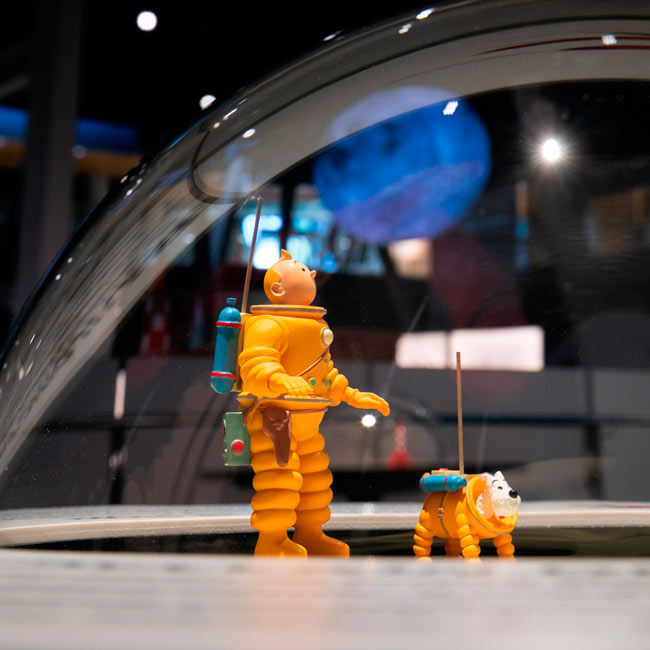
In 2019, the memorable trip to the Moon turns 50 years, a unique event that marked the history of events of the twentieth century. CaixaForum joins the commemorations with a funny and close exhibition about the work of Hergé and his famous character Tintin. Because Hergé was a visionary and, years before the first human-crewed mission left the planet, he had already put these charismatic protagonists in orbit. “Tintin and the Moon” covers a large part of the most famous and well-known space missions, in addition to planning a journey through the history of space exploration by the hand of Tintin and Milú. Until October 27th.
VALENCIA

Any occasion is a good moment to review the work of Fernando Léger, one of the parents of modernism. The IVAM, in collaboration with Tate Liverpool, organises this exhibition that brings together fifty pieces of the author, as well as videos, fabrics and murals, with which to take a tour of the trajectory of this Parisian creator. Besides, the exhibition revisits some key points of his artistic role and emphasises his profile of political criticism, being Léger, as he was, a staunch defender of the social function of art for all.
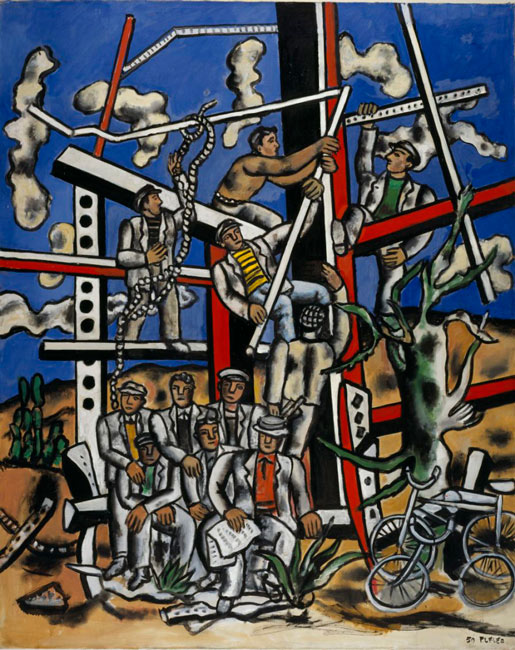
Fernando Léger, “Le tableau Les Constructeurs”, 1950

SANTIAGO DE COMPOSTELA

Media has extensively covered the refugee drama in recent years. However, the approach to the problem has sensationalist dyes that emphasise the drama of the experience lived by its protagonists and the catastrophic consequences of many failed trips. The CGAC of Santiago de Compostela brings together the work of about twenty contemporary artists under the curatorship of Piedad Solans and Santiago Olmo, in an exhibition that addresses this human conflict with a historical perspective and with less emphasis on the journalistic dissemination of the situation. Because societies and identities are also built on the basis of the flows of people. Exile has been, is and will be a great engine of cultural exchange and must be faced as a reality not exceptional, but purely human. "We refugees", until October 13th.
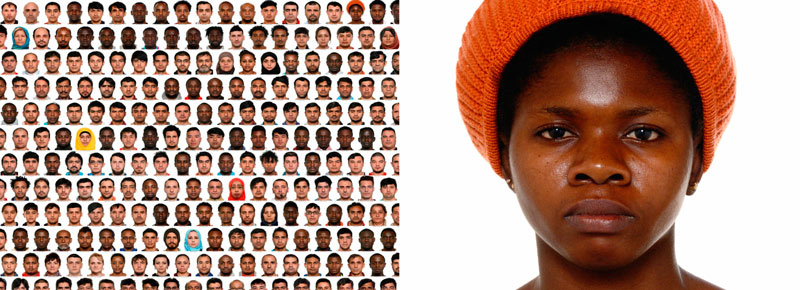
Roland Fischer, “Refugees”, 2016. (via cgac web, courtesy of the artist)

BARCELONA

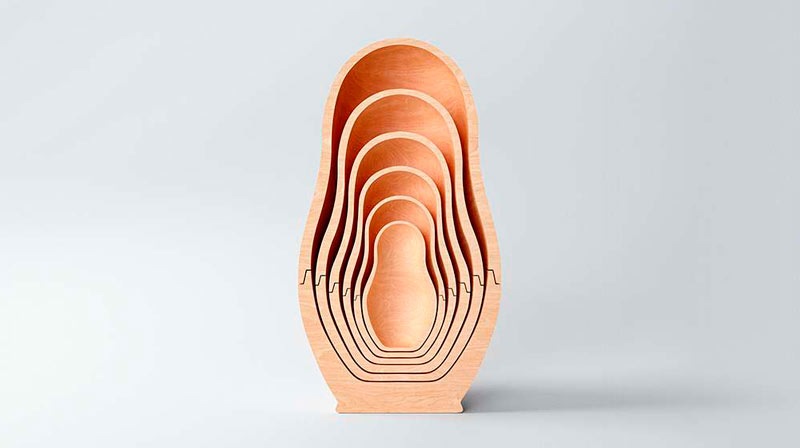
With educational vocation, the CCCB hosts the exhibition “Quantum”, a project that gathers the joint work of artists and scientists to facilitate the explanation of concepts related to quantum physics. The tour splits into two parts, on the one hand, the work of ten artists who introduce these notions in their work to demonstrate that quantum physics transcends the purely theoretical level of academicism, and, on the other, the development and results of nine research projects around this theoretical physics approach. The visitor faces a multitude of questions about our reality and the perception of the world in an enriching and different experience that will make us rethink the traditional postulates of the known. Until September 24th.
LEON

The exhibition “El giro notacional” of the MUSAC delves into the power of the notation systems in the different fields in which they apply, not only for academic purposes but also for reflection. The desire to limit something, to translate it into a universally understandable encrypted language is at the same time, a form of intervention that eliminates the arbitrariness and freedom of things that happen without a pre-established order. This collective exhibition brings together the work of a large group of artists under the curatorship of José Iges and Manuel Olveira. The route articulates around five main axes: the musical notation, the mathematical and scientific world, the notations of the kinetic movement, those of cartography and space and, finally, those of thought. Until September 15th.
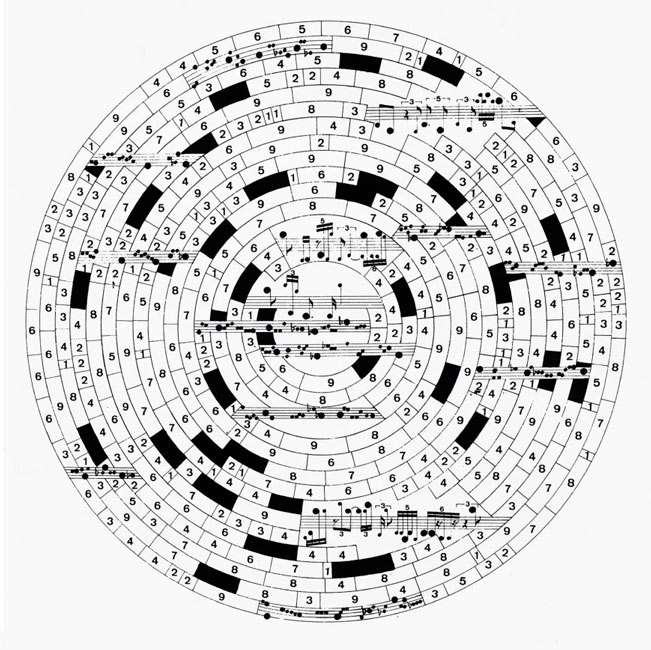
Josep Maria Mestres Quadreny, “Aronada”, 1971.


ART MADRID’26 INTERVIEW PROGRAM. CONVERSATIONS WITH ADONAY BERMÚDEZ


The painting of Daniel Bum (Villena, Alicante, 1994) takes shape as a space for subjective elaboration, where the figure emerges not so much as a representational motif but as a vital necessity. The repetition of this frontal, silent character responds to an intimate process: painting becomes a strategy for navigating difficult emotional experiences—an insistent gesture that accompanies and alleviates feelings of loneliness. In this sense, the figure acts as a mediator between the artist and a complex emotional state, linking the practice of painting to a reconnection with childhood and to a vulnerable dimension of the self.

The strong autobiographical dimension of his work coexists with a formal distance that is not the result of conscious planning, but rather functions as a protective mechanism. Visual restraint, an apparent compositional coolness, and an economy of means do not neutralize emotion; instead, they contain it, avoiding the direct exposure of the traumatic. In this way, the tension between affect and restraint becomes a structural feature of his artistic language. Likewise, the naïve and the disturbing coexist in his painting as inseparable poles, reflecting a subjectivity permeated by mystery and unconscious processes. Many images emerge without a clearly defined prior meaning and only reveal themselves over time, when temporal distance allows for the recognition of the emotional states from which they arose.


The Long Night. Oil, acrylic, and charcoal on canvas. 160 × 200 cm. 2024.


The human figure appears frequently in your work: frontal, silent, suspended. What interests you about this presence that seems both affirmative and absent?

I wouldn’t say that anything in particular interests me. I began painting this figure because there were emotions I couldn’t understand and a feeling that was very difficult for me to process. This character emerged during a very complicated moment in my life, and the act of making it—and remaking it, repeating it again and again—meant that, during the process, I didn’t feel quite so alone. At the same time, it kept me fresh and connected me to an inner child who was broken at that moment, helping me get through the experience in a slightly less bitter way.


Santito. Acrylic and oil on canvas. 81 × 65 cm. 2025.


There is a strong affective dimension in your work, but also a calculated distance, a kind of formal coldness. What role does this tension between emotion and restraint play?

I couldn’t say exactly what role that tension plays. My painting is rooted in the autobiographical, in memory, and in situations I have lived through that were quite traumatic for me. Perhaps, as a protective mechanism—to prevent direct access to that vulnerability, or to keep it from becoming harmful—that distance appears unconsciously. It is not something planned or controlled; it simply emerges and remains there.


Night Painter. Acrylic on canvas. 35 × 27 cm. 2025.


Your visual language oscillates between the naïve and the unsettling, the familiar and the strange. How do these tensions coexist for you, and what function do they serve in your visual exploration?

I think it reflects who I am. One could not exist without the other. The naïve could not exist without the unsettling; for me, they necessarily go hand in hand. I am deeply drawn to mystery and to the act of painting things that even I do not fully understand. Many of the expressions or portraits I create emerge from the unconscious; they are not planned. It is only afterwards that I begin to understand them—and almost never immediately. A considerable amount of time always passes before I can recognize how I was feeling at the moment I made them.


Qi. Acrylic on canvas. 81 × 65 cm. 2025.


The formal simplicity of your images does not seem to be a matter of economy, but of concentration. What kind of aesthetic truth do you believe painting can reach when it strips itself of everything superfluous?

I couldn’t say what aesthetic truth lies behind that simplicity. What I do know is that it is something I need in order to feel calm. I feel overwhelmed when there are too many elements in a painting, and I have always been drawn to the minimal—to moments when there is little, when there is almost nothing. I believe that this stripping away allows me to approach painting from a different state: more focused, more silent. I can’t fully explain it, but it is there that I feel able to work with greater clarity.


Crucifixion. Acrylic on canvas. 41 × 33 cm. 2025.


To what extent do you plan your work, and how much space do you leave for the unexpected—or even for mistakes?

I usually feel more comfortable leaving space for the unexpected. I am interested in uncertainty; having everything under control strikes me as rather boring. I have tried it on some occasions, especially when I set out to work on a highly planned series, with fixed sketches that I then wanted to translate into painting, but it was not something I identified with. I felt that a fundamental part of the process disappeared: play—that space in which painting can surprise even myself. For that reason, I do not tend to plan too much, and when I do, it is in a very simple way: a few lines, a plane of color. I prefer everything to happen within the painting itself.