Art Madrid'26 – SUNCITYBOY: THE EMPIRE OF THE EMOJI

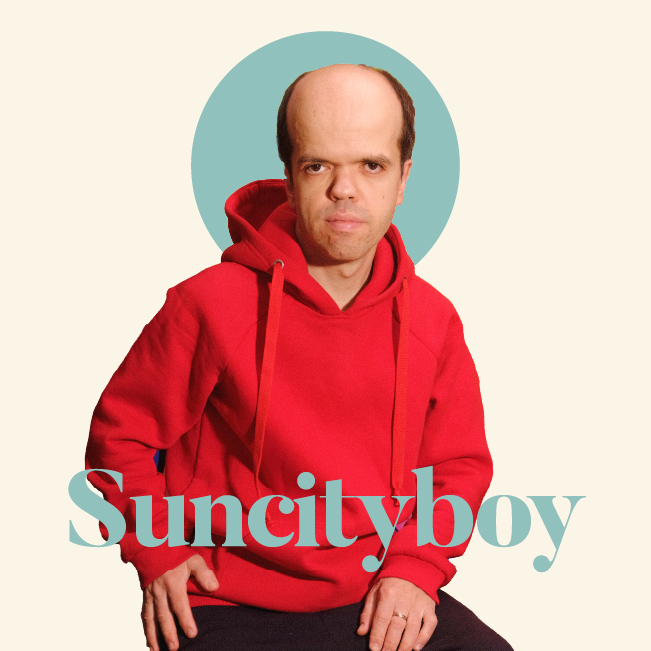
Suncityboy. Courtesy of the artist.

ARTE & PALABRA. CONVERSATIONS WITH CARLOS DEL AMOR

It is always difficult to create one's own universe, this complication increases when this universe is populated by characters known and recognized by all, who are part of the imagination of many, inventing on what already exists is doubly difficult. Suncityboy (Tver, Russia, 1984) has invented a world inhabited by fairy tale characters and cultural icons who share a common denominator: they are formed by small balls that assemble an impossible body with an emoji face and, despite the initial strangeness, immediately evoke empathy and familiarity.

Color overflows all its scenes and we meet Alice in Wonderland (or more precisely in Suncityboy's country), Dorothy in OZ, the seven dwarfs a bit changed or even a very particular interpretation of Vermeer's "Milkmaid". But they all stop being them to enter a new life where humor, irony, acidity and a huge dose of energy renew our view on things, theoretically very seen. From Marilyn to the birth of Venus, everything is susceptible to be "rounded" and to provoke a smile in us. If we have to choose between the angry emoji or the smiley emoji, his works will make us send the smiley emoji, and that is to be appreciated.
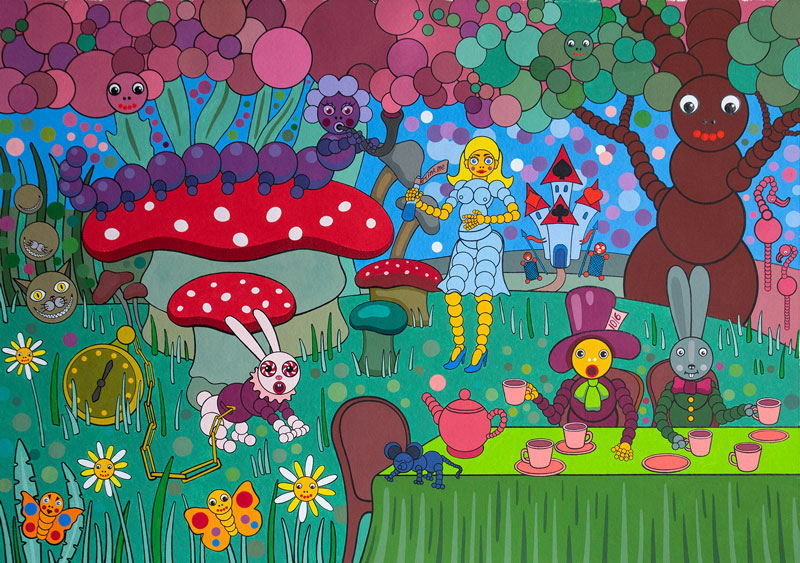
Aliceâs Adventures in Wonderland.Tinta y témpera sobre papel.2023.

How would you define your art in one word? Or better in an emoji.

It’s joy.

What is your favorite emoji?

This smiley (the artist points towards a painting behind himself).

What are the requirements for the characters of stories or famous works that you endow with a new life? What should they suggest to you or how do they reach you?

My characters are funny, many of them want to get into my pictures. From the world of Plato's ideas, heroes go to different outdoors, but almost all of them want to get to me. They take a turn and they are waiting for me to capture them. Not all of them, of course, because I'm a very busy person. I create new meanings for the characters: they stop living in everyday life. I think they are much more interested in the spherical world than in their non-spherical world. I can say, sure, I don't force anyone. If the hero doesn't like it, I don't keep him. I respect their rights.
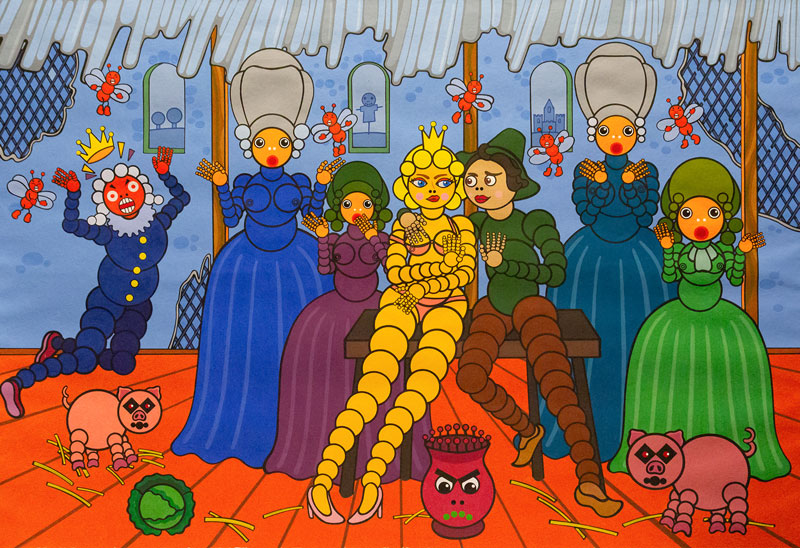
Svinedrengen. Gouache on paper. 2023.

Why the spherical, the round?

The sphere is a symbol of the universe. We all encounter spheres and circles in everyday life. Circles and spheres are the main form of my paintings. These are the stars in the sky, the atoms from which everything is made, and even money, the coins with which we pay took their form in the process of evolution, because everything tends towards the sphere. My task is to speak the language of spherism, to promote this knowledge to the people.

It was not for nothing that Hokusai wrote in his lost letter to Hiroshige on the road from Rome to Edo to Kyoto, "Suncityboy, if the future embodiment of world spherism, the personification of modernism through imaginism.”

The letter was stolen from his workshop because it had value for world culture.

Do we take everything too seriously?

The seriousness of our world is evidenced by the constant dispute of objects and forms in composition. We must understand that everything is much more serious than we think. There is a constant confrontation between forms. Circles have always competed with triangles for the main rights in composition. We see this in the images of ancient Egypt. Then they were joined by squares. A square character often creeps into my paintings. He tries to dispute the spherical harmony. But, to his great regret, he makes the composition more successful. You just have to look for it.
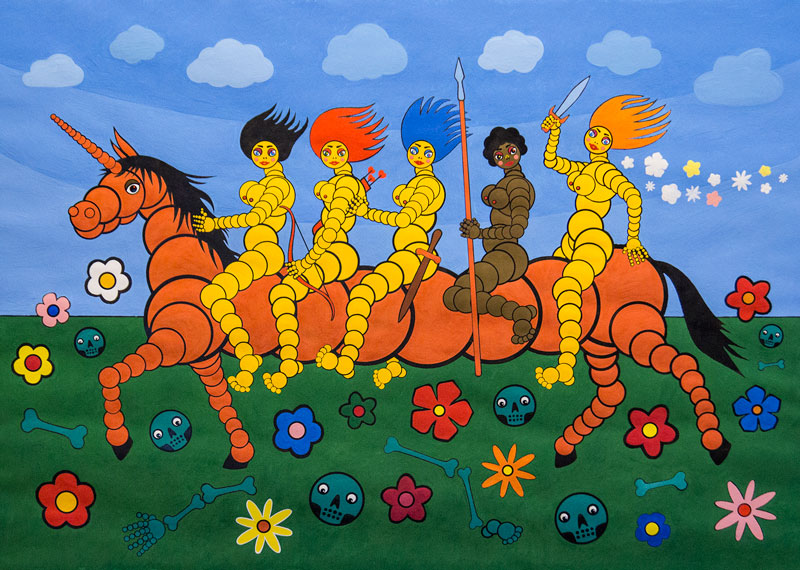
Amazons. Gouache on paper. 2023.

Drama or comedy?

The subjects of the paintings of spherical imaginism show the relationship of particles, shapes, and ideas. Characters can be both the meaning and the category of cognition. This is similar to the metamorphosis of temporary spatial transformations, when a character becomes an object and nature becomes a thing. This is the drama of the works. But at the same time, it's also comical because of this metaphor.
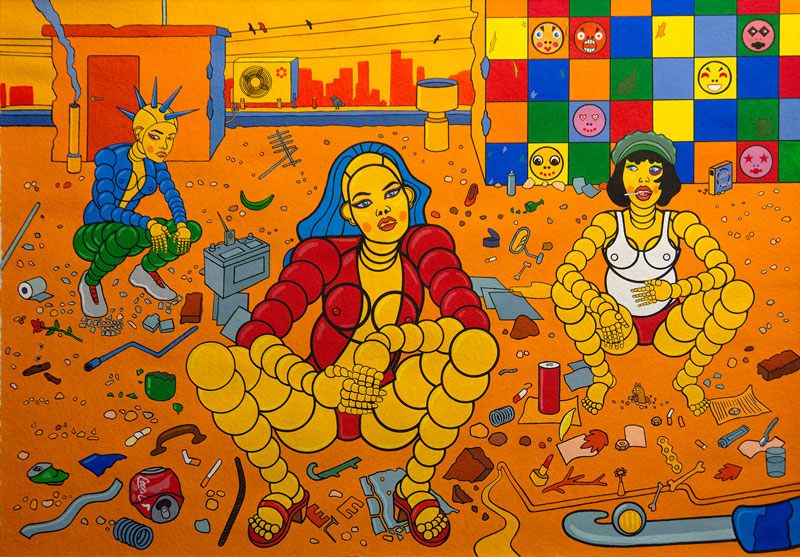
Roof Girls. Gouache on paper. 2023.

What role does music play in your creative process, I understand it is important.

Music is a circle of vinyl. It penetrates into all beings like neutrinos. Without music, it's difficult to achieve a good result. If you don't have a music player, you need to add something of yourself with your inner feeling.

You can imagine yourself with a large cello or saxophone. Music is the building material of creativity. In my case, these are bright-colored construction balls. Sometimes they turn into caramels.

Where is your art going (You can answer with an emoji if you wish) 😉

My art is moving into the future. It looks like a large spherical airplane. On board are my favorite heroes. I will appear as captain sometime during the flight. I walk between the isles and serve them drinks and treats. I think you can see this for yourself.

Thank you very much, Carlos. 😉


ART MADRID’26 INTERVIEW PROGRAM. CONVERSATIONS WITH ADONAY BERMÚDEZ


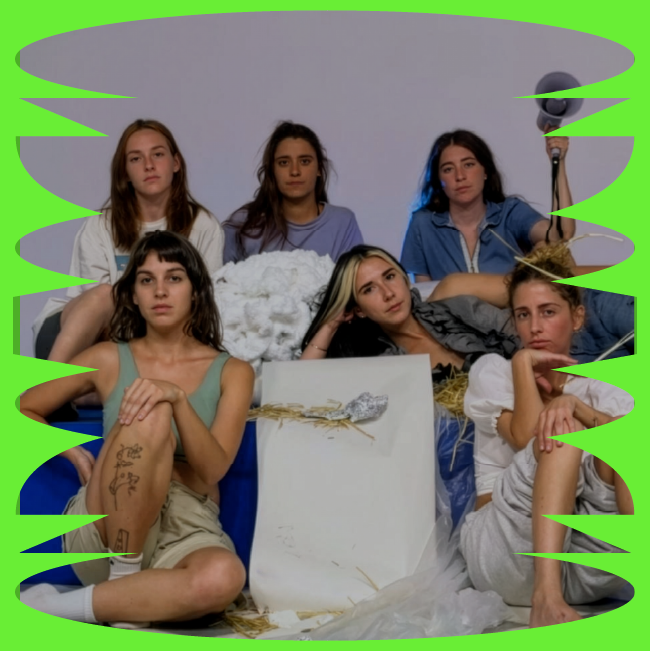
The practice of the collective DIMASLA (Diana + Álvaro) is situated at a fertile intersection between contemporary art, ecological thinking, and a philosophy of experience that shifts the emphasis from production to attention. Faced with the visual and material acceleration of the present, their work does not propose a head-on opposition, but rather a sensitive reconciliation with time, understood as lived duration rather than as a measure. The work thus emerges as an exercise in slowing down, a pedagogy of perception where contemplating and listening become modes of knowledge.

In the work of DIMASLA (Diana + Álvaro), the territory does not function as a framework but rather as an agent. The landscape actively participates in the process, establishing a dialogical relationship reminiscent of certain eco-critical currents, in which subjectivity is decentralized and recognized as part of a broader framework. This openness implies an ethic of exposure, which is defined as the act of exposing oneself to the climate, the elements, and the unpredictable, and this means accepting vulnerability as an epistemological condition.

The materials—fabrics, pigments, and footprints—serve as surfaces for temporary inscriptions and memories, bearing the marks of time. The initial planning is conceived as an open hypothesis, allowing chance and error to act as productive forces. In this way, the artistic practice of DIMASLA (Diana + Álvaro) articulates a poetics of care and being-with, where creating is, above all, a profound way of feeling and understanding nature.


In a historical moment marked by speed and the overproduction of images, your work seems to champion slowness and listening as forms of resistance. Could it be said that your practice proposes a way of relearning time through aesthetic experience?

Diana: Yes, but more than resistance or vindication, I would speak of reconciliation—of love. It may appear slow, but it is deliberation; it is reflection. Filling time with contemplation or listening is a way of feeling. Aesthetic experience leads us along a path of reflection on what lies outside us and what lies within.


The territory does not appear in your work as a backdrop or a setting, but as an interlocutor. How do you negotiate that conversation between the artist’s will and the voice of the place, when the landscape itself participates in the creative process?

Álvaro: For us, the landscape is like a life partner or a close friend, and naturally this intimate relationship extends into our practice. We go to visit it, to be with it, to co-create together. We engage in a dialogue that goes beyond aesthetics—conversations filled with action, contemplation, understanding, and respect.

Ultimately, in a way, the landscape expresses itself through the material. We respect all the questions it poses, while at the same time valuing what unsettles us, what shapes us, and what stimulates us within this relationship.


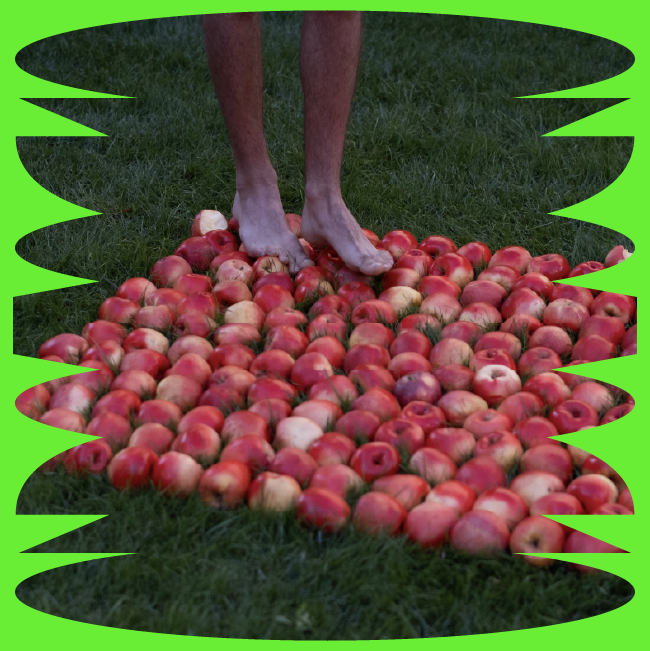
The Conquest of the Rabbits I & II. 2021. Process.


In your approach, one senses an ethic of exposure: exposing oneself to the environment, to the weather, to others, to the unpredictable. To what extent is this vulnerability also a form of knowledge?

Diana: For us, this vulnerability teaches us a great deal—above all, humility. When we are out there and feel the cold, the rain, or the sun, we become aware of how small and insignificant we are in comparison to the grandeur and power of nature.

So yes, we understand vulnerability as a profound source of knowledge—one that helps us, among many other things, to let go of our ego and to understand that we are only a small part of a far more complex web.


Sometimes mountains cry too. 2021. Limestone rockfall, sun, rain, wind, pine resin on acrylic on natural cotton canvas, exposed on a blanket of esparto grass and limestone for two months.. 195 cm x 130 cm x 3 cm.


Your works often emerge from prolonged processes of exposure to the environment. Could it be said that the material—the fabrics, the pigments, the traces of the environment—acts as a memory that time writes on you as much as you write on it?

Álvaro: This is a topic for a long conversation, sitting on a rock—it would be very stimulating. But if experiences shape people’s inner lives and define who we are in the present moment, then I would say yes, especially in that sense.

Leaving our comfort zone has led us to learn from the perseverance of plants and the geological calm of mountains. Through this process, we have reconciled ourselves with time, with the environment, with nature, with ourselves, and even with our own practice. Just as fabrics hold the memory of a place, we have relearned how to pay attention and how to understand. Ultimately, it is a way of deepening our capacity to feel.


The fox and his tricks. 2022. Detail.


To what extent do you plan your work, and how much space do you leave for the unexpected—or even for mistakes?

Diana: Our planning is limited to an initial hypothesis. We choose the materials, colours, places, and sometimes even the specific location, but we leave as much room as possible for the unexpected to occur. In the end, that is what it is really about: allowing nature to speak and life to unfold. For us, both the unexpected and mistakes are part of the world’s complexity, and within that complexity we find a form of natural beauty.