Art Madrid'26 – ARTISTS IN THE ANTIPODES

From Taiwan to Brazil and from Ecuador to Thailand

More than 200 artists represented by 41 galleries make up the general program of this edition of Art Madrid. During the fifteen years of the fair, the international presence of both artists and galleries has increased to 40% of the total.

Artists have come from Cuba, Venezuela, the United States, South Africa, Algeria, Iran, Taiwan, Brazil, Argentina... and dozens of countries that have participated in Art Madrid over the years.

In this edition we have such a variety of artists from faraway countries that we have found the line of the antipodes among several of them.

Mu Pan, Taiwan. Represented by Galerie LJ

Mu Pan describes his work as "simply about telling stories " In his intricate battle scenes, human figures, beasts and strange mixtures of the two come together in epic life-and-death struggles. In his "origaMU" paper sculptures, colorful creatures take on a 3D form. The artist is "a creator of worlds" as he puts it. He portrays critical stories full of details taken to the extreme, entering into an art where references to literary, political and cultural stories are intermingled.
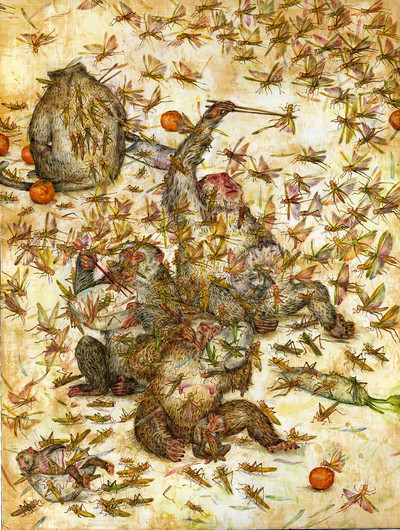
Mu Pan

Locusts, 2015

Acrílico sobre panel de madera

121 x 91cm

Mu Pan of Taiwanese origin studied Art at the School of Visual Arts in New York, where he now teaches illustration. During the past 2019 the collection SOLO welcomed part of this peculiar world in which one can get lost for hours discovering in every detail and in every corner of the painting something new.

With a critical and incisive look, but without losing his sense of humour and irony, the author captures in his paintings everything that displeases him, such as racism, violence or lies, and puts both the present time and nature in focus.

His artworks reflect the many cultural influences to which he has been exposed, from Chinese literature to superheroes, from ukiyoe to cinema and comics. To contemplate a work of Mu Pan is to soak up action, dynamism and energy through his meticulously constructed battles. His paintings have an extreme degree of detail that is reminiscent of the paintings of El Bosco, with connotations of the end of the world, hybrid characters, half man, half animal, on the verge of caricature, as well as epic scenes in which he mixes references to current events and manga culture. Mu Pan's work is a pretext to highlight everything that displeases him: violence, conflict or lies, which he captures in his paintings in the key of anger and humour. In the artist's words: "Drawing and painting are for me the most obvious ways to claim justice". Global warming, racism, classism or the trade wars between superpowers serve as inspiration for this artist who puts current events and human nature in the spotlight.
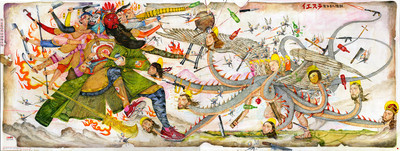
Mu Pan

Jesura The Holy Kaiju, 2019

Acrílico sobre panel de madera

92 x 243cm

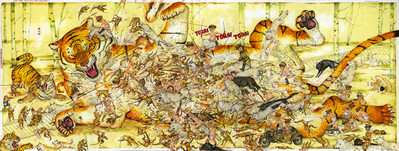
Mu Pan

Tiger, 2017

Acrílico sobre panel de madera

92 x 243cm

Chen Yun, Taiwan. Yiri Arts Gallery

Chen Yu's drawings have evolved from horizontal to vertical constructions, a compositional style that grows upwards, visually exploring the dimensional and psychological impact. Behind this methodically planned composition, and as in poetry, there are clues that allude to time and reality. With scenes in fixed camera, a detailed shot on one side, the silhouette of a woman on the opposite side, an image full of symbolism... Chen acts as a guide, carrying a weak light that accompanies the viewer into the depths of memory.

Chen Sheng-Wen studied Visual Communication Design at National Yunlin University in Taiwan. He has had several solo and group exhibitions in Taiwan and Japan. He has been awarded with Taipei Free Art Fair, Huashan 1914 Taipei.
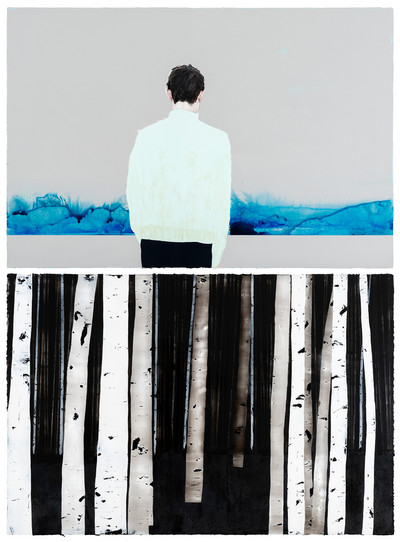
Chen Yun

Indigo. The light from the forest shine on the blue ocean, 2018

Ácrilico sobre lienzo (2 piezas)

130 x 194cm

Lai Wei-Yu, Taiwan. Yiri Arts Gallery

The artist Lai Wei-Yu takes seemingly absurd situations and explores them with childlike amazement. However, in the dark corners we can also glimpse the frustration and desolation of life. Lai Wei-Yu studied at the MFA Institute of Arts in Taiwan. His artwork has been shown in several individual and collective exhibitions and is also present in public collections such as that of the National Museum of Fine Arts in Taiwan.
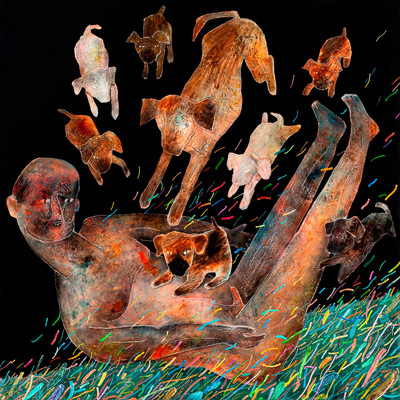
Lai Wei-Yu

My Family, 2018

Acrylic and charcoal on canvas

160 x 160cm

Paul Rosero Contreras (Quito, 1982). Más arte Galería

Paul is a conceptual artist who works with scientific information, speculative realism and different fictional narratives. His work explores issues related to geopolitics, environmental problems and the relationship of humans in extreme ecosystems. Rosero received an MFA from the California Institute of Arts - CalArts and an Interdisciplinary Master's Degree in Cognitive Systems and Interactive Media from Pompeu Fabra University in Barcelona. Her work has received national and international awards and has been widely exhibited at the 57th Venice Biennale, Antarctic Pavilion, Italy, at the 5th Moscow Biennale of Young Art, at the Quai Branly Museum in Paris, France, at the Cervantes Institute in Rome, Italy, at the Museum of History in Zaragoza, Spain, the H2 Art Center in Augsburg, Germany, at the 11th Moscow Biennale of Young Art. Biennial of Cuenca, Ecuador, in Import Projects, Berlin, Germany, in the 1st Antarctic Biennial, in the 1st Southern Biennial in Argentina, in the SIGGRAPH 2017 in Los Angeles, among others. Rosero teaches and researches at the Universidad San Francisco de Quito.
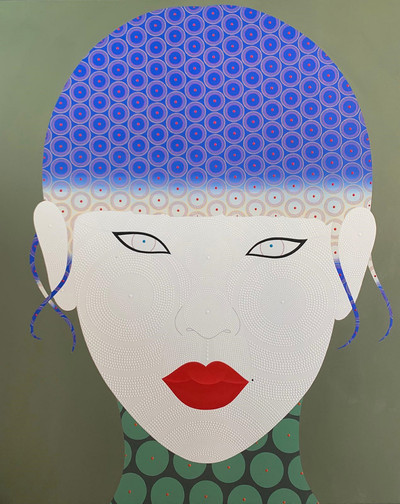
Chamnan Chongpaiboon

Girl, 2019

Acrylic on canvas

120 x 100cm

Chamnan Chongpaiboon, Thailand. Soraya Cartategui

Chamnan Chongpaiboon is part of the new generation of young Thai artists. He attended the Faculty of Fine Arts in Shupanburi and obtained his Bachelor of Fine Arts with a major in Printmaking from the King Mougkut Institute of Technology in Ladkrabang.

Chamnan artworks with an innovative graphic style, under the modern bases of multimedia art and Japanese printing forms. His inspiration is closely linked to artists such as the Japanese Yayoi Kusama (1929, Matsumoto, Japan) whose work revolves around psychedelia, repetition and patterns. Her artistic production is limited due to the artist's meticulous work in making each piece. He is an artist with a great international career. Among the countries and cities where he has exhibited his pieces we find Australia, London, New York, Malaysia, Hong Kong, Jakarta, Miami, Singapore, etc.

Eduardo Marco, Porto Alegre (Brazil). Zielinsky Gallery

The artistic envoy that moves this photographer is the concern to clear up what is hidden from the common gaze; to reveal in its most literal sense what is apparently insignificant, but which the artist's gaze makes us perceive as a harmonic, igniting in us the spark of enthusiasm. In this process, Marco's honesty does not carry the heavy burden of theoretical assumptions; it is given without learned dogmas. Marco's gaze rescues the pristine beauty of the lotus lit in the mud puddle. He has participated in many projects in different parts of the world, such as China and Brazil.

Nina Franco. Rio de Janeiro (Brazil), Paulo Nunes Arte Contemporânea

The work of the visual artist Nina Franco leads us into the depths of contemporary socio-political conflicts. She has had two solo exhibitions presenting her main series: "Soul Black" in Brazil and "Let Me Scream" in Ireland, as well as several group exhibitions in Brazil, Ireland, Greece and the United Kingdom.
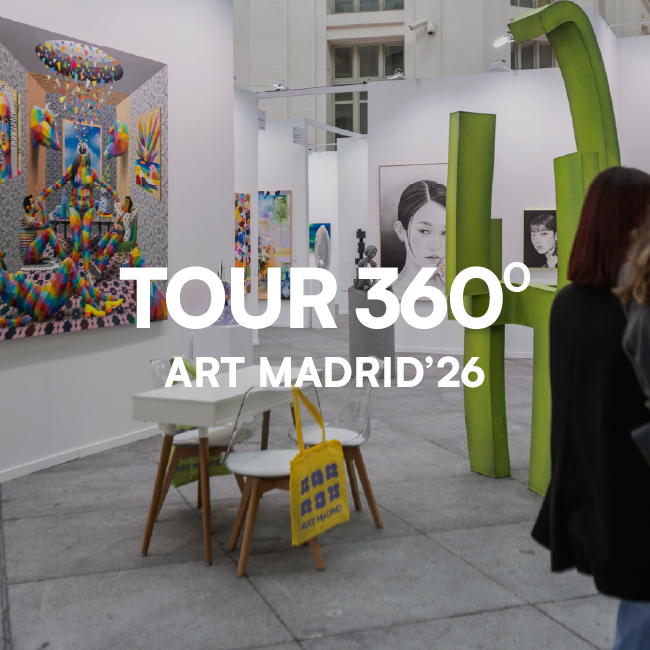
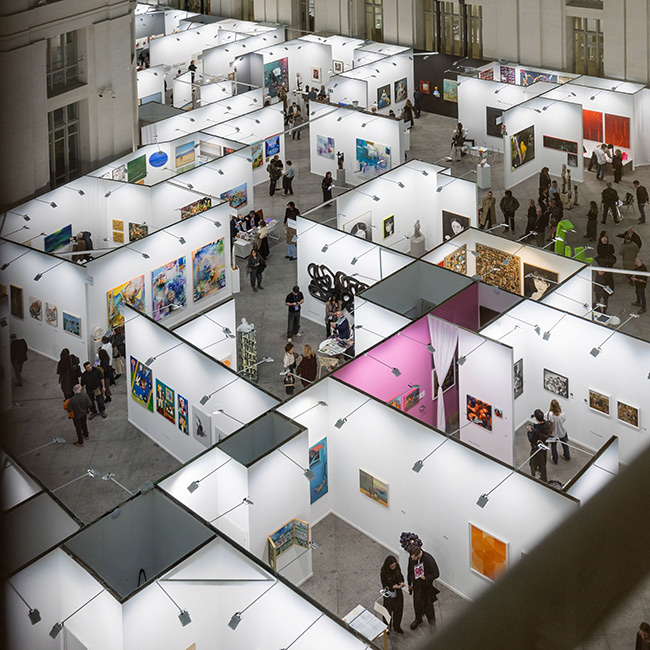
Each edition of Art Madrid is, above all, an exercise in observation. Rather than a closed declaration of intent, it functions as a space where different artistic practices coexist and enter into dialogue, reflecting the moment in which they are produced. In 2026, the fair reaches its 21st edition, consolidating an identity grounded in plurality, close attention to artistic practice, and the coexistence of diverse languages within a shared curatorial framework.


Simone Theelen. Dream Botanic. 2023. Mixed media on leather. 160 × 140 cm. Uxval Gochez Gallery.


In this context, Art Madrid’26 does not present a single dominant aesthetic or a unified narrative. What unfolds in the Galería de Cristal of the Palacio de Cibeles is a broad and varied landscape, shaped by the proposals of national and international galleries working with artists whose practices respond—each from very different positions—to shared questions: how to continue producing images, objects, and discourses in a saturated context; how to engage with tradition without becoming trapped by it; and how to make the contemporary visible without falling into the ephemeral.

This text offers a reading of the aesthetic currents running through the fair, understood not as closed categories but as lines of force. These currents help to clarify what visitors will encounter and from which coordinates a significant part of contemporary artistic production is emerging today. This approach is rooted in one of Art Madrid’s core principles: respecting the DNA of each exhibitor while fostering a plural creative ecosystem capable of reflecting the richness and diversity of the current artistic landscape.


Sergio de la Flora. La cena. 2022. Oil on canvas. 120 × 120 cm. Inéditad Gallery.


One of the most consistent features of Art Madrid’26 is the attention paid to materiality. Painting, sculpture, and works on paper are presented as spaces where material is not merely a support, but an active element within the discourse itself. Many of the works draw on traditional techniques—oil, acrylic, graphite, ceramic, or wood—but are approached with a fully contemporary awareness. Surfaces become sites of accumulation, erosion, sheen, or density. Gestures remain visible, and the construction of the work is embraced as an essential part of each artistic language.

This emphasis on materiality does not stem from nostalgia for craftsmanship, but from a desire for presence. In contrast to the relentless circulation of digital images, these works demand time, close viewing, and physical attention. Rather than seeking immediate impact, they invite a slower and more sustained relationship with the viewer.


Ana Cardoso. Ser Casa #2. 2025. Acrylic on MDF. 78 × 100 cm. Galeria São Mamede.


Painting occupies a central place within the fair, though it does so from highly diverse positions. This is not a return to academic models, nor a rejection of contemporaneity, but an expanded understanding of painting—open to the incorporation of other materials and visual languages. Works appear in which oil coexists with spray paint, collage, resins, or graphite; surfaces where the pictorial merges with the object-based; images that move between abstraction, fragmented figuration, and symbolic reference. Painting is understood here as a flexible field, capable of absorbing influences from urban art, design, photography, and archival practices. For visitors, this results in a journey where painting is not presented as a homogeneous language, but as a territory of constant exploration shaped by varied and enriching formal decisions.


Mario Soria. My Candy House. 2024. Oil on canvas mounted on panel. 59 × 50 cm. Aurora Vigil-Escalera.


Rather than fading away, art history emerges at Art Madrid’26 as an active working material. Some proposals engage directly with classical iconographies or traditional genres such as portraiture, still life, or historical scenes, but do so from a critical and displaced perspective.

These works do not aim to reproduce past models. Instead, they place them under tension by altering context or scale, introducing unexpected elements, or foregrounding aspects that today appear problematic or revealing. Tradition is approached not as a fixed canon, but as an open archive—one that can be revisited, questioned, and rewritten. This dialogue resonates both with viewers who recognize historical references and with those who encounter them through a contemporary lens, aware that images of the past continue to shape how we understand the present.


Yasiel Elizagaray. From the Liminal series, No. 1. 2025. Mixed media on canvas. 170 × 150 cm. Nuno Sacramento Arte Contemporânea.


Another defining thread of Art Madrid’26 is the dissolution of boundaries between disciplines. Many works resist classification within a single category, operating simultaneously as painting and object, sculpture and drawing, image and structure.

This hybridity reflects a contemporary context in which artistic languages no longer function in isolation. The resulting works call for open-ended readings, where form, material, and idea interact without fixed hierarchies, encouraging viewers to navigate meaning through experience rather than predefined frameworks.


Faustino Ruiz de la Peña. Lope. 2025. Oil, pencil and pigment. 31 × 27 cm. Galería Arancha Osoro.


Drawing and works on paper hold a significant presence in this edition. Far from being understood as preparatory or secondary, many of these pieces function as autonomous works—precise, deliberate, and conceptually robust.

Through lines, grids, voids, and repetitions, artists construct images that explore territory, memory, architecture, and the body. An economy of means does not diminish complexity; instead, paper becomes a space for visual thinking, where the passage of time and the trace of gesture are clearly registered. These works introduce a slower rhythm into the fair, inviting moments of pause and attentive observation.


Prado Vielsa. Haz de luz 2502. 2025. Digital print on folded transparent cast acrylic. 29 × 27 × 23 cm. Carmen Terreros Gallery.


Sculpture occupies an especially meaningful position at Art Madrid’26, situated between the organic and the structural, and between artisanal processes and industrial solutions. The use of recycled wood, ceramics, metals, and synthetic materials is not merely technical, but conceptual—prompting reflection on materiality, time, and transformation.

These pieces emphasize form, balance, and spatial relationships, understanding sculpture as a body that engages in dialogue with its environment and with the physical presence of the viewer. Often presented as symbolic objects rather than narrative devices, they activate open fields of association where meaning emerges through experience rather than explanation.


Reload. Blond Ambition. 2025. Pink, black and white marble. 62 × 32 × 12 cm. LAVIO.


Alongside more gestural and material-based approaches, the fair also includes works grounded in geometry, pattern, and structure. Built upon precise visual systems, these pieces employ repetition, symmetry, and modulation to generate rhythm and tension. They offer a counterpoint of restraint and formal control within the broader context of the fair, expanding the aesthetic spectrum and underscoring the diversity of contemporary artistic approaches.

Many of the works presented articulate non-linear narratives composed of symbols, cross-references, and deliberately ambiguous spaces. Rather than offering closed stories or singular interpretations, they function as open images—points of activation that invite interpretive engagement.

This approach reflects a contemporary sensibility that challenges the notion of fixed meaning, shifting part of the responsibility for interpretation onto the viewer. The artwork becomes a space of negotiation, where memory, experience, and perception actively shape understanding.


MINK. CRISTATUS – Ambition. 2025. Spray paint on wood. 120 × 106 cm.La Mercería.600:800


The body of work brought together in this edition reveals a sustained engagement with matter as a site of reflection and meaning-making. In the face of increasingly rapid and dematerialized modes of production, these works reaffirm the value of material support, process, and time as fundamental elements of artistic practice. This shared orientation does not define a single aesthetic, but establishes a common ground where diverse practices converge around the need to anchor artistic experience in the tangible and the constructed. Within this context, Art Madrid consolidates itself as a meeting space where contemporary art is presented with critical awareness, rigor, and clarity—fostering an active relationship between artwork, artist, and audience.