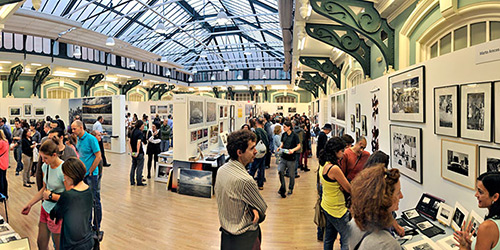
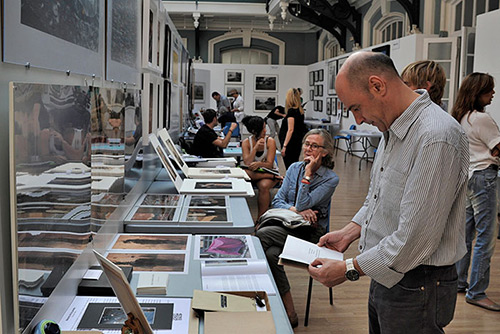
Art Madrid'26 – Entrefotos phtotography fair helds it\'s XVI edition in La Casa del Reloj (Matadero Madrid)

The slogan with which this fair defines itself immediately reveals the intention of the organizers. This is an event that promotes the encounter and dialogue as equals between buyer-visitor and photographer-artist. The idea is to create a forum for direct communication, "without intermediaries", where the artist, omnipresent beside his work, has the opportunity to explain their work and the spirit of his creations, and the visitor has the opportunity to see face to face the artist hand, his/her intimate and personal universe.


The idea began 16 years ago, when the founders of the initiative detected a lack of more open and communicative proposals in the Spanish market. The enhancement of the photo seemed to require not only a recognition by the public, but also to promote discussion and exchange circles to reflect on this technique and contribute to generate a constructive discourse in dialogue with the visitor. And so, in 1998, Luis Baylon, José María Díaz-Maroto, Evaristo Delgado and Pasquale Caprile, at the study of the latter, in Madrid, decided to create EntreFotos. This enthusiastic quartet tried to emulate in our country the photography encounters that were spreading through Europe, and publicize the author photography. Today, after 16 years of uninterrupted call, the show continues to respond to the original idea with which was born.


EntreFotos is a gathering of four days devoted to photography and its creators, where all the curious, passionate, unbelievers and skeptics are welcome. Purchase invitations and other indecent proposals will be accepted. This edition features the participation of 35 artists, selected by an independent committee: Beroiz Pérez de la Rada, Alberto Espinosa, Andreas Strobel, Angelica Sole De La Llave, Carlos Regueira, Cristina Esteban Briones, Elena García Guerrero, Gert Voor in't Holt, Iris Encina, Jesus Botaro, Jorge Flores, Julian Ochoa, José Luis López Moral, José Luis Núñez, Juanma Vidal, Juan Sande, Laura Len, María Antonia García de la Vega, Oscar Rivilla, Ariza Pedro Gonzalez, Pepe Huelves, Pilar Pequeño, Ramon Fernandez Rafer Barcia, Rebecca Lebron, Rubén García, Soledad Pulgar, Tino Garcia, Valme de Toledo, Masaur, Maite Sánchez Urueña, Labandeira Jesús Gómez, Xavier Mollà i Revert and Zdenek Tusek. In addition, the exhibition offer is completed with a program of activities which foresees book signings, awards and the chance to see live the process of photographic portrait of the artist's hand Xavier Gómez.

Another point of reference in EntreFotos is the fair's prize in recognition of a career that each year awards to an author of reference. This time the winner is José Luis Mur who is also a photographer, was a founder of Fotocasión mid 70s, in the wake of Madrid, establishment landmark dedicated to the world of photography and is now one of the largest devoted to this discipline in Europe shops.
 
EntreFotos opens this Thursday, November 27th, at 18:30 and will be open until Sunday 30 at the Sala La Lonja de la Casa del Reloj of Matadero Madrid.
 
More information:
Programme (http://www.entrefotosferia.com/#!programa/c1543)


ART MADRID’26 INTERVIEW PROGRAM. CONVERSATIONS WITH ADONAY BERMÚDEZ


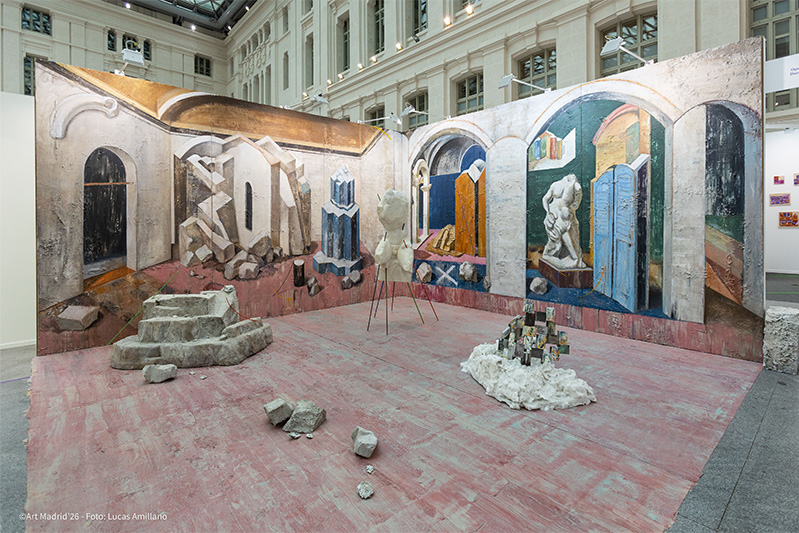
The work of Cedric Le Corf (Bühl, Germany, 1985) is situated in a territory of friction, where the archaic impulse of the sacred coexists with a critical sensibility characteristic of contemporary times. His practice is grounded in an anthropological understanding of the origin of art as a foundational gesture: the trace, the mark, the need to inscribe life in the face of the awareness of death.

The artist establishes a complex dialogue with the Spanish Baroque tradition, not through stylistic mimicry, but through the emotional and material intensity that permeates that aesthetic. The theatricality of light, the embodiment of tragedy, and the hybridity of the spiritual and the carnal are translated in his work into a formal exploration, where underlying geometry and embedded matter generate perceptual tension.

In Le Corf’s practice, the threshold between abstraction and figuration is not an opposition but a site of displacement. Spatial construction and color function as emotional tools that destabilize the familiar. An open methodology permeates this process, in which planning coexists with a deliberate loss of control. This allows the work to emerge as a space of silence, withdrawal, and return, where the artist confronts his own interiority.


The Fall. 2025. Oil on canvas.195 × 150 cm.


In your work, a tension can be perceived between devotion and dissidence. How do you negotiate the boundary between the sacred and the profane?

In my work, I feel the need to return to rock art, to the images I carry with me. From the moment prehistoric humans became aware of death, they felt the need to leave a trace—marking a red hand on the cave wall using a stencil, a symbol of vital blood. Paleolithic man, a hunter-gatherer, experienced a mystical feeling in the presence of the animal—a form of spiritual magic and rituals linked to creation. In this way, the cave becomes sacred through the abstract representation of death and life, procreation, the Venus figures… Thus, art is born. In my interpretation, art is sacred by essence, because it reveals humankind as a creator.


Between Dog and Wolf II. 2025. Oil on canvas. 97 × 70 cm.


Traces of the Spanish Baroque tradition can be seen in your work. What do you find in it that remains contemporary today?

Yes, elements of the Spanish Baroque tradition are present in my work. In the history of art, for example, I think of Arab-Andalusian mosaics, in which I find a geometry of forms that feels profoundly contemporary. In Spanish Baroque painting and sculpture, one recurring theme is tragedy: death and the sacred are intensely embodied, whether in religious or profane subjects, in artists such as Zurbarán, Ribera, El Greco, and also Velázquez. I am thinking, for example, of the remarkable equestrian painting of Isabel of France, with its geometry and nuanced portrait that illuminates the painting.

When I think about sculpture, the marvelous polychrome sculptures of Alonso Cano, Juan de Juni, or Pedro de Mena come to mind—works in which green eyes are inlaid, along with ivory teeth, horn fingernails, and eyelashes made of hair. All of this has undoubtedly influenced my sculptural practice, both in its morphological and equestrian dimensions. Personally, in my work I inlay porcelain elements into carved or painted wood.


Between Dog and Wolf I. 2025. Oil on canvas. 97 × 70 cm.


What interests you about that threshold between the recognizable and the abstract?

For me, any representation in painting or sculpture is abstract. What imposes itself is the architectural construction of space, its secret geometry, and the emotion produced by color. It is, in a way, a displacement of the real in order to reach that sensation.


The Anatomical Angel. 2013. Ash wood and porcelain. 90 × 15 × 160 cm.


Your work seems to move between silence, abandonment, and return. What draws you toward these intermediate spaces?

I believe it is by renouncing the imitation of external truth, by refusing to copy it, that I reach truth—whether in painting or in sculpture. It is as if I were looking at myself within my own subject in order to better discover my secret, perhaps.


Justa. 2019. Polychrome oak wood. 240 × 190 × 140 cm.


To what extent do you plan your work, and how much space do you leave for the unexpected—or even for mistakes?

It is true that, on occasions, I completely forget the main idea behind my painting and sculpture. Although I begin a work with very clear ideas—preliminary drawings and sketches, preparatory engravings, and a well-defined intention—I realize that, sometimes, that initial idea gets lost. It is not an accident. In some cases, it has to do with technical difficulties, but nowadays I also accept starting from a very specific idea and, when faced with sculpture, wood, or ceramics, having to work in a different way. I accept that.