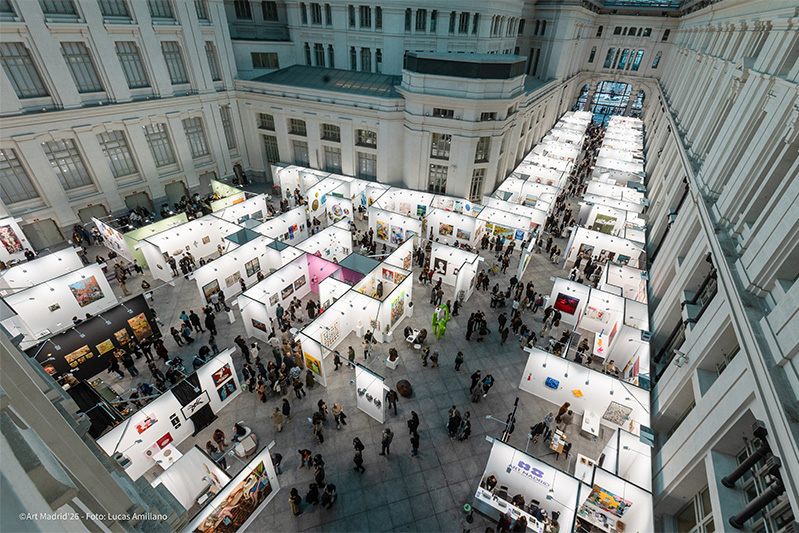
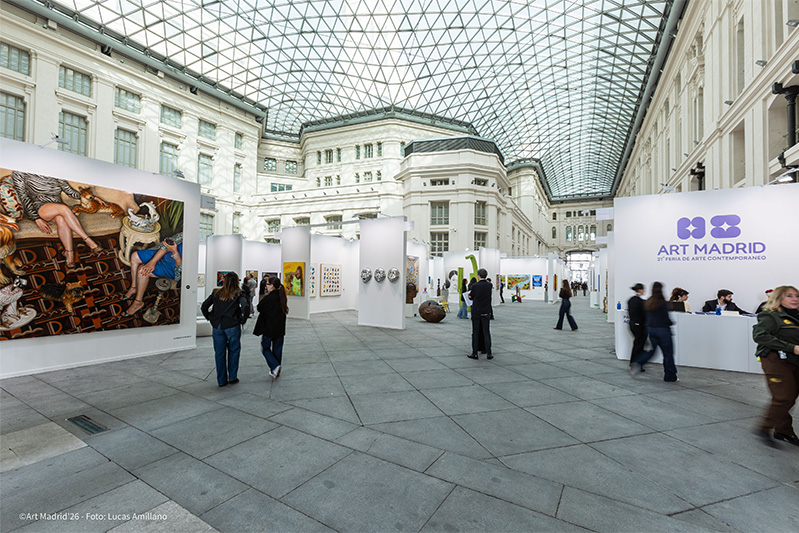
Art Madrid'26 – ICONOSPHERE”, THE ROUTE CURATED BY NATALIA ALONSO IN ART MADRID THAT IS PART OF THE “ONE SHOT COLLECTORS” PROGRAM

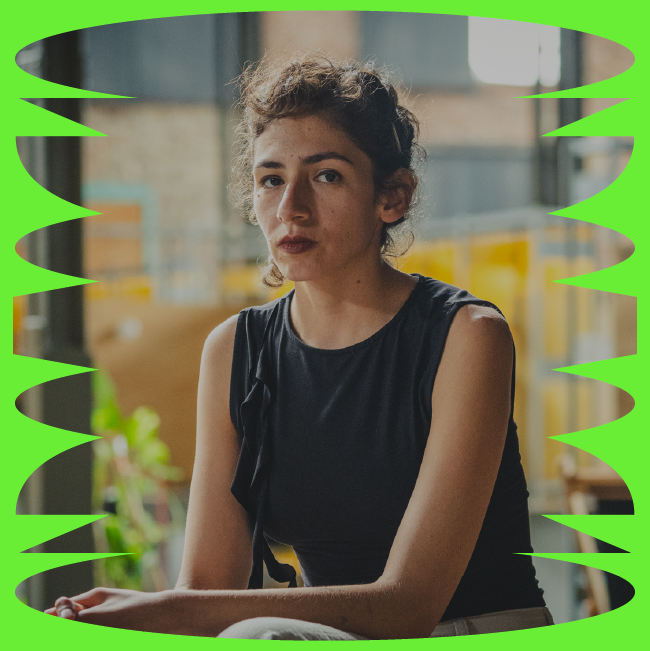
Natalia Alonso Arduengo retratada por Federico Granell

The critic and independent curator Natalia Alonso Arduengo will be in charge of the curated tour of Art Madrid for the second consecutive year, which, together with the Collecting Program, will form part of "One Shot Collectors".

Natalia Alonso Arduengo (1984, Madrid): Lives in Gijón and works between her place of residence and Madrid. She has a degree in Art History from the University of Oviedo, and she's a critic and independent curator. Part of her interests are oriented to art made by women and focused on gender aspects. In this sense, she has curated shows such as "Perséfone's Fugue" by Cristina Ferrández and Norma Desmond's Syndrome by Cristina Toledo. Another issue towards which she directs her work is living and how the contemporary subject relates to the environment. Under this theme, she was the guest curator of Art Madrid in 2021 with the project "El arte de habitar", which brought together, among others, artists such as Sandra Paula Fernández, Silvia Flechoso, Hugo Alonso and Guillermo Oyágüez.

She has worked for media such as the magazine "Tendencias del Mercado del Arte" and has been at the helm of the blog "Con el arte en los talones" for years, which has now changed to radio format in a program broadcast on RTPA's La Buena Tarde. Currently, she works as Liaison Manager for Arteinformado. She is director of ArteOviedo, a contemporary art fair held in the Principality's capital that brings together a selection of galleries from the region.
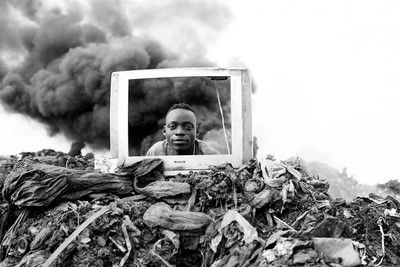
Mário Macilau

Breaking news, 2015

Pigmento inyectado

60 x 90cm

ICONOSPHERE

Every image is an artifice. This axiom of Román Gubern sticks in mind like the finger of the recruitment poster made by James Montgomery Flagg, which is the cover of Gubern's book entitled Iconic mass media of the late nineties of the last century. In his final chapter, dedicated to the electronic image, he outlined the future that was to come. Over two decades later, the presence and influence of images in our society are winning the battle of oversupply and over information, from mass media to self-media and the metaverse. The curated selection of works for ARTMADRID22 seeks to reflect on the ways of looking at and the ways of reading images, the subject's interaction with them, and the relationships and influences between them. How do we assimilate and rework images today? What look do we apply to multiform reality?
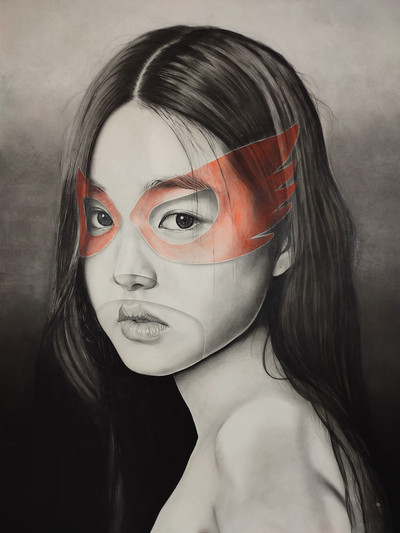

Lantomo

(un)MASKED FIGHTER, 2021

Grafito, carbón, acuarela sobre papel encolado a madera

130 x 97cm


The curated tour comprises twelve works from different disciplines, among which drawing and photography stand out. The artists that are part of this selection are: Catarina Patrício (Sâo Mamede), Mário Macilau (Galerie Alex Serra), Lantomo (BAT alberto cornejo), Beatriz Díaz Ceballos (Rodrigo Juarranz), Chang Teng-Yuan (Yiri Arts), David Delgado Ruiz (DDR Art Gallery), Juana González (Arena Martínez Projects), Aurora Cañero (Galería Kreisler) , Julien Primard (Galerie LJ), Jaime Sancorlo (Inéditad), Kepa Garraza (Víctor Lope Arte Contemporáneo) y María Treviño (Moret Art).
ART MADRID’26 INTERVIEW PROGRAM. CONVERSATIONS WITH ADONAY BERMÚDEZ


The pictorial work of Sergio Rocafort (Valencia, 1995) is articulated as a field of questioning rather than a system of closed visual statements. His paintings do not seek to close off meaning, but rather to activate an open perceptual experience, in which the viewer participates in a critical exercise of reconsidering the ways of seeing, interpreting, and conceiving painting in the present. The image thus presents itself as an unstable territory, where perception constantly oscillates between the visible and the imagined, and meaning is constructed in a provisional and shared manner.

One of the structural axes of his work is the tension between scale and intimacy. The format functions as a relational device, alternating physical immersion with concentrated attention, generating an expository rhythm that prompts the viewer to move around, approach, and withdraw. This spatial dynamic engages with a painting situated on the threshold between figuration and abstraction, sustaining a reflection on painting as both window and physical object, while emphasizing its material and spatial condition.

Rocafort’s creative process is also grounded in a dialectic between intuition and control. Far from a romantic notion of chance, the unexpected is understood as guided pictorial thinking, in which every decision—even those that appear accidental—responds to a critical awareness of the act of painting and a progressive refinement of the means of expression.


Untitled. 2024. Oil on panel, 30 x 45 cm..


Questioning seems to inhabit your painting. What kind of questions do you want your work to pose to the viewer?

Generally, my intention is for the work to provoke more questions than answers. Ultimately, I believe my work refers to shared spaces that nevertheless remain open to interpretation. I think that this interplay of questions—questions that arise for me as an artist in the studio—is interesting when it is later transferred to the viewer in the exhibition space. These questions usually concern the way we look, the way we interpret, and the way we conceive painting. It is a constant game between what we see and what we imagine.


Untitled. 2025. Oil on linen. 32.5 × 22.5 cm.


Your works seem to constantly stretch scale, moving from the intimate to the immersive. How do you decide what format each investigation requires?

I believe the main reason I choose one format or another depends on the exhibition installation. Beyond how each individual work functions, I think it is the overall vision that completes the project and gives it coherence and meaning. In many cases, these contrasts arise because a small work encourages an intimate approach, while a large work can have a stronger impact. Ultimately, this play of tensions causes the viewer to move closer, step back, and generates an interesting dialogue within the exhibition space itself.

In my case, I tend to work quite a lot with large formats because of the impact they produce. I believe there is a kind of translation that takes place—one that extends to the tools themselves—and this allows for greater expressiveness and a stronger impact on the viewer.


Untitled. 2015. Graphite on paper. 80 x 65 cm.


Critics often highlight your attention to proportion and detail. How do these concepts operate in a painting that resists figuration?

I do not think my painting resists figuration; rather, it constantly plays at its edges. Most of my references are figurative, but I seek to continually tension the relationship between volume and classical notions of pictorial construction, without losing the idea of the painting as a window—or rather, as an object. This relationship between painting-as-window and painting-as-physical-object is fundamental in my work; both aspects share common ground.

The result would be very different if one of these elements were set aside. But the game is not only formal: it is about generating ambiguity, creating a point at which the viewer must complete the work. I believe this operates both in hyperrealist figuration and in geometric abstraction, which is what I have been working on recently.

Abstraction allows me to detach completely from the image. In fact, I do not work with photographs or a predefined imaginary; instead, I generate my own notion of volume and space without relying on a prior model. Ultimately, even if I do not start from a figurative reference, this freedom coexists with the basic principles of painting. Neo Rauch, for example, does not need a maquette or a photograph, and I believe that same freedom is present in my work without abandoning those fundamental notions of painting.


Untitled. 2025. Oil on linen. 32.5 x 22.5 cm.


In your relationship with black, contrast, and chromatic vibration, how do you decide when a chromatic tension should be restrained or emphasized?

I think something similar happens here to what occurs with formats—it largely depends on the exhibition space. A painting can be small yet possess great chromatic force and a high level of contrast; even if it alludes to intimacy, it can generate a strong visual impact. In a larger format, the opposite may occur: low contrast or subtle nuances may function better. Everything depends on the relationship established between the works in the exhibition space and on how we want to bring the viewer closer or push them back in order to generate visual tension. In my work, synthesis, clarity, and the depth offered by color and material have always been present. I increasingly try to limit my resources so that the work functions with the bare minimum. Lately, for example, I have been drawing a great deal and working almost entirely with monochromatic ranges, because within that simplicity I believe many nuances can be explored and revealed—transparencies, density, contrast. This is, in essence, the chromatic game in my work.


To what extent do you plan your work, and how much space do you leave for the unexpected—or even for mistakes?

I have always thought that I leave a great deal of room for error and chance, but lately I believe less in that version of the creative process. I think there is always a reflection and a guiding hand behind these “accidents.” I do try to allow unforeseen things to happen, but what emerges I would call intuition rather than chance, and I try to embrace it and guide it. This is, essentially, my way of understanding painting.

As for how I manage the timing of my projects, toward the end of this year I have a solo exhibition planned at Shiras Gallery, which will be a good moment to consolidate the works I have been developing and their visual impact. Recently, I have also been focusing on Art Madrid, which is approaching, and I am seeking for the exhibited works to have a cohesion, coherence, and clarity that some earlier works lacked. This time, the luminosity and saturation present in parts of my work shine more than ever, and I trust that the gallery will achieve a very successful exhibition installation at the fair.