Art Madrid'26 – ECHOES OF A FAR VIBRATION: MORE THAN HUMANS

The Thyssen-Bornemisza Museum and TBA21 (Thyssen-Bornemisza Contemporary Art) have just opened the exhibition "More than humans" that will be open to the public until December 1st.

This exhibition brings together the work of Dominique Gonzalez-Foerster and Tomás Saraceno, under the curating of Stefanie Hessler, in the third project of collaboration between both institutions so far. With these cooperation proposals, the Thyssen Museum expands its connection with contemporary art and explores ways to generate a dialogue between both collections.
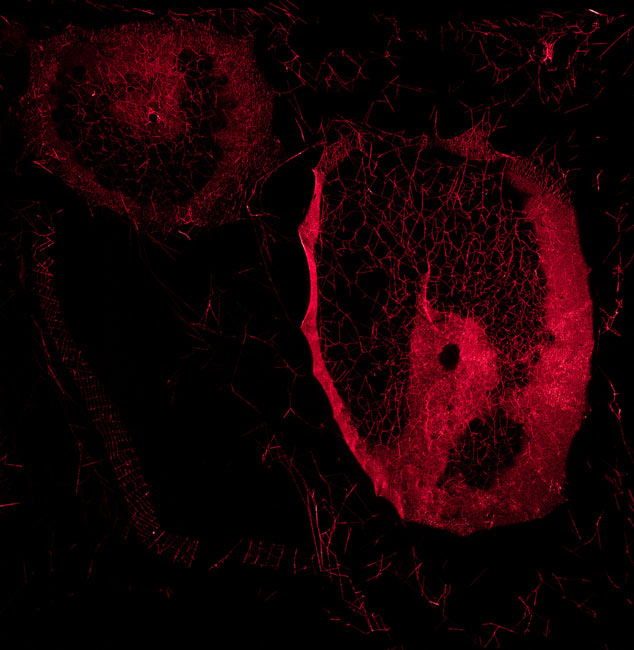
Tomás Saraceno, “How to catch the universe in a spider web?”, 2018

Hessler has always been interested in interdisciplinary creative processes and the desire to share the work of artists and researchers who feed on different sources. This has led her to manage projects where art coexists with other disciplines to enrich a shared message that allows addressing issues from different perspectives. In this exhibition, the viewer is invited to ask questions about topics related to technology, artificial intelligence or the power of the unknown. The coexistence of the work of these two artists, apparently so disparate, articulates through the idea of vibration: the one that causes the sound or movement of objects in space, and the one that perceives a receiver, as a passive listener or as a being connected to a sensor network.
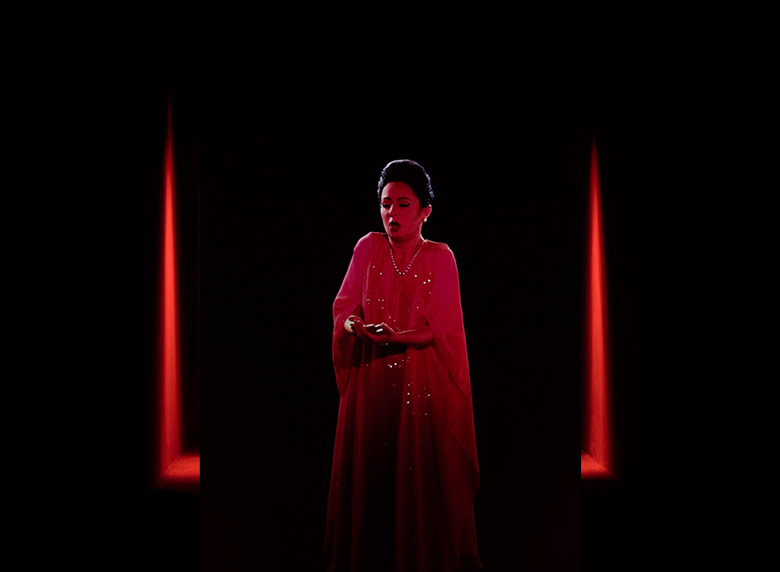
Dominique Gonzalez-Foerster, “Opera (QM.15)”, 2016. Video-intallation. Thyssen-Bornemisza Art Contemporary Collection. Photo: Andrea Rossetti

The strange link that originates between these works requires an interpretive effort to understand the subtlety of the approach, but everything makes sense in this space inhabited by works of art and waiting to receive visitors to unravel those mysteries.

The recent work of Tomás Saraceno has focused on investigating the development of spiders, which has led him to collaborate with geologists and entomologists to examine the behaviour of these arthropods and study their architectures. In the exhibition, one of his latest work "How to catch the universe in a spider web?", a large installation that mimics the networks that weave arachnids, will be present. With these delicate structures, we realise the subtlety of the movement of the air, of the soft tensions that occur with each vibration.
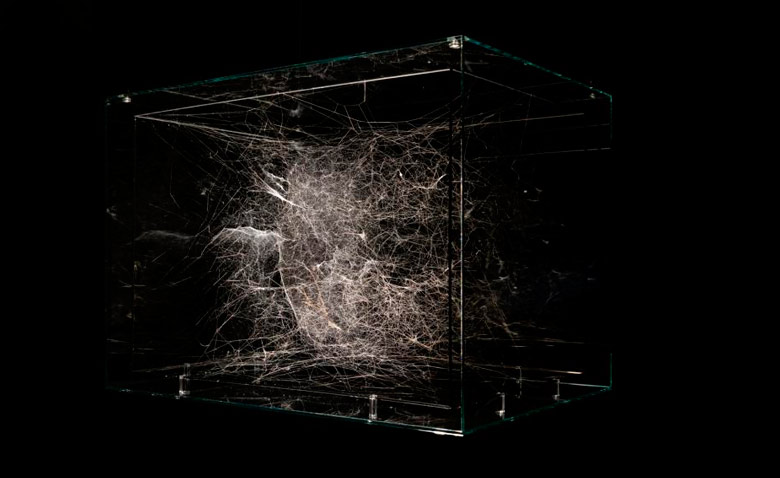
Tomás Saraceno, “Hybrid semi-social solitary Instrument HD 74874” built by: a triplet of Cyrtophora citricola - four weeks and a solo Agelena labyrinthica - one week, 2019

For his part, Dominique Gonzalez-Foerster enters the scene with a piece from his latest project, in which he recovers famous characters thanks to the support of technology. In “Opera (QM.15)”, the artist himself plays the role of the soprano María Callas thanks to a holographic illusion. Synchronising his movements with the sound, when reproducing some of the most famous arias that the singer interpreted, he creates a spooky effect that makes its way between the rooms of the museum. Here, the vibrations of the voice will be those that move the threads of the cobwebs, revealing the relationship between these works.
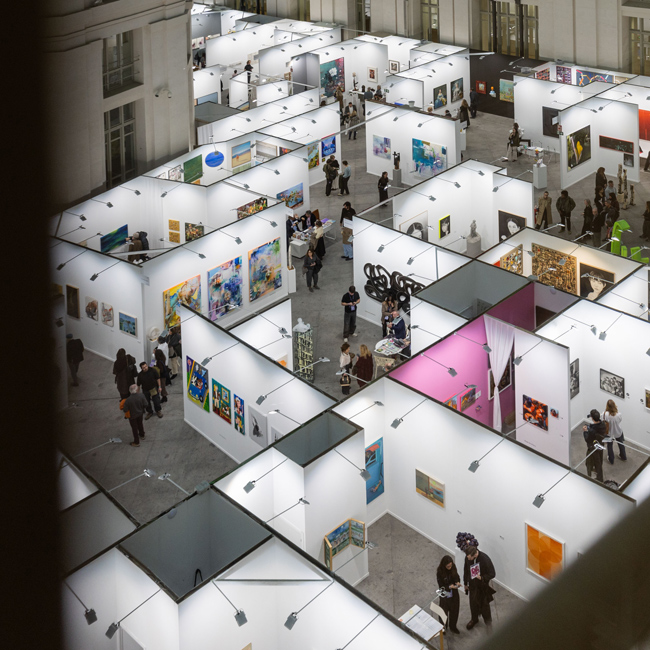
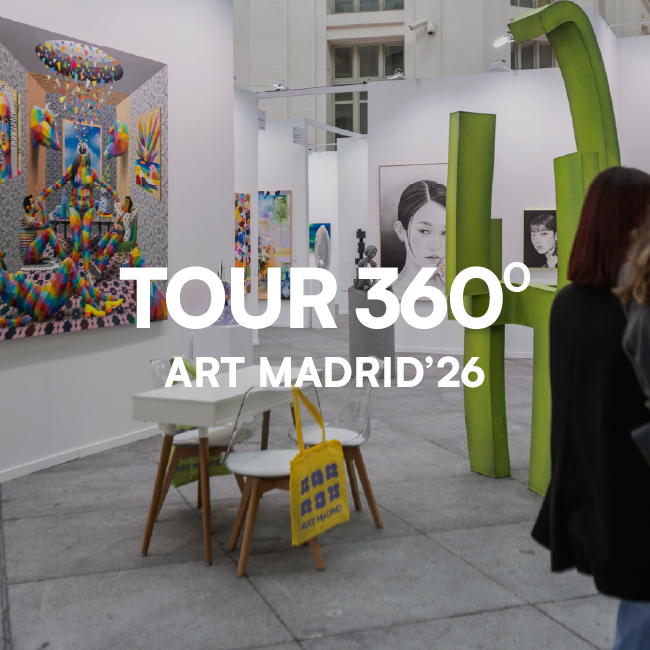
 

Daniel Barrio. Guest artist of the third edition of OPEN BOOTH. Courtesy of the artist.


DESPIECE. PROTOCOLO DE MUTACIÓN


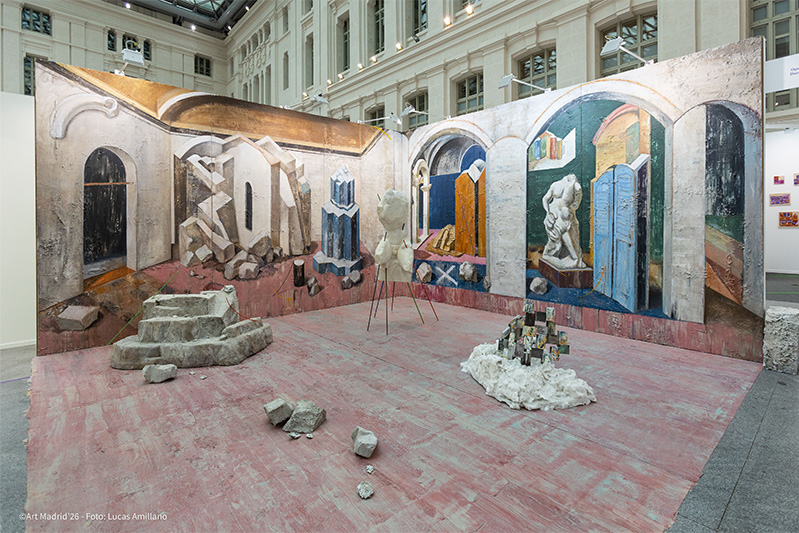
As part of the Art Madrid’26 Parallel Program, we present the third edition of Open Booth, a space conceived as a platform for artistic creation and contemporary experimentation. The initiative focuses on artists who do not yet have representation within the gallery circuit, offering a high-visibility professional context in which new voices can develop their practice, explore forms of engagement with audiences, and consolidate their presence within the current art scene. On this occasion, the project features artist Daniel Barrio (Cuba, 1988), who presents the site-specific work Despiece. Protocolo de mutación.

Daniel Barrio’s practice focuses on painting as a space for experimentation, from which he explores the commodification of social life and the tyranny of media approval. He works with images drawn from the press and other media, intervening in them pictorially to disrupt their original meaning. Through this process, the artist opens up new readings and questions how meaning is produced, approaching painting as a space of realization, therapy, and catharsis.

Despiece. Protocolo de mutación is built from urban remnants, industrial materials, and fragments of history, inviting us to reflect on which memories we inherit, which we consume, and which ones we are capable of creating. Floors, walls, and volumes come together to form a landscape under tension, where the sacred coexists with the everyday, and where cracks matter more than perfection.

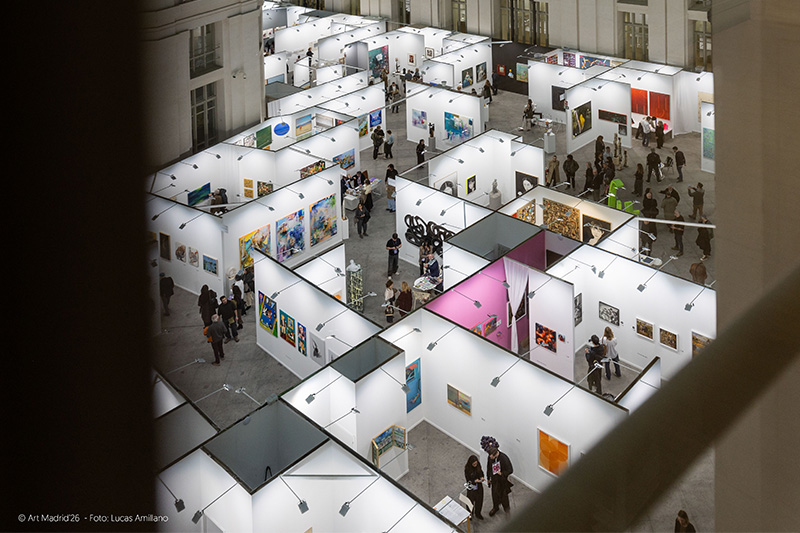
The constant evolution of art calls for ongoing exchange between artists, institutions, and audiences. In its 21st edition, Art Madrid reaffirms its commitment to acting as a catalyst for this dialogue, expanding the traditional boundaries of the art fair context and opening up new possibilities of visibility for emerging practices.


Despiece. Protocolo de mutación emerges from a critical and affective impulse to dismantle, examine, and reassemble what shapes us culturally and personally. The work is conceived as an inseparable whole: an inner landscape that operates as a device of suspicion, where floors, walls, and volumes configure an ecosystem of remnants. It proposes a reading of history not as a linear continuity, but as a system of forces in permanent friction, articulating space as an altered archive—a surface that presents itself as definitive while remaining in constant transformation.


The work takes shape as a landscape constructed from urban waste, where floors, walls, and objects form a unified body made of lime mortar, PVC from theatrical signage, industrial foam, and offering wax. At the core of the project is an L-shaped structure measuring 5 × 3 meters, which reinterprets the fresco technique on reclaimed industrial supports. The mortar is applied wet over continuous working days, without a pursuit of perfection, allowing the material to reveal its own character. Orbiting this structure are architectural fragments: foam blocks that simulate concrete, a 3D-printed and distorted Belvedere torso, and a wax sculptural element embedded with sandpaper used by anonymous workers and artists, preserving the labor of those other bodies.

A white wax sculptural element functions within the installation as a point of sensory concentration that challenges the gaze. Inside it converge the accumulated faith of offering candles and the industrial residues of the studio, recalling that purity and devotion coexist with the materiality of everyday life. The viewer’s experience thus moves beyond the visual: bending down, smelling, and approaching its vulnerability transforms perception into an intimate, embodied act. Embedded within its density are sanding blocks used by artists, artisans, and laborers, recovered from other contexts, where the sandpaper operates as a trace of the effort of other bodies, following a protocol of registration with no autobiographical intent.

Despiece. Protocolo de mutación addresses us directly, asking: which memory do we value—the one we consume, or the one we construct with rigor? The audience leaves behind a purely contemplative position to become part of the system, as the effort of moving matter, documentary rigor, and immersive materiality form a body of resistance against a mediated reality. The project thus takes shape as an inner landscape, where floor, surface, and volume articulate an anatomy of residues. Adulteration operates as an analytical methodology applied to the layers of urban reality, intervening in history through theatrical and street advertising, architectural remnants, and administrative protocols, proposing that art can restore the capacity to build one’s own memory, even if inevitably fragmented.


ABOUT THE ARTIST

DANIEL BARRIO (1988, Cuba)

Daniel Barrio (Cienfuegos, Cuba, 1988) is a visual artist whose practice articulates space through painting, understanding the environment as an altered archive open to critical intervention. He studied at the Academy of Fine Arts of Cienfuegos (2004–2008), specializing in painting, and later at the Madrid Film School (ECAM, 2012–2015), where he studied Art Direction. His methodology integrates visual thinking with scenographic narrative.

His trajectory includes solo exhibitions such as La levedad en lo cotidiano (Galería María Porto, Madrid, 2023), Interiores ajenos (PlusArtis, Madrid, 2022), and Tribud (Navel Art, Madrid, 2019), as well as significant group exhibitions including Space is the Landscape (Estudio Show, Madrid, 2024), Winterlinch (Espacio Valverde Gallery, Madrid, 2024), Hiberia (Galería María Porto, Lisbon, 2023), and the traveling exhibition of the La Rioja Young Art Exhibition (2022).

A member of the Resiliencia Collective, his work does not pursue the production of objects but rather the articulation of pictorial devices that generate protocols of resistance against the flow of disposable images. In a context saturated with immediate data, his practice produces traces and archives what must endure, questioning not the meaning of the work itself but the memory the viewer constructs through interaction—thus reclaiming sovereignty over the gaze and inhabiting ruins as a method for understanding the present.