Art Madrid'26 – OKUDA SAN MIGUEL, GUEST ARTIST AT ART MADRID\'18

Okuda San Miguel.


Suddenly, when turning that corner in that street of Porto, an impressive figure hits your look. It seems to grow up in the road, it seems to spring up from concrete like if it were a creature come from a parallel universe. Tens of facets of color, a geometric organism raises up in front of you and, also suddenly, you realize that you are looking at a phone box. It is an Okuda San Miguel’s, his signature, his shapes that appear on walls, alleys, buildings, bricks of the main capitals of the world, India, Mali, Mozambique, The US, Japan, Chile, Brazil, Peru, South Africa, Mexico and almost the whole Europe.
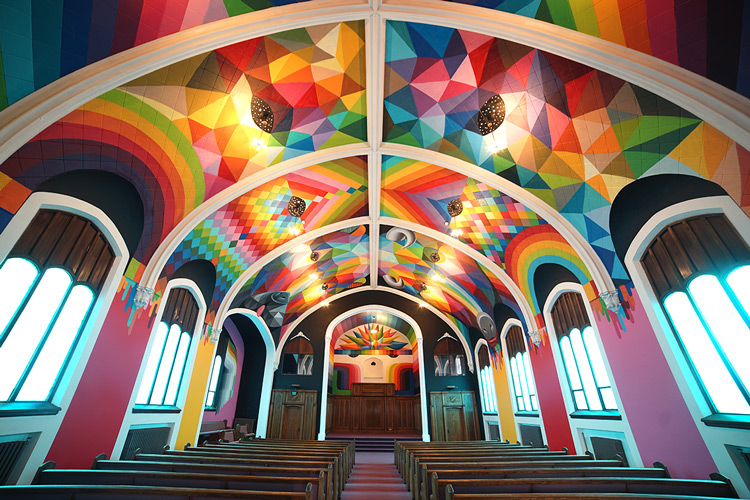


Okuda San Miguel. The International Church of Cannabis. Denver. 2017


His urban essence has enriched with time with the oriental philosophy, with metaphysical issues about the infinite, the universal, erasing the boundaries between the man and the nature, between the man and the art, to create an unique iconography that talks about the contradictions between modernity and tradition, between the homo capitalismus and the homo ludens, between the me and the myself in a continuous transformation.


“My art reflects my love for metamorphosis. Playing with the shapes I highlight this juxtaposition within my characters, mixing their profiles and personalities. I paint my faces with geometric patterns to show the equality between the different races, placing all skin types on the same level; this multicolorism symbolizes multiculturalism", Okuda San Miguel states.
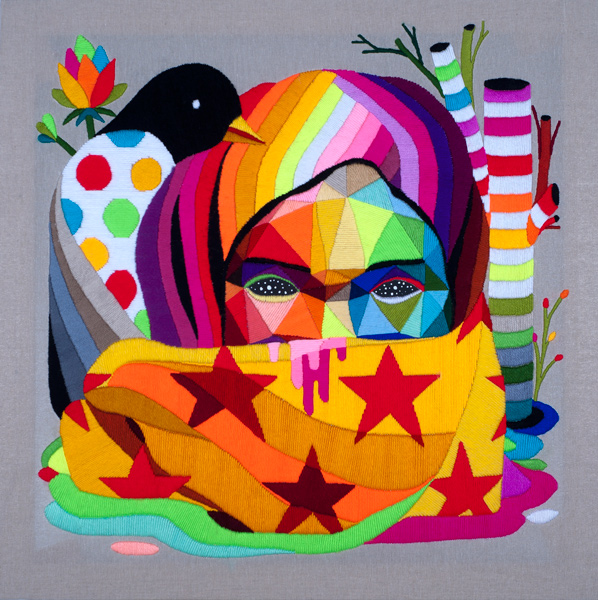


Okuda San Miguel. Refugee Goddess. 2017


The jump from streets to the galleries, to the work in a studio, has been inevitable, a new generation of collectors and art lovers were asking for some fresh air in the market and this artist has brought to them a colour hurricane. "I use colours as a symbol of life and the natural world, while the gray scale in my paintings represents the concrete, death, dust and material of the classic sculptures," Okuda explains.


Now, Art Madrid, to celebrate its 13th edition and, why not saying it, to fight against superstitions, has asked to Okuda a little of his magic and he will be the guest artist in Art Madrid’18, joining the list of guests of past editions along with Ouka Leele, Carmen Calvo and Riera i Aragó, all of them seekers of new shapes and experimenters of the image.
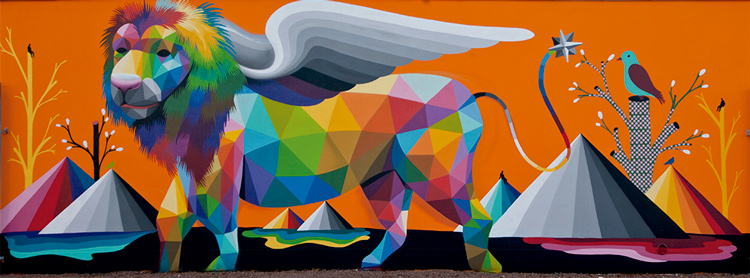


Okuda San Miguel. Lion. Arcugnano. Italy. 2016


With Okuda San Miguel, and in collaboration with Ink And Movement, we will develop an exclusive work to Art Madrid and many other actions that we will tell about. Welcome, Okuda!


About the artist:
Okuda San Miguel. Santander, 1980. He lives in Madrid, where he also has his studio. Degree in Fine Arts from the Universidad Complutense de Madrid. His unique iconographic language of geometric and multicolored patterns on the streets of cities around the world have made of him one of the most recognized urban artists today. Renowned for his large-scale projects, Okuda is recognized for the transformation he made at the end of 2015 of an Asturian church: "Kaos Temple" like it was renamed, which has become a new icon of contemporary art. In parallel with his work in public space, in 2009 Okuda began his own practice of study. Since then, his work has been exhibited in galleries and venues as diverse as India, Mali, Mozambique, United States, Japan, Chile, Brazil, Peru, South Africa or Mexico, in addition to almost the entire European continent.
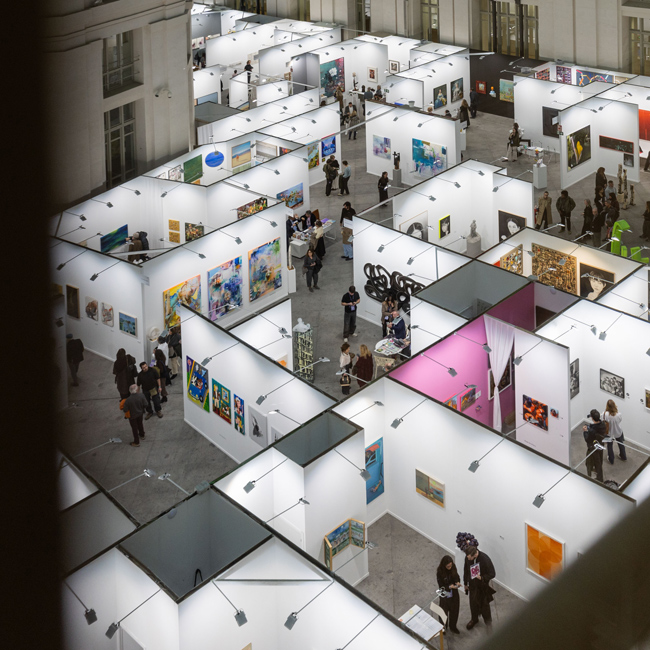
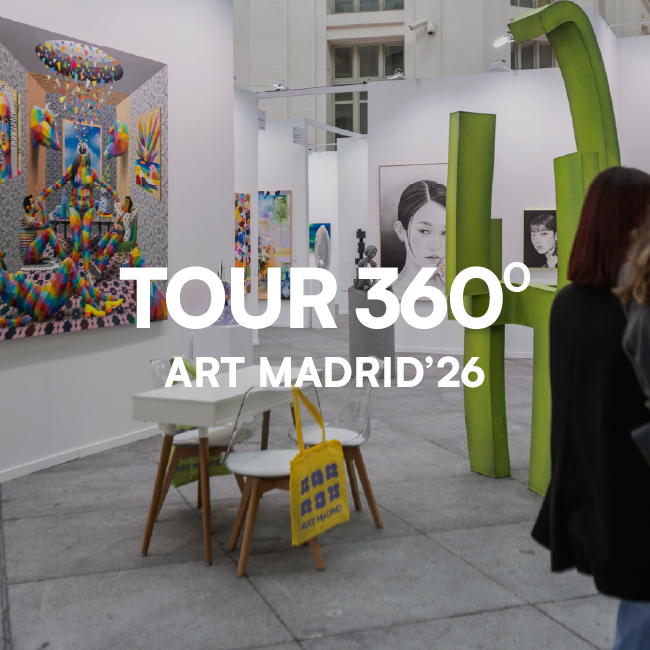


ART MADRID’26 INTERVIEW PROGRAM. CONVERSATIONS WITH ADONAY BERMÚDEZ


The painting of Daniel Bum (Villena, Alicante, 1994) takes shape as a space for subjective elaboration, where the figure emerges not so much as a representational motif but as a vital necessity. The repetition of this frontal, silent character responds to an intimate process: painting becomes a strategy for navigating difficult emotional experiences—an insistent gesture that accompanies and alleviates feelings of loneliness. In this sense, the figure acts as a mediator between the artist and a complex emotional state, linking the practice of painting to a reconnection with childhood and to a vulnerable dimension of the self.

The strong autobiographical dimension of his work coexists with a formal distance that is not the result of conscious planning, but rather functions as a protective mechanism. Visual restraint, an apparent compositional coolness, and an economy of means do not neutralize emotion; instead, they contain it, avoiding the direct exposure of the traumatic. In this way, the tension between affect and restraint becomes a structural feature of his artistic language. Likewise, the naïve and the disturbing coexist in his painting as inseparable poles, reflecting a subjectivity permeated by mystery and unconscious processes. Many images emerge without a clearly defined prior meaning and only reveal themselves over time, when temporal distance allows for the recognition of the emotional states from which they arose.


The Long Night. Oil, acrylic, and charcoal on canvas. 160 × 200 cm. 2024.


The human figure appears frequently in your work: frontal, silent, suspended. What interests you about this presence that seems both affirmative and absent?

I wouldn’t say that anything in particular interests me. I began painting this figure because there were emotions I couldn’t understand and a feeling that was very difficult for me to process. This character emerged during a very complicated moment in my life, and the act of making it—and remaking it, repeating it again and again—meant that, during the process, I didn’t feel quite so alone. At the same time, it kept me fresh and connected me to an inner child who was broken at that moment, helping me get through the experience in a slightly less bitter way.


Santito. Acrylic and oil on canvas. 81 × 65 cm. 2025.


There is a strong affective dimension in your work, but also a calculated distance, a kind of formal coldness. What role does this tension between emotion and restraint play?

I couldn’t say exactly what role that tension plays. My painting is rooted in the autobiographical, in memory, and in situations I have lived through that were quite traumatic for me. Perhaps, as a protective mechanism—to prevent direct access to that vulnerability, or to keep it from becoming harmful—that distance appears unconsciously. It is not something planned or controlled; it simply emerges and remains there.


Night Painter. Acrylic on canvas. 35 × 27 cm. 2025.


Your visual language oscillates between the naïve and the unsettling, the familiar and the strange. How do these tensions coexist for you, and what function do they serve in your visual exploration?

I think it reflects who I am. One could not exist without the other. The naïve could not exist without the unsettling; for me, they necessarily go hand in hand. I am deeply drawn to mystery and to the act of painting things that even I do not fully understand. Many of the expressions or portraits I create emerge from the unconscious; they are not planned. It is only afterwards that I begin to understand them—and almost never immediately. A considerable amount of time always passes before I can recognize how I was feeling at the moment I made them.


Qi. Acrylic on canvas. 81 × 65 cm. 2025.


The formal simplicity of your images does not seem to be a matter of economy, but of concentration. What kind of aesthetic truth do you believe painting can reach when it strips itself of everything superfluous?

I couldn’t say what aesthetic truth lies behind that simplicity. What I do know is that it is something I need in order to feel calm. I feel overwhelmed when there are too many elements in a painting, and I have always been drawn to the minimal—to moments when there is little, when there is almost nothing. I believe that this stripping away allows me to approach painting from a different state: more focused, more silent. I can’t fully explain it, but it is there that I feel able to work with greater clarity.


Crucifixion. Acrylic on canvas. 41 × 33 cm. 2025.


To what extent do you plan your work, and how much space do you leave for the unexpected—or even for mistakes?

I usually feel more comfortable leaving space for the unexpected. I am interested in uncertainty; having everything under control strikes me as rather boring. I have tried it on some occasions, especially when I set out to work on a highly planned series, with fixed sketches that I then wanted to translate into painting, but it was not something I identified with. I felt that a fundamental part of the process disappeared: play—that space in which painting can surprise even myself. For that reason, I do not tend to plan too much, and when I do, it is in a very simple way: a few lines, a plane of color. I prefer everything to happen within the painting itself.