Art Madrid'26 – PAC PRESENTS THERTIFY: THE APP FOR E-COLLECTING ART HAS ARRIVED

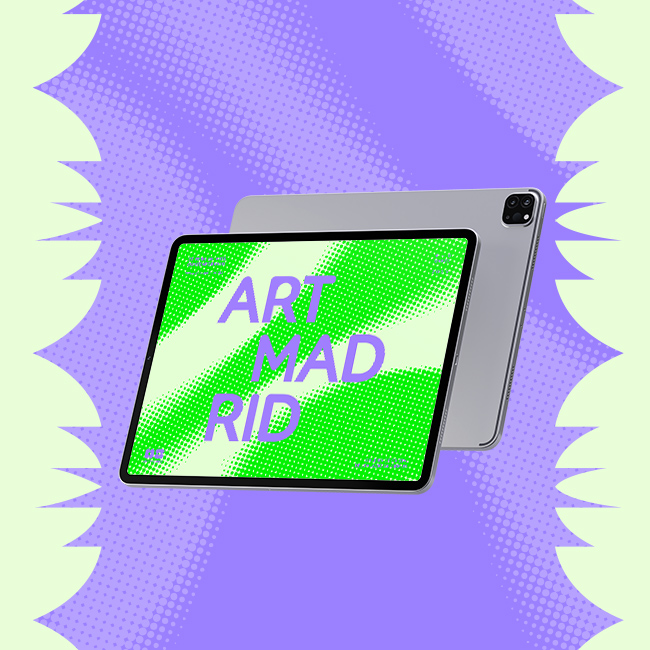
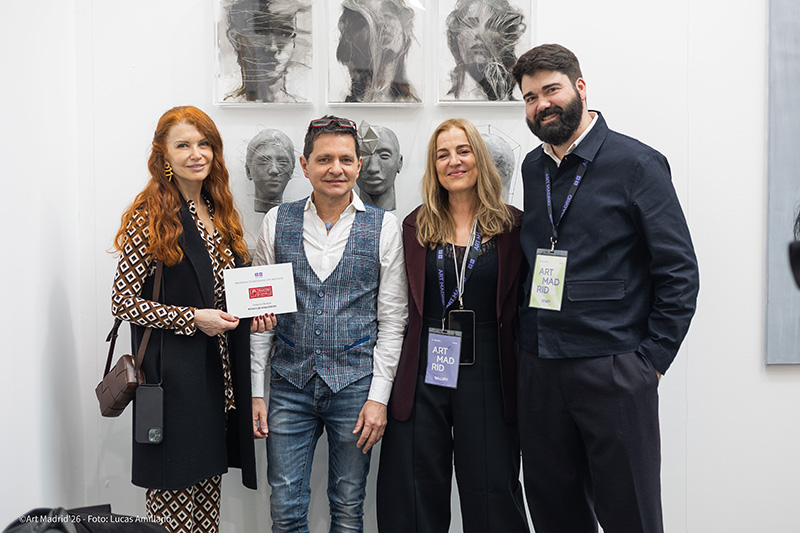
PAC Plataforma de Arte Contemporáneo, Art Madrid'19 media partner, presents its latest project: Thertify, an innovative application for all art lovers. In an agile and intuitive way, from now on with Thertify, artists, collectors, art galleries, institutions and any other interested person will be able to connect simultaneously through an online platform that allows ordering, certifying and sharing artwork collections.
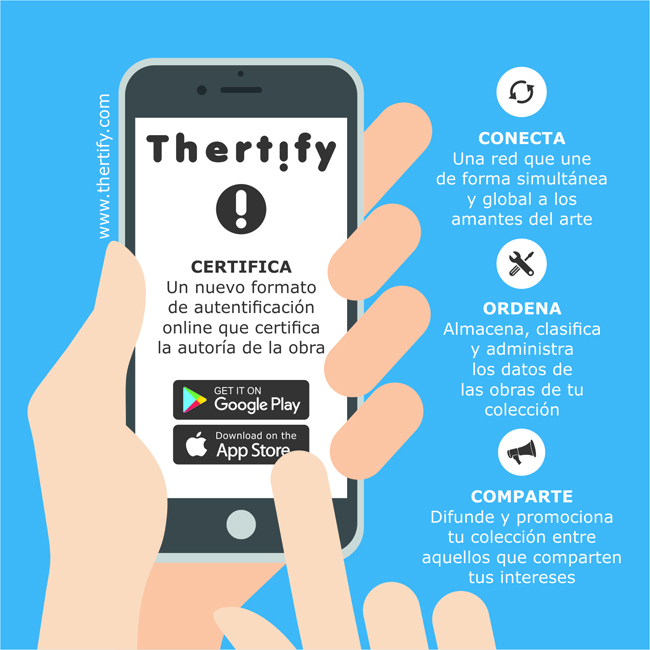
It is a new application that opens infinite possibilities because it takes in a network that allows storing, classifying, managing and connecting data regarding works that shape an art collection. In addition, it offers a new online authentication format that includes the possibility of certifying the authorship of the piece digitally.

"Connect, organize, classify, save, certify, revalue, disseminate and promote the most current art through Thertify"

As its creators explain, "the art market is undergoing a complete revolution and its transformation comes hand in hand with the Internet. The network has become, not only a tool for managing and art purchasing but also a global showcase where to see and be seen. The digital age has created a new way of enjoying and consuming art and with it new generations of collectors. "If we live in the Information Age, of the new media and virtual reality, why not benefit from the advances that, in the same way, can also be applied to the culture sector?

Available for IOS and for Android, where you can download this revolutionary App and discover a new concept of collecting created for our digital era.
As many of you know, PAC Plataforma de Arte Contemporáneo is one of the cultural digital spaces with the greatest growth and impact of recent years in the Spanish-speaking context. Formed by a young and vital team of editors and collaborators, with Óscar García leading them, they maintain a close relationship with contemporary art, the current exhibition scene and the exhibition circuits.

In addition to the extensive and always updated content it offers, PAC stands out for developing and getting involved in different projects, such as publishing the "Ensayos Absolut", "PAC on Tour" or "#ProyectoPuente", the first Urban Art Auction held in Spain. Among these projects the #NOPORAMORALARTE stands out, becoming one of the most interesting initiatives of the sector. Under this slogan, the project promotes the real, fair and economic recognition of the work of artists and other agents of a sector in which, unfortunately, much remains to be improved in relation to professional practices. PAC achieved the empathy and support of numerous artists, curators and collectors, and even a documentary about the experience was created. Another of the most interesting initiatives is "Woman Art House", coordinated by Sara Torres. The project, born within the Twitter network and today also promoted by PAC, aims to vindicate the role and trajectory of contemporary women artists in the history of art, from a rigorous, educational and inclusive vision.

For more information about Thertify please check out here
 

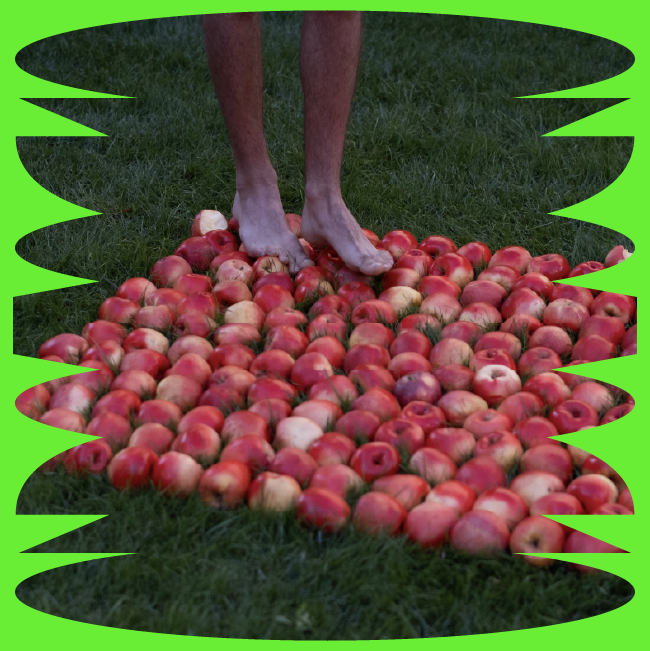
Daniel Barrio. Guest artist of the third edition of OPEN BOOTH. Courtesy of the artist.


DESPIECE. PROTOCOLO DE MUTACIÓN


As part of the Art Madrid’26 Parallel Program, we present the third edition of Open Booth, a space conceived as a platform for artistic creation and contemporary experimentation. The initiative focuses on artists who do not yet have representation within the gallery circuit, offering a high-visibility professional context in which new voices can develop their practice, explore forms of engagement with audiences, and consolidate their presence within the current art scene. On this occasion, the project features artist Daniel Barrio (Cuba, 1988), who presents the site-specific work Despiece. Protocolo de mutación.

Daniel Barrio’s practice focuses on painting as a space for experimentation, from which he explores the commodification of social life and the tyranny of media approval. He works with images drawn from the press and other media, intervening in them pictorially to disrupt their original meaning. Through this process, the artist opens up new readings and questions how meaning is produced, approaching painting as a space of realization, therapy, and catharsis.

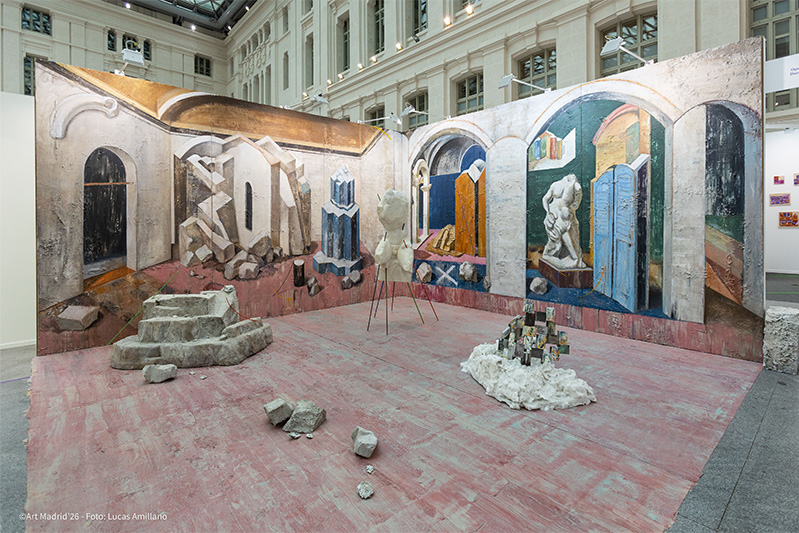
Despiece. Protocolo de mutación is built from urban remnants, industrial materials, and fragments of history, inviting us to reflect on which memories we inherit, which we consume, and which ones we are capable of creating. Floors, walls, and volumes come together to form a landscape under tension, where the sacred coexists with the everyday, and where cracks matter more than perfection.

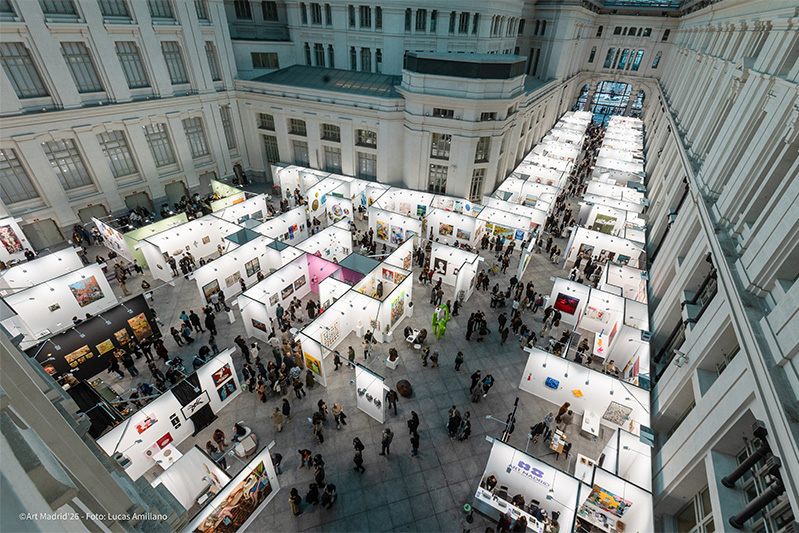
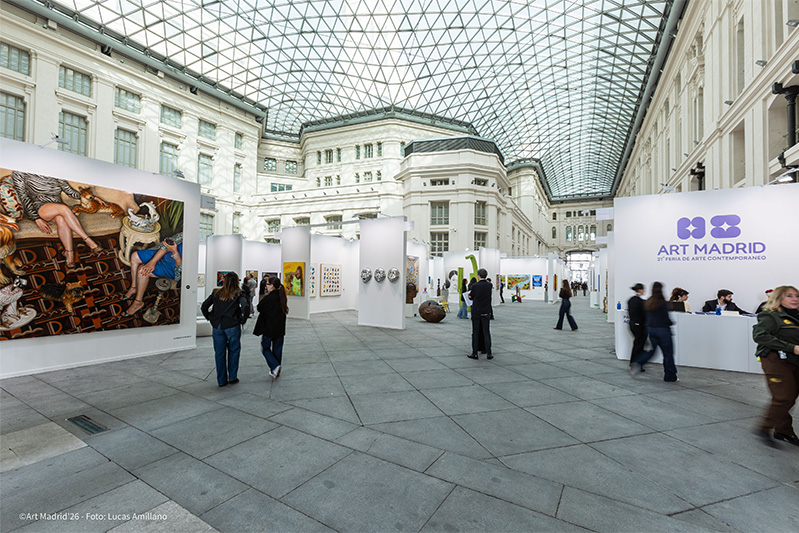
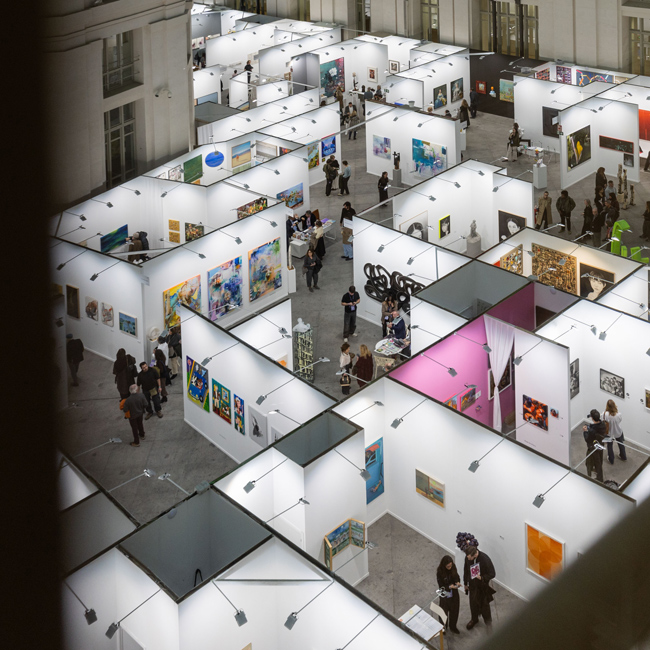
The constant evolution of art calls for ongoing exchange between artists, institutions, and audiences. In its 21st edition, Art Madrid reaffirms its commitment to acting as a catalyst for this dialogue, expanding the traditional boundaries of the art fair context and opening up new possibilities of visibility for emerging practices.


Despiece. Protocolo de mutación emerges from a critical and affective impulse to dismantle, examine, and reassemble what shapes us culturally and personally. The work is conceived as an inseparable whole: an inner landscape that operates as a device of suspicion, where floors, walls, and volumes configure an ecosystem of remnants. It proposes a reading of history not as a linear continuity, but as a system of forces in permanent friction, articulating space as an altered archive—a surface that presents itself as definitive while remaining in constant transformation.


The work takes shape as a landscape constructed from urban waste, where floors, walls, and objects form a unified body made of lime mortar, PVC from theatrical signage, industrial foam, and offering wax. At the core of the project is an L-shaped structure measuring 5 × 3 meters, which reinterprets the fresco technique on reclaimed industrial supports. The mortar is applied wet over continuous working days, without a pursuit of perfection, allowing the material to reveal its own character. Orbiting this structure are architectural fragments: foam blocks that simulate concrete, a 3D-printed and distorted Belvedere torso, and a wax sculptural element embedded with sandpaper used by anonymous workers and artists, preserving the labor of those other bodies.

A white wax sculptural element functions within the installation as a point of sensory concentration that challenges the gaze. Inside it converge the accumulated faith of offering candles and the industrial residues of the studio, recalling that purity and devotion coexist with the materiality of everyday life. The viewer’s experience thus moves beyond the visual: bending down, smelling, and approaching its vulnerability transforms perception into an intimate, embodied act. Embedded within its density are sanding blocks used by artists, artisans, and laborers, recovered from other contexts, where the sandpaper operates as a trace of the effort of other bodies, following a protocol of registration with no autobiographical intent.

Despiece. Protocolo de mutación addresses us directly, asking: which memory do we value—the one we consume, or the one we construct with rigor? The audience leaves behind a purely contemplative position to become part of the system, as the effort of moving matter, documentary rigor, and immersive materiality form a body of resistance against a mediated reality. The project thus takes shape as an inner landscape, where floor, surface, and volume articulate an anatomy of residues. Adulteration operates as an analytical methodology applied to the layers of urban reality, intervening in history through theatrical and street advertising, architectural remnants, and administrative protocols, proposing that art can restore the capacity to build one’s own memory, even if inevitably fragmented.


ABOUT THE ARTIST

DANIEL BARRIO (1988, Cuba)

Daniel Barrio (Cienfuegos, Cuba, 1988) is a visual artist whose practice articulates space through painting, understanding the environment as an altered archive open to critical intervention. He studied at the Academy of Fine Arts of Cienfuegos (2004–2008), specializing in painting, and later at the Madrid Film School (ECAM, 2012–2015), where he studied Art Direction. His methodology integrates visual thinking with scenographic narrative.

His trajectory includes solo exhibitions such as La levedad en lo cotidiano (Galería María Porto, Madrid, 2023), Interiores ajenos (PlusArtis, Madrid, 2022), and Tribud (Navel Art, Madrid, 2019), as well as significant group exhibitions including Space is the Landscape (Estudio Show, Madrid, 2024), Winterlinch (Espacio Valverde Gallery, Madrid, 2024), Hiberia (Galería María Porto, Lisbon, 2023), and the traveling exhibition of the La Rioja Young Art Exhibition (2022).

A member of the Resiliencia Collective, his work does not pursue the production of objects but rather the articulation of pictorial devices that generate protocols of resistance against the flow of disposable images. In a context saturated with immediate data, his practice produces traces and archives what must endure, questioning not the meaning of the work itself but the memory the viewer constructs through interaction—thus reclaiming sovereignty over the gaze and inhabiting ruins as a method for understanding the present.