Art Madrid'26 – Pride and Prejudice: An Exhibition that Challenges Stereotypes

In the year 2020 in the heart of Barcelona a wandering gallery was born, the same one that in February 2021 would debut at Art Madrid with an exhibition proposal focused on contemporary portraits; with this subject matter it would manage to create a powerful dialogue between artwork and audience and make the seal Inéditad remain in the history of the event that contained it.

Jean Carlos Puerto. Protección. Oil and copper leaf on wood. 60 x 48. 2021. Image courtesy of the gallery.

Since that first time and until today, the wandering gallery has managed to build projects on otherness, has repositioned in the spotlight the discourses on the LGTBIQ+ collective, has consolidated a group of artists who share its principles of resilience and empathy and the best thing is that it continues to bet from the professionalism and commitment to give voice to the difference.
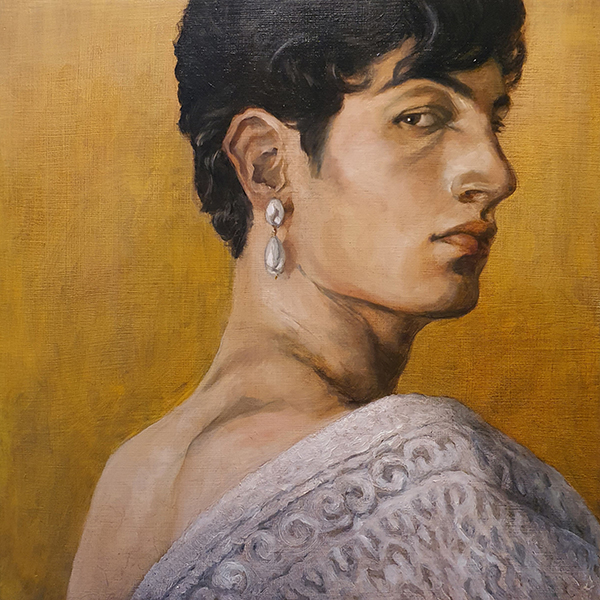
Claudio Petit-Laurent.. El Joven de la Perla. Oil on wood. 30 x 30 cm. 2023. Image courtesy of the gallery.

Inéditad Gallery, thanks to its founder Luis López, its collaborators and the infinite possibilities manifested in the works of the artists it represents, is a gallery that has demonstrated its capacity and courage to stimulate the sensibility of the public through art and seduce a generation that moves between the glass window and the analogical story. Inéditad is a nomadic gallery that has gathered around it a community of artists and has moved the context with exhibition projects that think about LGTBIQ+ art without prejudices.
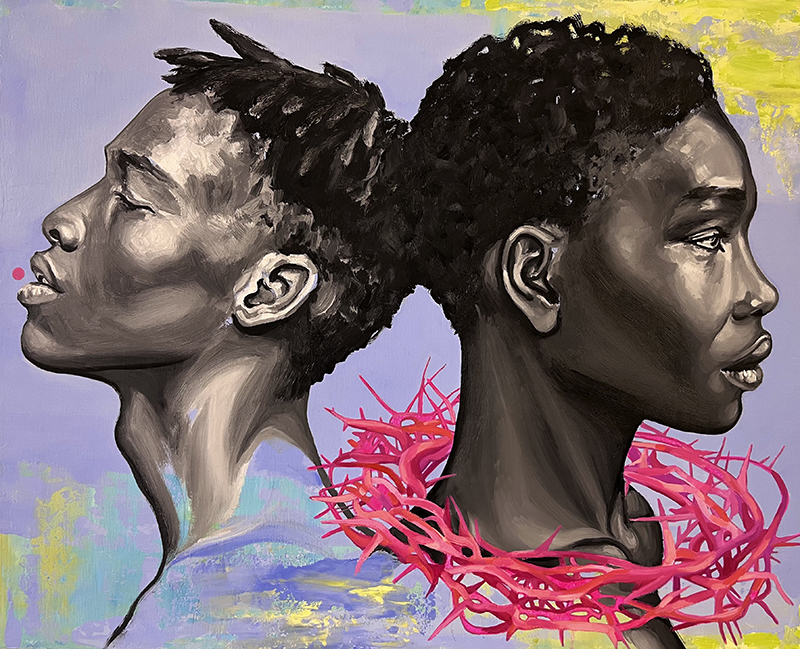
Pepa Salas Vilar. Las marcas del arcoiris. Oil on canvas. 40 x 50 cm. 2022. Image courtesy of the gallery.

Pride and Prejudice was inaugurated. An exhibition that brings together the works of sixteen artists: Abel Carrillo, Alex Domènech, Carlos Enfedaque, Silvia Flechoso, Jamalajama, Daniel Jaén, Claudio Petit-Laurent, Jean Carlos Puerto, Fernando Romero, Pablo Rodríguez, Pepa Salas Vilar, Jack Smith, Pablo Sola, Bran Sólo, Elia Tomás and Utürüo. Painting, illustration, photography and digital art are the manifestations that bring into dialogue around fifty neatly threaded pieces, in a discursive line that discusses such a latent phenomenon as discrimination. To achieve this, the artists invited to the exhibition question themselves whether: Does discrimination exist within the LGTBIQ+ collective?
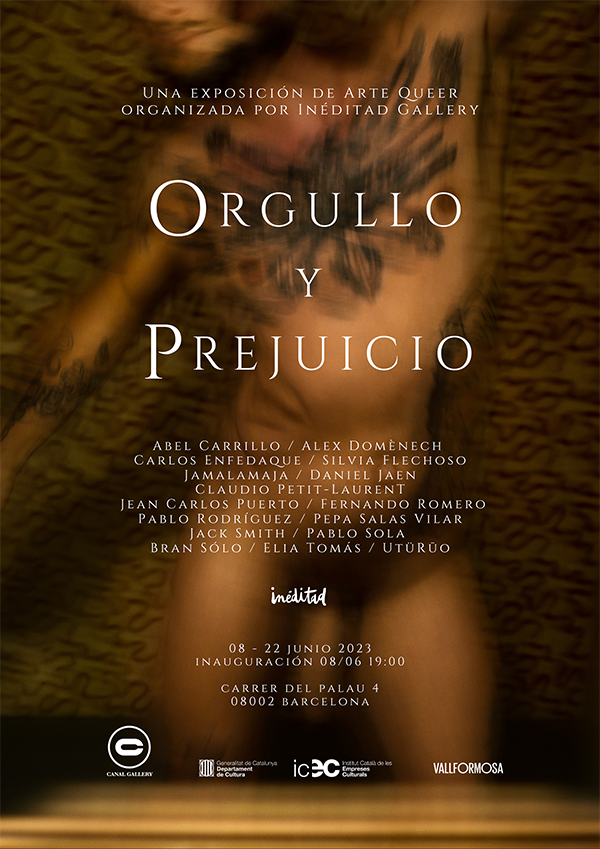
Pride and Prejudice Official Poster. Image courtesy of the gallery.

With approaches on and from the body, the proposal invites to celebrate diversity, proposes to question and self-question the prejudices and attitudes of society against the collective. Pride and Prejudice is a space for dialogue about the constructs imposed on us by society. It is also an oasis in which to deconstruct with tolerance and respect the subjectivities that sometimes prevent us from approaching the production of the participating artists, simply because "the beautiful" does not fit in an androgynous body. The subjugation of stereotypes are pressed with determination to find the beauty of diversity in other palpable facets of reality.
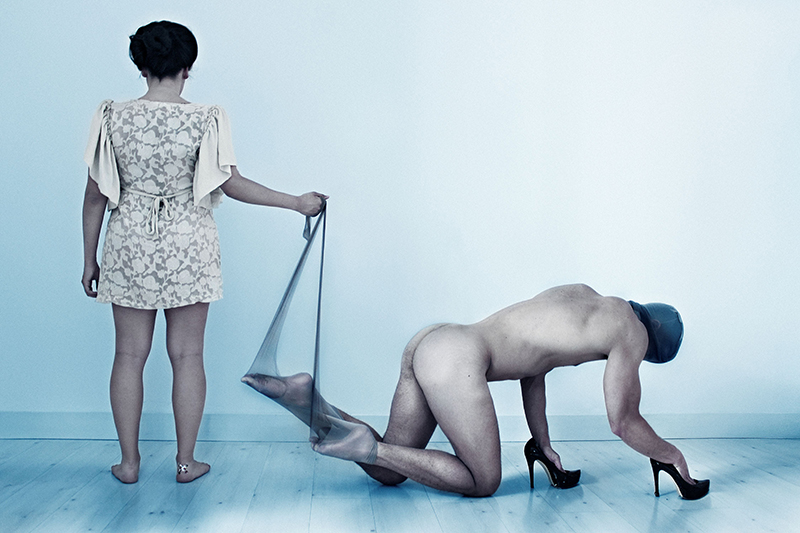
Pablo Sola. All men are dogs. Photography. 2014. Image courtesy of the gallery.

Throughout these three years Inéditad has stimulated the vindictive projection towards bad practices, has questioned estates around the LGTBIQ+ body and the most admirable thing, is that these capacities have resurfaced around the dialogue and the visual narrative of the stories that are told from the visual: Artworks that are people, art that is, per se, humanity. Overcome impositions and accept what is different in order to continue fighting against homophobia, biphobia, lesbophobia or transphobia and defend the equal rights that all the acronyms of the collective deserve in our community.

That's Pride and Prejudice: One creature, the happiest in the world. And maybe other projects and other people have said it - or felt it - before, but none so fairly.
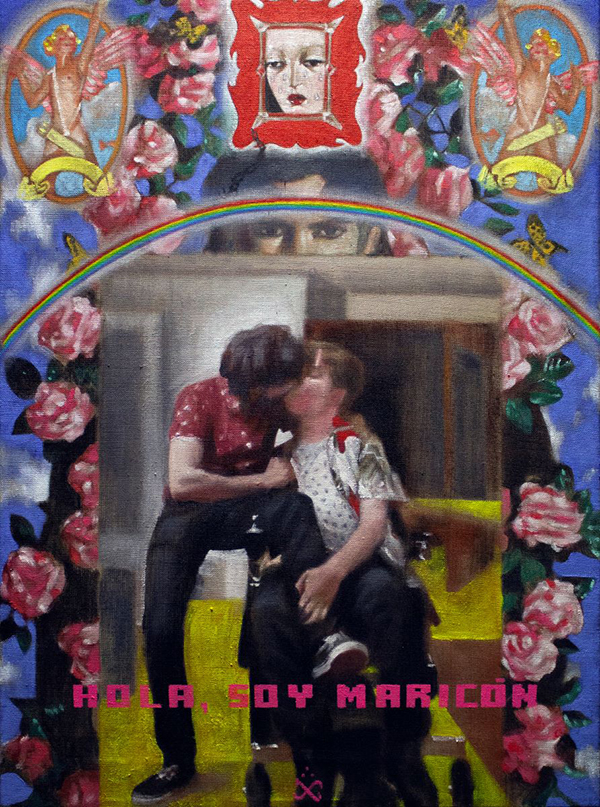
Silvia Flechoso. Hola, soy maricón. Oil on canvas. 73 x 54 cm. 2023. Image courtesy of the gallery.

From June 8th until June 22nd you can visit Pride and Prejudice. Carrer de Palau núm. 4. Canal Gallery space. Barcelona.
ART MADRID’26 INTERVIEW PROGRAM. CONVERSATIONS WITH ADONAY BERMÚDEZ


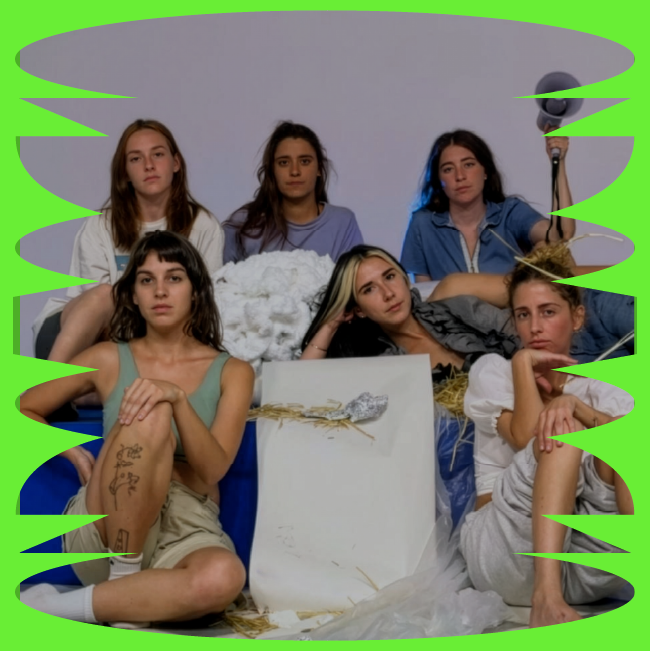
The practice of the collective DIMASLA (Diana + Álvaro) is situated at a fertile intersection between contemporary art, ecological thinking, and a philosophy of experience that shifts the emphasis from production to attention. Faced with the visual and material acceleration of the present, their work does not propose a head-on opposition, but rather a sensitive reconciliation with time, understood as lived duration rather than as a measure. The work thus emerges as an exercise in slowing down, a pedagogy of perception where contemplating and listening become modes of knowledge.

In the work of DIMASLA (Diana + Álvaro), the territory does not function as a framework but rather as an agent. The landscape actively participates in the process, establishing a dialogical relationship reminiscent of certain eco-critical currents, in which subjectivity is decentralized and recognized as part of a broader framework. This openness implies an ethic of exposure, which is defined as the act of exposing oneself to the climate, the elements, and the unpredictable, and this means accepting vulnerability as an epistemological condition.

The materials—fabrics, pigments, and footprints—serve as surfaces for temporary inscriptions and memories, bearing the marks of time. The initial planning is conceived as an open hypothesis, allowing chance and error to act as productive forces. In this way, the artistic practice of DIMASLA (Diana + Álvaro) articulates a poetics of care and being-with, where creating is, above all, a profound way of feeling and understanding nature.


In a historical moment marked by speed and the overproduction of images, your work seems to champion slowness and listening as forms of resistance. Could it be said that your practice proposes a way of relearning time through aesthetic experience?

Diana: Yes, but more than resistance or vindication, I would speak of reconciliation—of love. It may appear slow, but it is deliberation; it is reflection. Filling time with contemplation or listening is a way of feeling. Aesthetic experience leads us along a path of reflection on what lies outside us and what lies within.


The territory does not appear in your work as a backdrop or a setting, but as an interlocutor. How do you negotiate that conversation between the artist’s will and the voice of the place, when the landscape itself participates in the creative process?

Álvaro: For us, the landscape is like a life partner or a close friend, and naturally this intimate relationship extends into our practice. We go to visit it, to be with it, to co-create together. We engage in a dialogue that goes beyond aesthetics—conversations filled with action, contemplation, understanding, and respect.

Ultimately, in a way, the landscape expresses itself through the material. We respect all the questions it poses, while at the same time valuing what unsettles us, what shapes us, and what stimulates us within this relationship.


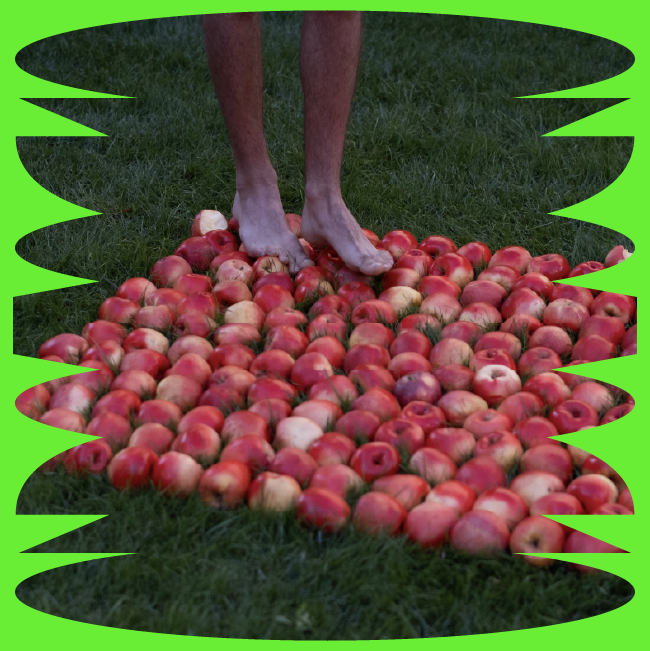
The Conquest of the Rabbits I & II. 2021. Process.


In your approach, one senses an ethic of exposure: exposing oneself to the environment, to the weather, to others, to the unpredictable. To what extent is this vulnerability also a form of knowledge?

Diana: For us, this vulnerability teaches us a great deal—above all, humility. When we are out there and feel the cold, the rain, or the sun, we become aware of how small and insignificant we are in comparison to the grandeur and power of nature.

So yes, we understand vulnerability as a profound source of knowledge—one that helps us, among many other things, to let go of our ego and to understand that we are only a small part of a far more complex web.


Sometimes mountains cry too. 2021. Limestone rockfall, sun, rain, wind, pine resin on acrylic on natural cotton canvas, exposed on a blanket of esparto grass and limestone for two months.. 195 cm x 130 cm x 3 cm.


Your works often emerge from prolonged processes of exposure to the environment. Could it be said that the material—the fabrics, the pigments, the traces of the environment—acts as a memory that time writes on you as much as you write on it?

Álvaro: This is a topic for a long conversation, sitting on a rock—it would be very stimulating. But if experiences shape people’s inner lives and define who we are in the present moment, then I would say yes, especially in that sense.

Leaving our comfort zone has led us to learn from the perseverance of plants and the geological calm of mountains. Through this process, we have reconciled ourselves with time, with the environment, with nature, with ourselves, and even with our own practice. Just as fabrics hold the memory of a place, we have relearned how to pay attention and how to understand. Ultimately, it is a way of deepening our capacity to feel.


The fox and his tricks. 2022. Detail.


To what extent do you plan your work, and how much space do you leave for the unexpected—or even for mistakes?

Diana: Our planning is limited to an initial hypothesis. We choose the materials, colours, places, and sometimes even the specific location, but we leave as much room as possible for the unexpected to occur. In the end, that is what it is really about: allowing nature to speak and life to unfold. For us, both the unexpected and mistakes are part of the world’s complexity, and within that complexity we find a form of natural beauty.