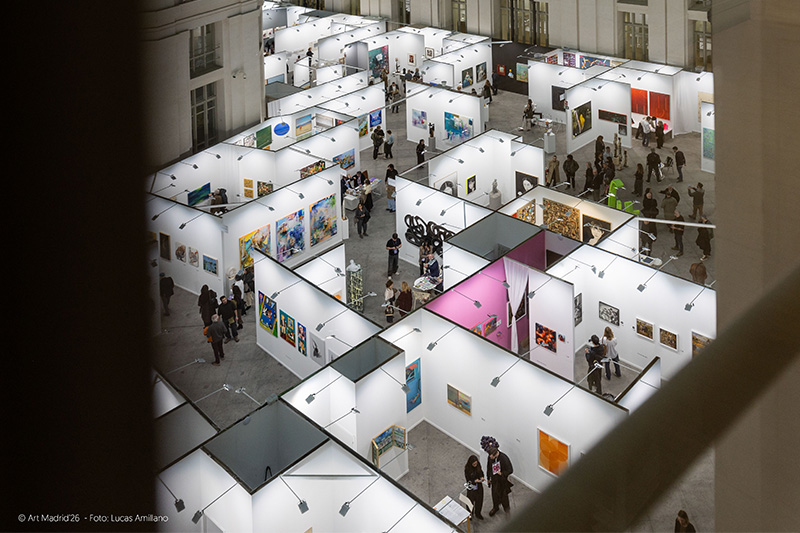
Art Madrid'26 – ONE SHOT COLLECTORS RETURNS: THE ART MADRID'24 COLLECTING PROGRAM

Art Madrid, with the support of One Shot Hotels, presents "One Shot Collectors", a Collectors Program integrated into the core of the fair, with the firm commitment to facilitate the public's connection with contemporary art. One Shot Hotels, a young boutique hotel chain with meticulous design and exceptional location in the heart of Spain's most important cities, is sponsoring the One Shot Collectors Program for the fourth edition at Art Madrid'24.

The passion for collecting art can become a true devotion based on various criteria such as historical-artistic, aesthetic, emotional, social or economic. These criteria converge in an aesthetic and personal exercise that moves experienced collectors and new buyers. The act of owning or acquiring a work of art is a complete experience, from getting to know the artist to understanding and sharing the discourse that underlies the work. Building a collection is also perceived as a form of investment in something tangible and secure, with significant potential for future returns. It also plays a key role in supporting the creative economy.
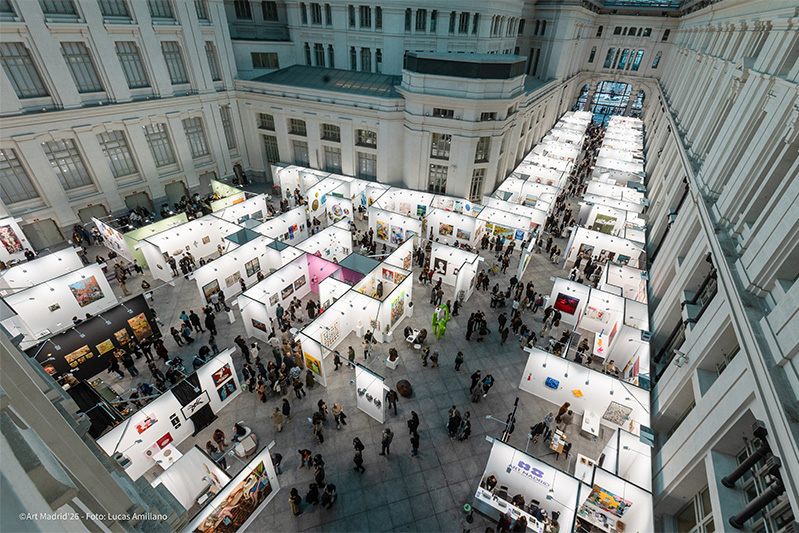
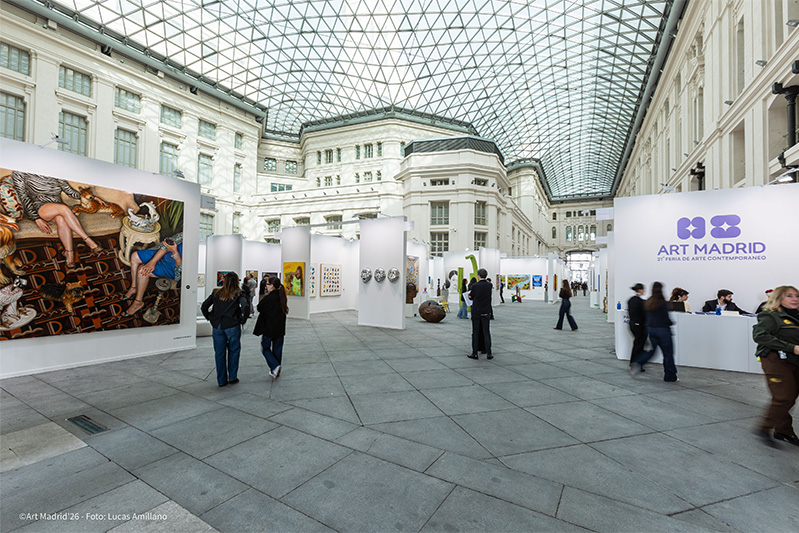
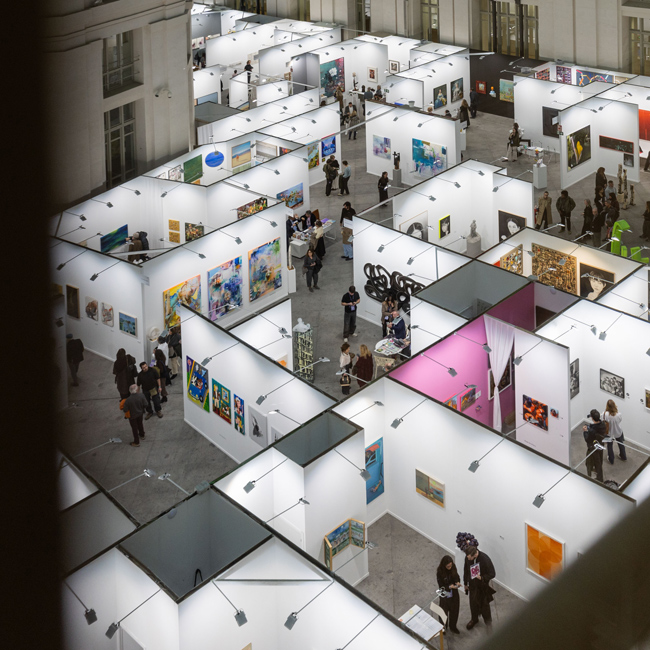
Art Madrid.18ª Edición. Febrero de 2023. Galería de Cristal del Palacio de Cibeles. Imagen cortesía Too Many Flash.

An art collection is something that must evolve gradually, that must be built over time, always based on information according to our interests. The main thing is to enjoy the experience of viewing art, not to feel intimidated, and to trust our taste. But how do we decide what to focus on and in which direction to go? Where do we start? How do we relate one purchase to the next? A good acquisition happens by following your taste, learning to recognize what appeals and interests you, and educating yourself before and during the acquisition process. Collecting can be an emotional journey, a journey of knowledge, with a social or economic background, or simply an aesthetic and personal exercise. That is why it is always a good idea to be accompanied by an advisor when buying art. As well as the recommendation of a gallery that supports and legitimizes the work of art.

The professional advice of an expert is a "safe" and coherent way to make a decision, since the collector, in addition to enhancing and maximizing the quality and value of his collection, also seeks to enrich the buying experience and its enjoyment. In the 19th edition of Art Madrid'24, we will have a space for advice from Ana Suárez Gisbert, art advisor, lawyer and expert appraiser with extensive experience in the art market. This advisory service is designed for experienced collectors, those who are looking for their first art collection, and even for corporate collectors who want to reflect the values of their brand in an art collection. The Art Madrid'24 Collecting Program takes into account the different profiles, needs and preferences, generating a personalized tour and guidance.

Whether due to lack of time or the desire for professional guidance, our Art Advisor will be able to find and prepare a selection of artworks according to the requirements and budget of each buyer, as well as assist in the negotiation process of acquiring a work of art.

IThe beginning of a collection can be motivated by a desire for knowledge and exploration on an aesthetic, social, economic or even business level. From Art Madrid, we encourage collecting for those people and companies that want to bet on patronage and investment. This initiative is aimed at professionals in the sector and enthusiasts of contemporary art who wish to collect for the first time or continue to build their collection. Art Madrid offers a great range of opportunities to acquire works in disciplines such as photography, painting, sculpture or installation, within a wide price range.

Este servicio forma parte del Programa One Shot Collectors y es gratuito para quienes se registren con antelación.

For more information, please send an email to vip@art-madrid.com or register for the program with this form:

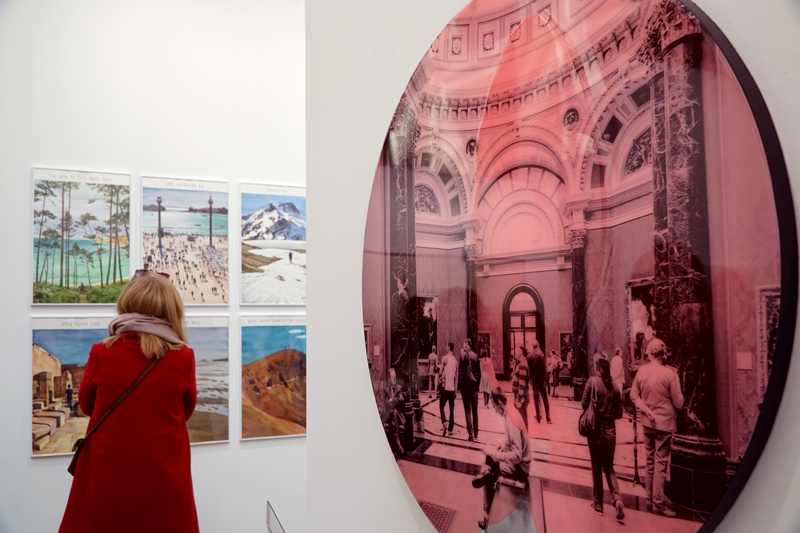
The circle as critical device and the marker as contemporary catalyst


POSCA, the Japanese brand of water-based paint markers, has established itself since the 1980s as a central instrument within contemporary artistic practices associated with urban art, illustration, graphic design, and interdisciplinary experimentation. Its opaque, highly pigmented, fast-drying formula—compatible with surfaces as diverse as paper, wood, metal, glass, and textiles—has enabled a technical expansion that extends beyond the traditional studio, engaging public space, objects, and installation practices alike.


In this context, POSCA operates as more than a working tool; it functions as a material infrastructure for contemporary creation. It is a technical device that enables immediacy of gesture without sacrificing chromatic density or formal precision. Its versatility has contributed to the democratization of languages historically associated with painting, fostering a more horizontal circulation between professional and amateur practices.

This expanded dimension of the medium finds a particularly compelling conceptual framework in The Rolling Collection, a traveling exhibition curated by ADDA Gallery. The project proposes a collective investigation of the circular format, understood not merely as a formal container but as a symbolic structure and a field of spatial tension.


Historically, the circle has operated as a figure of totality, continuity, and return. Within the framework of The Rolling Collection, the circular format shifts away from its classical symbolic charge toward an experimental dimension, becoming a support that challenges the hegemonic rectangular frontality of the Western pictorial tradition. The absence of angles demands a reconsideration of composition, balance, and directional flow.

Rather than functioning as a simple formal constraint, this condition generates a specific economy of visual decisions. The curved edge intensifies the relationship between center and periphery, dissolves internal hierarchies, and activates both centrifugal and centripetal dynamics. The resulting body of work interrogates the very processes through which images are constructed.


Following its 2025 tour through Barcelona, Ibiza, Paris, London, and Tokyo, a selection of the exhibition is presented at Art Madrid, reinforcing its international scope and its adaptability to diverse cultural contexts. The proposal for Art Madrid’26 brings together artists whose practices unfold at the intersection of urban art, contemporary illustration, and hybrid methodologies: Honet, Yu Maeda, Nicolas Villamizar, Fafi, Yoshi, and Cachetejack.

While their visual languages vary—ranging from graphic and narrative approaches to chromatic explorations charged with gestural intensity—the curatorial framework establishes a shared axis: a free, experimental, and distinctly color-driven attitude. In this sense, color functions as a conceptual structure that articulates the works while simultaneously connecting them to the specific materiality of POSCA.


The marker’s inherent chromatic vibrancy engages in dialogue with the formal assertiveness of the circle, generating surfaces in which saturation and contrast take center stage. The tool thus becomes embedded within the exhibition discourse, operating as a coherent extension of the participating artists’ aesthetic vocabularies.

One of the project’s most significant dimensions is the active incorporation of the public. Within the exhibition space—activated by POSCA during Art Madrid’26—visitors will be invited to intervene on circular supports installed on the wall using POSCA markers, thereby symbolically integrating themselves into The Rolling Collection during its presentation in Madrid.


This strategy introduces a relational dimension that destabilizes the notion of the closed artwork. Authorship becomes decentralized, and the exhibition space transforms into a dynamic surface for the accumulation of gestures. From a theoretical standpoint, the project may be understood as aligning with participatory practices that, without compromising formal coherence, open the artistic dispositif to contingency and multiplicity.

The selection of POSCA as the instrument for this collective intervention is deliberate. Its ease of use, line control, and compatibility with multiple surfaces ensure an accessible experience without diminishing the visual potency of the outcome. In this way, the marker operates as a mediator between professional practice and spontaneous experimentation, dissolving technical hierarchies.


The title itself, The Rolling Collection, suggests a collection in motion—unfixed to a single space or definitive configuration. Its itinerant nature, combined with the incorporation of local interventions, transforms the project into an organism in continuous evolution. Within this framework, POSCA positions itself as a material catalyst for a transnational creative community. Long associated with urban scenes and emerging practices, the brand reinforces its identity as an ally of open, experimental, and collaborative processes.

POSCA x The Rolling Collection should not be understood merely as a collaboration between a company and a curatorial initiative; rather, it constitutes a strategic convergence of tool, discourse, and community. The project proposes a reflection on format, the global circulation of contemporary art, and the expansion of authorship, while POSCA provides the technical infrastructure that makes both individual works and collective experience possible.