Art Madrid'26 – RUBÉN MARTÍN DE LUCAS WILL BE THE GUEST ARTIST OF ART MADRID’19

For its next edition of 2019, Art Madrid bets on the creative talent of Madrid-born artist Rubén Martín de Lucas, who will present an exclusive issue of his "Repúblicas mínimas" and will have a very active participation in the fair.

With the choice of the guest artist, Art Madrid wants to support authors in an initial or intermediate career that stand out for their committed character, their constant search for new expressive languages, the continuity in their artistic practice and the development of transnational projects that explore new discourses in contemporary art. It is a firm commitment to the creative talent that the fair will translate in a greater presence of the artist, by calling to participatory actions that involve the public with the processes of artistic production.
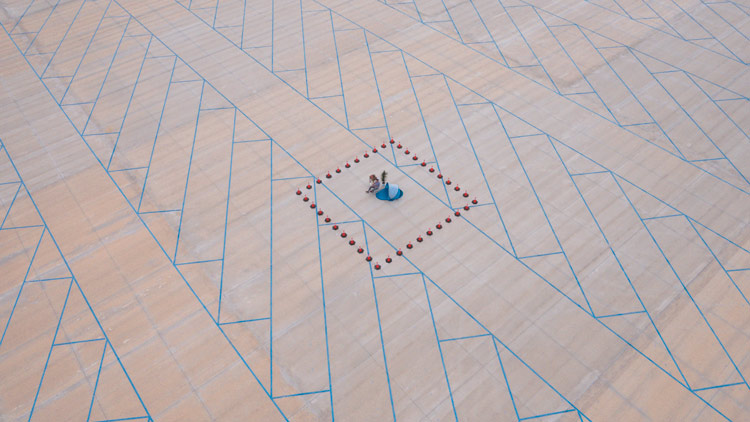
Rubén Martín de Lucas, "Repúblicas mínimas", nº 5

Since the beginning of his solo career, Rubén Martín de Lucas has developed a work focused on the relationship of the individual with the environment and his intervention on the territory. The discursive load of the work of this multidisciplinary artist adopts numerous forms and proposals, from painting to photography, although in recent times his projects tend to video creation. With an expressive language that starts from the exploration of the landscape and the analysis of the footprint of humankind in nature, Rubén proposes a critical approach to certain concepts that result in artificial delimitations, barriers and separations which the landscape does not understand. As he explains: "I speak of borders, of the strange concept of property of the land, of overpopulation, of industrial agriculture, of the anthropisation of the landscape. Understanding my work takes time and a small effort on the part of the viewer." To these ideas responds his most ambitious project "Stupid borders", of which "Repúblicas mínimas" is one of his lines of work: a process of creation permanently open that will have in Art Madrid a new unpublished piece.
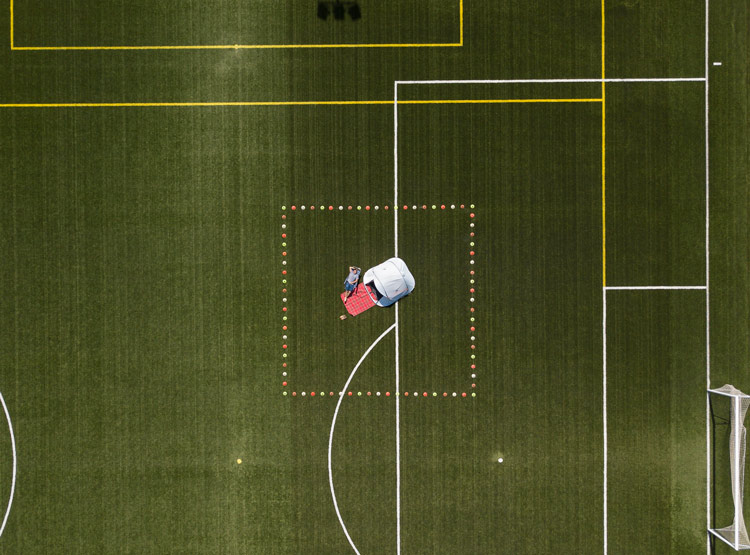
Rubén Martín de Lucas, "Repúblicas mínimas", nº 11

From Art Madrid we want to value the constant evolution, the expressive search and the discursive commitment of Rubén's work. He is an indefatigable artist who does not understand obstacles, and risks in his works with innovative proposals. In addition, he has a mature and transcendent artistic discourse, resulting in a coherent and very promising career.

Rubén Martín de Lucas graduated in Civil Engineering in 2002, but before finishing his studies he began to excel in his artistic side by co-founding the Boa Mistura group, a collective that stands out mainly for its urban art interventions in Brazil, South Africa, Germany, Mexico or Norway. In 2015 he decided to start his solo career with a discourse focused on the reflection on the intervention of mankind in the environment; a thematic line from which several projects have already emerged and which have allowed Rubén to participate in numerous exhibitions inside and outside Spain.
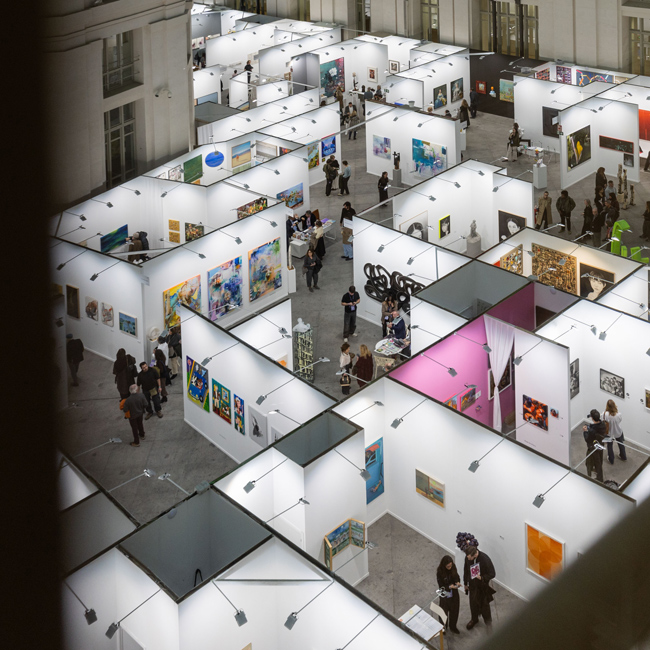


ART MADRID’26 INTERVIEW PROGRAM. CONVERSATIONS WITH ADONAY BERMÚDEZ


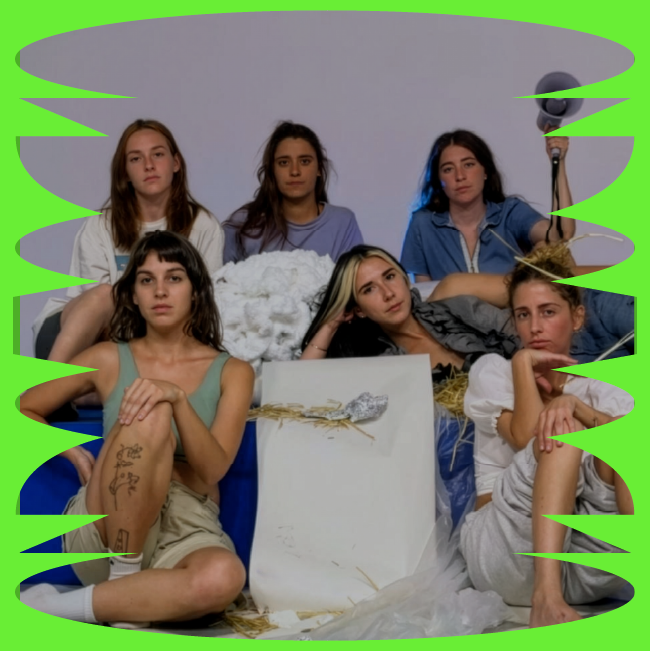
The practice of the collective DIMASLA (Diana + Álvaro) is situated at a fertile intersection between contemporary art, ecological thinking, and a philosophy of experience that shifts the emphasis from production to attention. Faced with the visual and material acceleration of the present, their work does not propose a head-on opposition, but rather a sensitive reconciliation with time, understood as lived duration rather than as a measure. The work thus emerges as an exercise in slowing down, a pedagogy of perception where contemplating and listening become modes of knowledge.

In the work of DIMASLA (Diana + Álvaro), the territory does not function as a framework but rather as an agent. The landscape actively participates in the process, establishing a dialogical relationship reminiscent of certain eco-critical currents, in which subjectivity is decentralized and recognized as part of a broader framework. This openness implies an ethic of exposure, which is defined as the act of exposing oneself to the climate, the elements, and the unpredictable, and this means accepting vulnerability as an epistemological condition.

The materials—fabrics, pigments, and footprints—serve as surfaces for temporary inscriptions and memories, bearing the marks of time. The initial planning is conceived as an open hypothesis, allowing chance and error to act as productive forces. In this way, the artistic practice of DIMASLA (Diana + Álvaro) articulates a poetics of care and being-with, where creating is, above all, a profound way of feeling and understanding nature.


In a historical moment marked by speed and the overproduction of images, your work seems to champion slowness and listening as forms of resistance. Could it be said that your practice proposes a way of relearning time through aesthetic experience?

Diana: Yes, but more than resistance or vindication, I would speak of reconciliation—of love. It may appear slow, but it is deliberation; it is reflection. Filling time with contemplation or listening is a way of feeling. Aesthetic experience leads us along a path of reflection on what lies outside us and what lies within.


The territory does not appear in your work as a backdrop or a setting, but as an interlocutor. How do you negotiate that conversation between the artist’s will and the voice of the place, when the landscape itself participates in the creative process?

Álvaro: For us, the landscape is like a life partner or a close friend, and naturally this intimate relationship extends into our practice. We go to visit it, to be with it, to co-create together. We engage in a dialogue that goes beyond aesthetics—conversations filled with action, contemplation, understanding, and respect.

Ultimately, in a way, the landscape expresses itself through the material. We respect all the questions it poses, while at the same time valuing what unsettles us, what shapes us, and what stimulates us within this relationship.


The Conquest of the Rabbits I & II. 2021. Process.


In your approach, one senses an ethic of exposure: exposing oneself to the environment, to the weather, to others, to the unpredictable. To what extent is this vulnerability also a form of knowledge?

Diana: For us, this vulnerability teaches us a great deal—above all, humility. When we are out there and feel the cold, the rain, or the sun, we become aware of how small and insignificant we are in comparison to the grandeur and power of nature.

So yes, we understand vulnerability as a profound source of knowledge—one that helps us, among many other things, to let go of our ego and to understand that we are only a small part of a far more complex web.


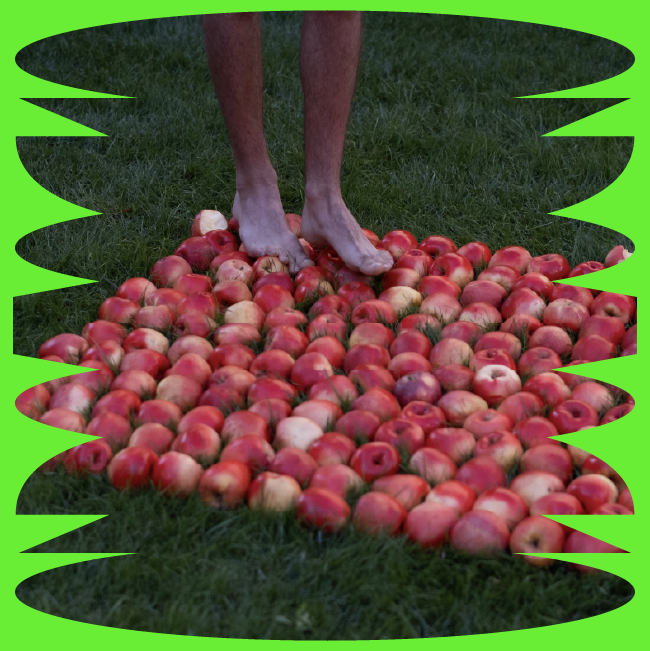
Sometimes mountains cry too. 2021. Limestone rockfall, sun, rain, wind, pine resin on acrylic on natural cotton canvas, exposed on a blanket of esparto grass and limestone for two months.. 195 cm x 130 cm x 3 cm.


Your works often emerge from prolonged processes of exposure to the environment. Could it be said that the material—the fabrics, the pigments, the traces of the environment—acts as a memory that time writes on you as much as you write on it?

Álvaro: This is a topic for a long conversation, sitting on a rock—it would be very stimulating. But if experiences shape people’s inner lives and define who we are in the present moment, then I would say yes, especially in that sense.

Leaving our comfort zone has led us to learn from the perseverance of plants and the geological calm of mountains. Through this process, we have reconciled ourselves with time, with the environment, with nature, with ourselves, and even with our own practice. Just as fabrics hold the memory of a place, we have relearned how to pay attention and how to understand. Ultimately, it is a way of deepening our capacity to feel.


The fox and his tricks. 2022. Detail.


To what extent do you plan your work, and how much space do you leave for the unexpected—or even for mistakes?

Diana: Our planning is limited to an initial hypothesis. We choose the materials, colours, places, and sometimes even the specific location, but we leave as much room as possible for the unexpected to occur. In the end, that is what it is really about: allowing nature to speak and life to unfold. For us, both the unexpected and mistakes are part of the world’s complexity, and within that complexity we find a form of natural beauty.