Art Madrid'26 – THE ART OF TERROR

Halloween has become fashionable nowadays because it adds a bit of humour and mystery to a traditionally solemn and serious celebration in which we face a mandatory appointment with death. Despite the imported traditions, the emptying of pumpkins and the famous phrase "trick or treat" (which was never said in our country ever), the truth is that there is a certain homogeneity in the fact that we get ready for an encounter with the after-death world. From this core idea, derive the others that play with the fear of the unknown, the fear of death, the connection with the underworld, etc., proposing a more open and humorous approach. And we, in our particular Halloween, make a reminder of some works that treat fear and terror in a masterly way.
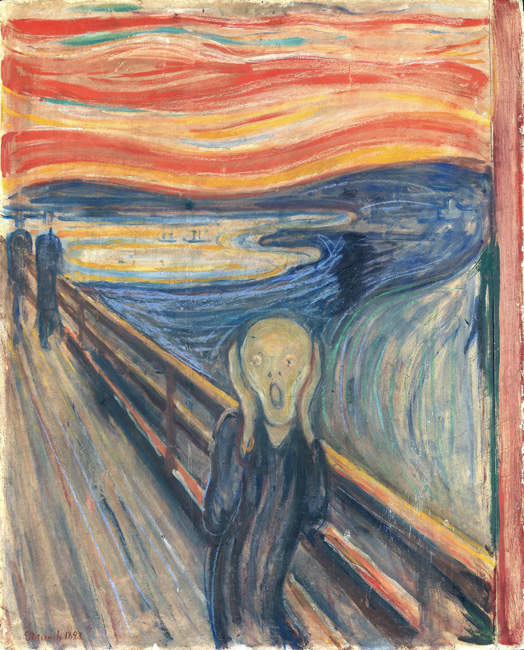
Edvard Munch, "The scream", 1893

This well-known Munch painting is the work par excellence of the Expressionism, an artistic stream that tried to convey the sensations through the colour, without necessarily keeping coherence and verisimilitude. This artist, known for his tormented and dejected character, was one of the greatest representatives of this movement. The most famous version of this work is in Oslo, in the National Gallery of Norway, where it was stolen several times, the last in 2004, until in 2006 the piece could be recovered.
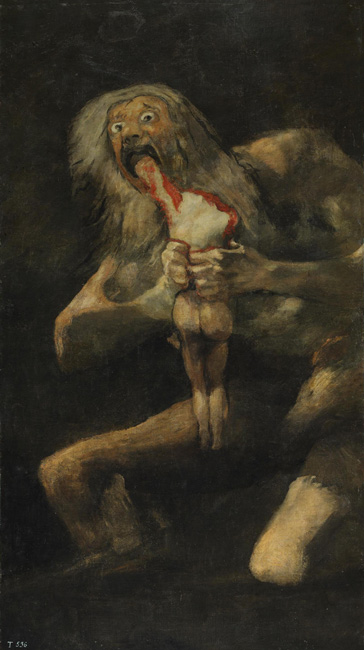
Goya, "Saturn devouring his son", (1819-1823)

.jpg)

One of the most tormented paintings known is "Saturn devouring his son", by Goya. This work is framed within his famous period of Black Paintings, all dry oils, painted on the wall, in which the artist deals with dark themes related to tragedy and depression. This period coincides with a serious illness of the painter, who channelled his displeasure and disappointment through his work. Saturn represents the Titan Chronos, the god of time, who devours everything in its path. It is a crude and raw work that does not hide its violence, and that Goya had in his house of the Quinta del Sordo.
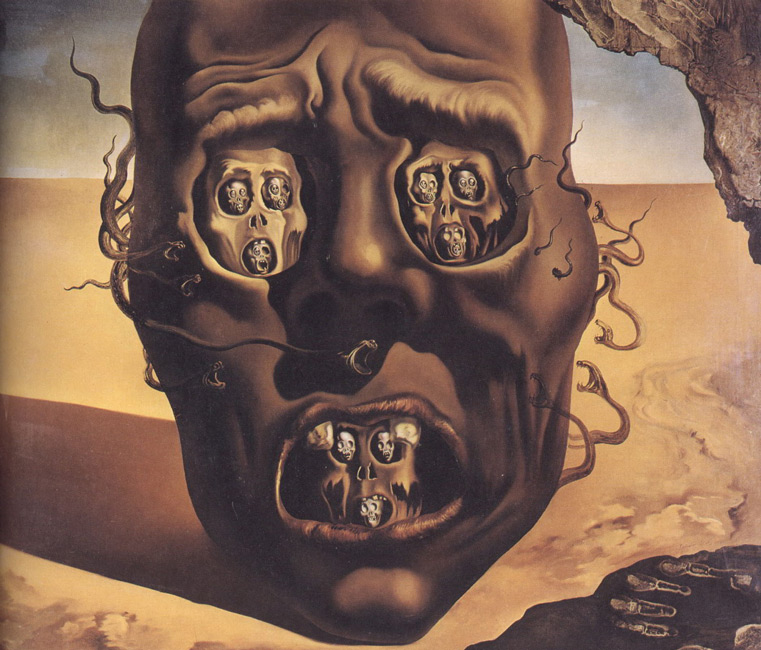
Salvador Dalí, "The face of war", 1940

"The face of war" painted by Dalí between the end of the Civil War and the beginning of World War II represents the horror of tragedy, the empty sockets, which enclose other faces multiplied in an infinite approximation, to manifest the desolation and impotence. It is said that another motivation of the author for this painting was the execution of Federico García Lorca, with whom Dalí had an intimate relationship.
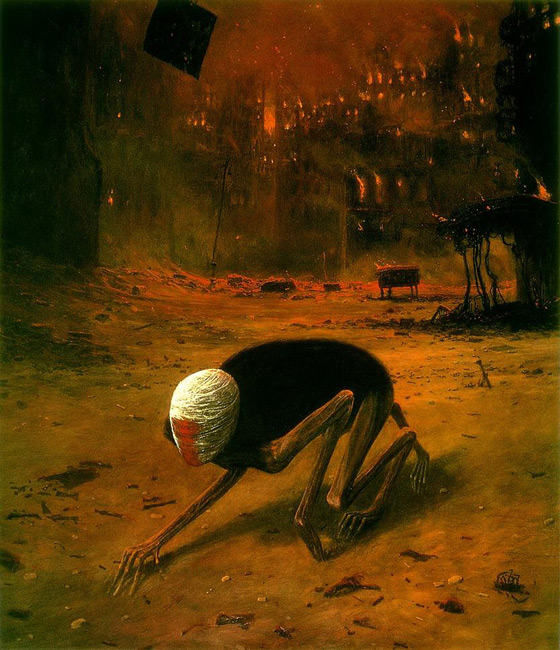
Zdzislaw Beksinski

And we must highlight the work of Zdzislaw Beksinski. The life of this Polish artist was also testimony to a great life tragedy. He himself was found dead of 17 stabs in his home in 2005. This multidisciplinary author is considered one of the maximum representatives of contemporary surrealism, and his works do not leave indifferent. The presence of death, the connections with the underworld, the horror of sinister images with beings devoured by apocalyptic entities are their most recurrent motives. Beksinski said that he painted what was in his dreams, but he was very jealous of what he communicated, because he destroyed several of his works because he said they were too personal for the world to know them.


ART MADRID’26 INTERVIEW PROGRAM. CONVERSATIONS WITH ADONAY BERMÚDEZ


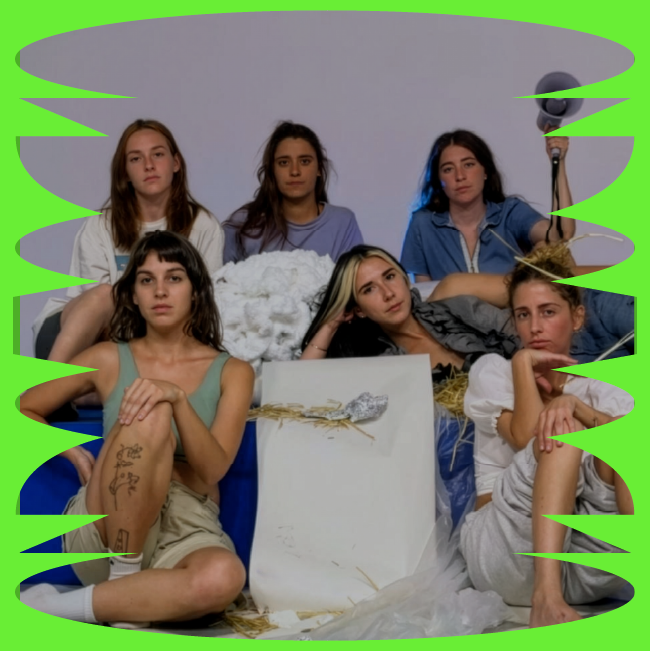
The practice of the collective DIMASLA (Diana + Álvaro) is situated at a fertile intersection between contemporary art, ecological thinking, and a philosophy of experience that shifts the emphasis from production to attention. Faced with the visual and material acceleration of the present, their work does not propose a head-on opposition, but rather a sensitive reconciliation with time, understood as lived duration rather than as a measure. The work thus emerges as an exercise in slowing down, a pedagogy of perception where contemplating and listening become modes of knowledge.

In the work of DIMASLA (Diana + Álvaro), the territory does not function as a framework but rather as an agent. The landscape actively participates in the process, establishing a dialogical relationship reminiscent of certain eco-critical currents, in which subjectivity is decentralized and recognized as part of a broader framework. This openness implies an ethic of exposure, which is defined as the act of exposing oneself to the climate, the elements, and the unpredictable, and this means accepting vulnerability as an epistemological condition.

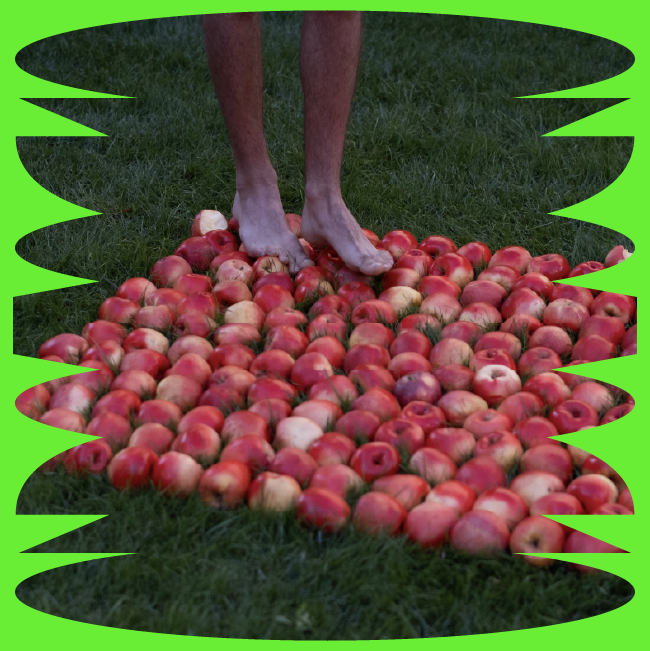
The materials—fabrics, pigments, and footprints—serve as surfaces for temporary inscriptions and memories, bearing the marks of time. The initial planning is conceived as an open hypothesis, allowing chance and error to act as productive forces. In this way, the artistic practice of DIMASLA (Diana + Álvaro) articulates a poetics of care and being-with, where creating is, above all, a profound way of feeling and understanding nature.


In a historical moment marked by speed and the overproduction of images, your work seems to champion slowness and listening as forms of resistance. Could it be said that your practice proposes a way of relearning time through aesthetic experience?

Diana: Yes, but more than resistance or vindication, I would speak of reconciliation—of love. It may appear slow, but it is deliberation; it is reflection. Filling time with contemplation or listening is a way of feeling. Aesthetic experience leads us along a path of reflection on what lies outside us and what lies within.


The territory does not appear in your work as a backdrop or a setting, but as an interlocutor. How do you negotiate that conversation between the artist’s will and the voice of the place, when the landscape itself participates in the creative process?

Álvaro: For us, the landscape is like a life partner or a close friend, and naturally this intimate relationship extends into our practice. We go to visit it, to be with it, to co-create together. We engage in a dialogue that goes beyond aesthetics—conversations filled with action, contemplation, understanding, and respect.

Ultimately, in a way, the landscape expresses itself through the material. We respect all the questions it poses, while at the same time valuing what unsettles us, what shapes us, and what stimulates us within this relationship.


The Conquest of the Rabbits I & II. 2021. Process.


In your approach, one senses an ethic of exposure: exposing oneself to the environment, to the weather, to others, to the unpredictable. To what extent is this vulnerability also a form of knowledge?

Diana: For us, this vulnerability teaches us a great deal—above all, humility. When we are out there and feel the cold, the rain, or the sun, we become aware of how small and insignificant we are in comparison to the grandeur and power of nature.

So yes, we understand vulnerability as a profound source of knowledge—one that helps us, among many other things, to let go of our ego and to understand that we are only a small part of a far more complex web.


Sometimes mountains cry too. 2021. Limestone rockfall, sun, rain, wind, pine resin on acrylic on natural cotton canvas, exposed on a blanket of esparto grass and limestone for two months.. 195 cm x 130 cm x 3 cm.


Your works often emerge from prolonged processes of exposure to the environment. Could it be said that the material—the fabrics, the pigments, the traces of the environment—acts as a memory that time writes on you as much as you write on it?

Álvaro: This is a topic for a long conversation, sitting on a rock—it would be very stimulating. But if experiences shape people’s inner lives and define who we are in the present moment, then I would say yes, especially in that sense.

Leaving our comfort zone has led us to learn from the perseverance of plants and the geological calm of mountains. Through this process, we have reconciled ourselves with time, with the environment, with nature, with ourselves, and even with our own practice. Just as fabrics hold the memory of a place, we have relearned how to pay attention and how to understand. Ultimately, it is a way of deepening our capacity to feel.


The fox and his tricks. 2022. Detail.


To what extent do you plan your work, and how much space do you leave for the unexpected—or even for mistakes?

Diana: Our planning is limited to an initial hypothesis. We choose the materials, colours, places, and sometimes even the specific location, but we leave as much room as possible for the unexpected to occur. In the end, that is what it is really about: allowing nature to speak and life to unfold. For us, both the unexpected and mistakes are part of the world’s complexity, and within that complexity we find a form of natural beauty.