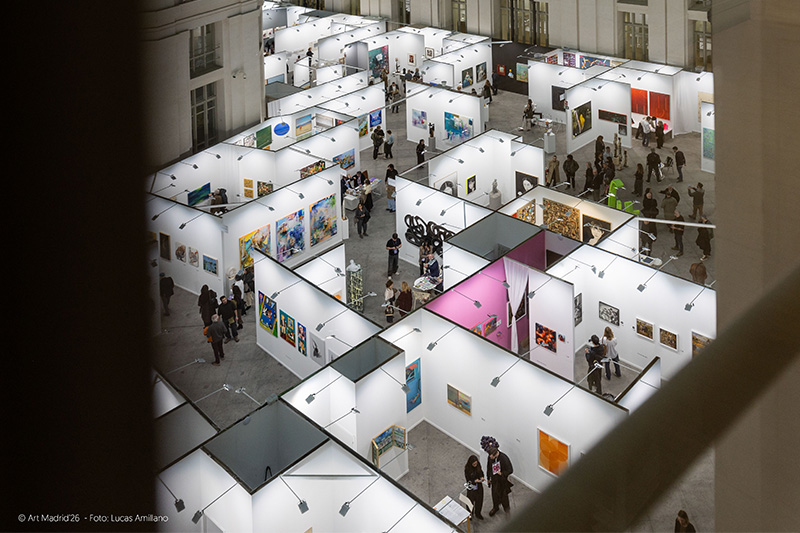
Art Madrid'26 – THE PORTUGUESE GALLERIES OF ART MADRID FAIR

While Art Lounge repeats in Art MAdrid, Nuno Sacramento and Arte Periférica are premiered in this edition with new artists and others of recognized trajectory. An opportunity to get closer to the Portuguese art market.
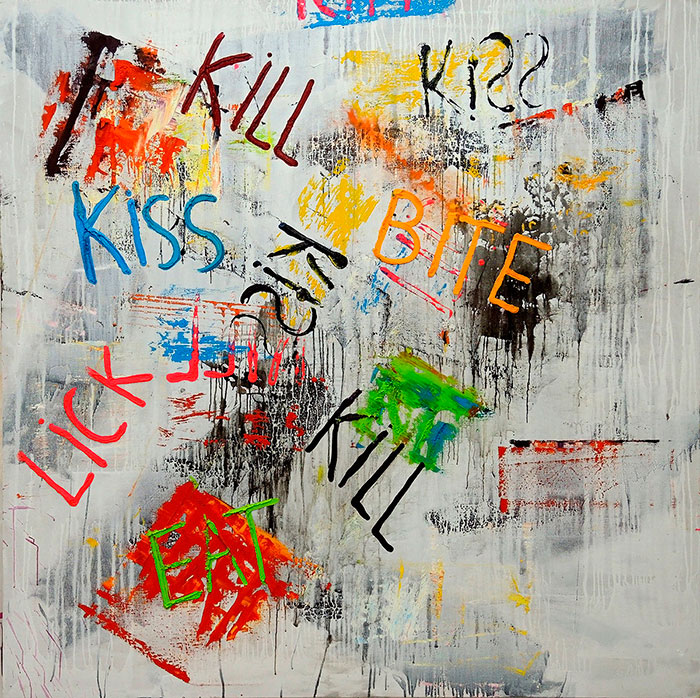


Papartus. Untitled - Mixed media on canvas - 200 x 200 cm - 2014


The gallery Nuno Sacramento was founded in the city of Aveiro (Portugal) in 2003. In 2009 the gallery changes its headquarters to Ílhavo, where it has a space specially designed to be a contemporary art gallery. Nuno Sacramento performs six individual and collective exhibitions per year, and publishes catalogs about its artists. In addition, he actively participates in museums and cultural centers in many Portuguese cities and around the world, highlighting those made in the Museum of Decorative Arts in Havana and those of the CEART Museum in Madrid.


Nuno Sacramento comes to Art Madrid’17 with a monograph by the artist Papartus, who returns to the cultural scene in Madrid with recent works of large format. Some of the artist's pieces are in public collections such as the Huarte Museum in Navarra, the Malaga Architects Association and the Pamplona City Hall, among others.
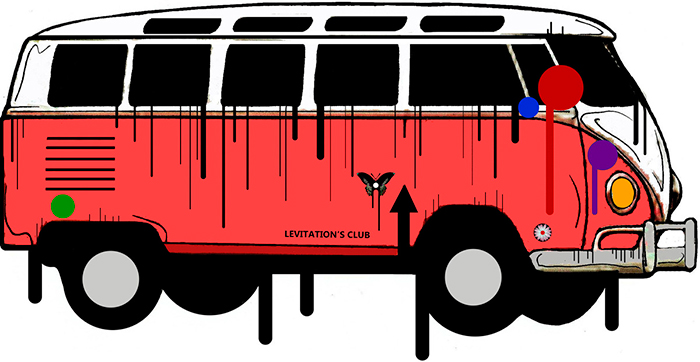


Joâo Noutel. Untitled - Mixed technique on MDF - 130 x 68 cm - 2016


Art Lounge Gallery, one of the veteran foreign galleries in Art Madrid, selects artists from many different origins, defending the importance of cultural exchange and promoting the work of artists little known in Portugal. Its intention is to enhance the internationalization of the contemporary plastic arts.


The gallery will exhibit in its stand the work of artists with very different lines, like Fabio Camarotta, Ana Michaelis, Joâo Noutel, the Spanish Carmen Calvo, Angela Bassano and Felix Farfán.


The work of Farfán (Brazil, 1960), for example, has enjoyed great recognition in South America, especially in his native Brazil, in the 80's of last century. His work has participated in numerous collective and individual exhibitions in Brazil, Brasilia, Recife, Olinda and Sao Paulo. In his art works, with a style very similar to Carmen Calvo's, the artist mixes drawing with the assemblage and collage, traditional symbols and popular culture in colorful mixed techniques on which embroiery, rips and colors to create their particular universe.
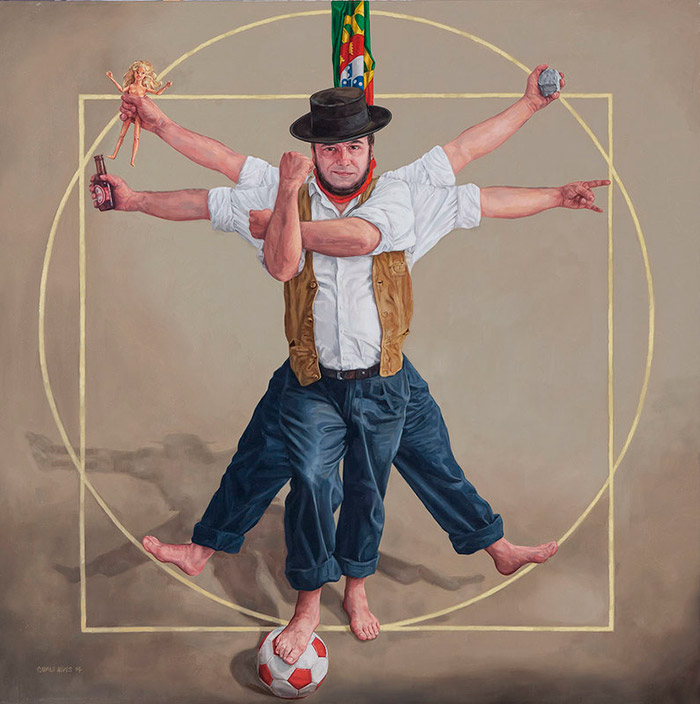


Camilo Alves. Zé Povinho according to Vetrúvio. Oil on canvas. 100x100 cm. 2014


Arte Periférica Gallery was founded in 1991 by Anabela Antunes and Pedro Reigadas and, since 1994, occupies a special place in the popular Cultural Center of Belem, on the outskirts of Lisbon, where it also has a shop of Fine Arts products. During 25 years of activity it has been outstanding for promoting the work of young artists from inside and outside Portugal, with special dedication to Spanish and Asian artists. Arte Periférica has imposed an ambitious agenda with 12 annual exhibitions.


His proposal for Art Madrid includes the work of Angela Sanchez, Eva Navarro, Eva Armisén, Camilo Alves and Isabel Sabino.


Isabel Sabino (Lisbon, 1955) has exhibited individually in Lisbon on numerous occasions, with Arte Periférica Gallery but also with the Galería Novo Século and at the Casa Museo Jorge Vieira. He has participated in collective exhibitions such as the Biennial of Lagos or the Biennial of Vila Nova de Cerveira. Her work, eminently on paper, is expressed in mixed techniques, watercolors and drawing to talk about an almost surrealist figuration in which the scenes - ilusions , allegories and dreams- appear fulled of color spots, geometric structures and apparently delocalized elements in a Painting full of energy.


ART MADRID’26 INTERVIEW PROGRAM. CONVERSATIONS WITH ADONAY BERMÚDEZ


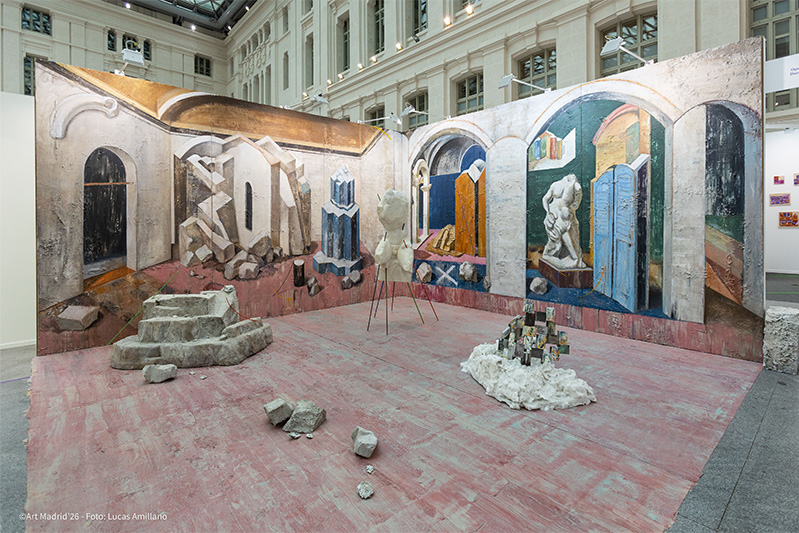
The work of Cedric Le Corf (Bühl, Germany, 1985) is situated in a territory of friction, where the archaic impulse of the sacred coexists with a critical sensibility characteristic of contemporary times. His practice is grounded in an anthropological understanding of the origin of art as a foundational gesture: the trace, the mark, the need to inscribe life in the face of the awareness of death.

The artist establishes a complex dialogue with the Spanish Baroque tradition, not through stylistic mimicry, but through the emotional and material intensity that permeates that aesthetic. The theatricality of light, the embodiment of tragedy, and the hybridity of the spiritual and the carnal are translated in his work into a formal exploration, where underlying geometry and embedded matter generate perceptual tension.

In Le Corf’s practice, the threshold between abstraction and figuration is not an opposition but a site of displacement. Spatial construction and color function as emotional tools that destabilize the familiar. An open methodology permeates this process, in which planning coexists with a deliberate loss of control. This allows the work to emerge as a space of silence, withdrawal, and return, where the artist confronts his own interiority.


The Fall. 2025. Oil on canvas.195 × 150 cm.


In your work, a tension can be perceived between devotion and dissidence. How do you negotiate the boundary between the sacred and the profane?

In my work, I feel the need to return to rock art, to the images I carry with me. From the moment prehistoric humans became aware of death, they felt the need to leave a trace—marking a red hand on the cave wall using a stencil, a symbol of vital blood. Paleolithic man, a hunter-gatherer, experienced a mystical feeling in the presence of the animal—a form of spiritual magic and rituals linked to creation. In this way, the cave becomes sacred through the abstract representation of death and life, procreation, the Venus figures… Thus, art is born. In my interpretation, art is sacred by essence, because it reveals humankind as a creator.


Between Dog and Wolf II. 2025. Oil on canvas. 97 × 70 cm.


Traces of the Spanish Baroque tradition can be seen in your work. What do you find in it that remains contemporary today?

Yes, elements of the Spanish Baroque tradition are present in my work. In the history of art, for example, I think of Arab-Andalusian mosaics, in which I find a geometry of forms that feels profoundly contemporary. In Spanish Baroque painting and sculpture, one recurring theme is tragedy: death and the sacred are intensely embodied, whether in religious or profane subjects, in artists such as Zurbarán, Ribera, El Greco, and also Velázquez. I am thinking, for example, of the remarkable equestrian painting of Isabel of France, with its geometry and nuanced portrait that illuminates the painting.

When I think about sculpture, the marvelous polychrome sculptures of Alonso Cano, Juan de Juni, or Pedro de Mena come to mind—works in which green eyes are inlaid, along with ivory teeth, horn fingernails, and eyelashes made of hair. All of this has undoubtedly influenced my sculptural practice, both in its morphological and equestrian dimensions. Personally, in my work I inlay porcelain elements into carved or painted wood.


Between Dog and Wolf I. 2025. Oil on canvas. 97 × 70 cm.


What interests you about that threshold between the recognizable and the abstract?

For me, any representation in painting or sculpture is abstract. What imposes itself is the architectural construction of space, its secret geometry, and the emotion produced by color. It is, in a way, a displacement of the real in order to reach that sensation.


The Anatomical Angel. 2013. Ash wood and porcelain. 90 × 15 × 160 cm.


Your work seems to move between silence, abandonment, and return. What draws you toward these intermediate spaces?

I believe it is by renouncing the imitation of external truth, by refusing to copy it, that I reach truth—whether in painting or in sculpture. It is as if I were looking at myself within my own subject in order to better discover my secret, perhaps.


Justa. 2019. Polychrome oak wood. 240 × 190 × 140 cm.


To what extent do you plan your work, and how much space do you leave for the unexpected—or even for mistakes?

It is true that, on occasions, I completely forget the main idea behind my painting and sculpture. Although I begin a work with very clear ideas—preliminary drawings and sketches, preparatory engravings, and a well-defined intention—I realize that, sometimes, that initial idea gets lost. It is not an accident. In some cases, it has to do with technical difficulties, but nowadays I also accept starting from a very specific idea and, when faced with sculpture, wood, or ceramics, having to work in a different way. I accept that.