FEMALE GALLERISTS, WOMEN OF ART IN ART MADRID’18
Jan 11, 2018
art madrid
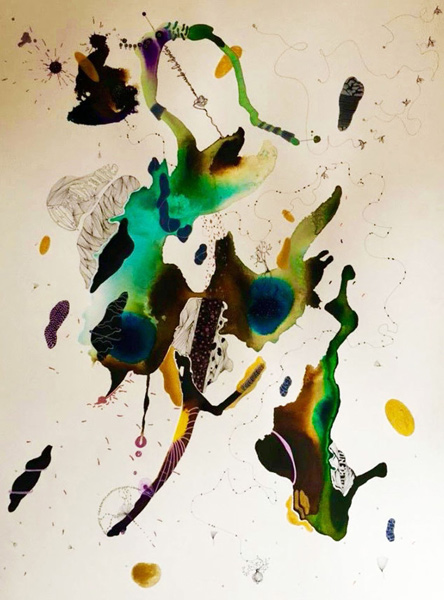
Nuria Formentí, “A veces ando por las nubes”, mixed technique.
Although the statistics continue to speak of a minimum visibility of women artists and a spurious role in the capital sectors of the art world (and we did not save any of the fairs or of the main institutions and museums ...), the women of art are coming out of this inherited trend and do what they have been doing for centuries: be true to their principles. In Art Madrid'18 we are lucky to work for years with great female professionals who have struggled to gain a foothold in the sector of their respective cities, women gallerists who bet on quality, for long and close relationships with their artists and for the intuition.
The Marita Segovia Gallery, in Madrid, opened its doors in 2004 and, uninterruptedly, has participated in national and international fairs, consolidating itself as a dynamic, eclectic space with an interesting curatorial work. The gallery works with national and foreign artists of short and long career and with work of all disciplines, from painting to photography, video-creation etc ... Marita Segovia presents a mixed proposal in Art Madrid’18 (2 male artists and 2 women) composed of Joaquim Chancho, Angela Glajcar, Hernández Pijuan and Dominica Sánchez.
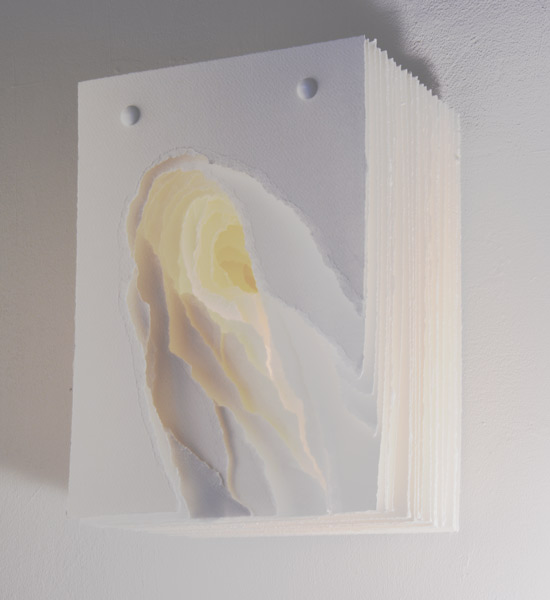
Angela Glajcar, “Terforation 007”, 200gr paper, metal support and plastic, 2017
Angela Glajcar is a German sculptor who works with plastic and paper and creates works that play with the space between solid and vacuum. She perforates sets of sheets of paper creating a strong sculptural presence that floats freely in space or rests on the plane. During the last years, she has received numerous recognitions, such as ZONTA Art Prize, Phoenix Art Prize and Regionale 2010 Wilhelm-Hack-Museum.
Dominica Sánchez, on the other hand, uses painting to arrive at a more intimate observation of the natural world, to establish a dialogue between the fragile and ephemeral and the volume's musculature. Sánchez has long perfected this pictorial language, whose simplicity does not clash with the depth of the emotions that the drawings entail, they are not just sketches for his sculptures, but rather independent works.
From Valencia, comes the gallery Alba Cabrera, directed by Graciela Devincenzi D'Amico that is dedicated from its origins to promote young values and renowned artists to whom it dedicates fantastic monographic exhibitions and shows their work in fairs around the world. It also proposes an egalitarian tandem at the February fair with works by Cristina Alabau, Nanda Botella, Calo Carratalá and José Juan Gimeno.
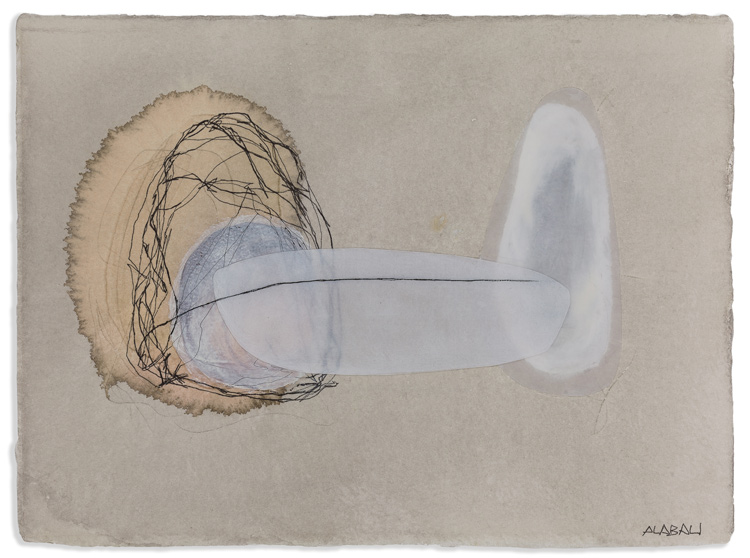
Cristina Alabau, “Espacio interior”, watercolor and collage, 2017.
Cristina Alabau moves between natural figurative and abstraction with light as the main protagonist of her canvases, which brings poetics, emotion, intimacy and that almost meditative tone reminiscent of oriental philosophies, contemplation and retirement. Her work can be seen in the Museum of Villafamés, the Spanish Ministry of Culture, the Palau de Valencia or the Polytechnic University of Valencia.
Nanda Botella is undoubtedly more material, in her paintings and collages she combines the sign and the doodle, the writing and the color stain, the textual and what is sewn. Her pieces are vertebrate, reticular, whose aesthetics can be understood as a collage of memories and dreams in which fragments of cloth are mixed, written messages and that evolve from paintings to installations, more luminous and experimental.
In Oviedo, Arancha Osoro runs an art space in the heart of the city that has become a reference for collectors and local art lovers. Focused exclusively on contemporary and emerging art, they opt for an authentic and personal art that has nothing to do with the mercantilist trends that move the artistic sector and they approach their clients with a fresh, innovative, future offer, working closely with each artist, helping them in their career to consolidate their own style. The artists participating in Art Madrid’18 of this gallery are Nuria Formenti, Jezebel, Kiko Miyares, Luis Parades and Roberto Rodríguez.
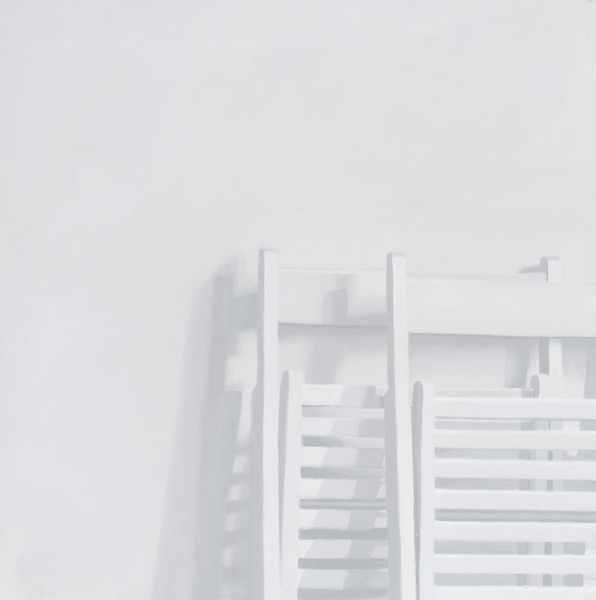
Jezabel Rodríguez, untitled, acrylic on canvas, 2017.
The artist Nuria Formentí was born in Gijón but has lived in different countries such as Panama, the United States, the United Kingdom, Switzerland, although it was Colombia, specifically Cartagena de Indias, the city that left her a deep impression and in which, in 1999, she started to paint. Her work, essentially on paper, in watercolor, graphite and ink, has often been described as magical realism because her drawings and spots have something of narration and dream. Pictorial art and word are mixed in her papers, which recalls the first vocation as a writer of this artist.
Jezabel Rodríguez paints memories. In her paintings, the matter is a fugitive, transparent matter, almost a phantom of the object, of still life, a shadow of presence ... Educated in diverse disciplines such as sculpture, painting and ceramics, her paintings, of a pure white have fragile volumes like pieces freshly taken out of the oven. In 2016, she participated in the exhibition in the Museum of Fine Arts of Asturias "Contemporary Art in the Museum of Fine Arts of Asturias, last generations", she won the third prize in the Contest of Casimiro Baragaña and the second prize in the XXI Painting Contest Nicanor Pinole.
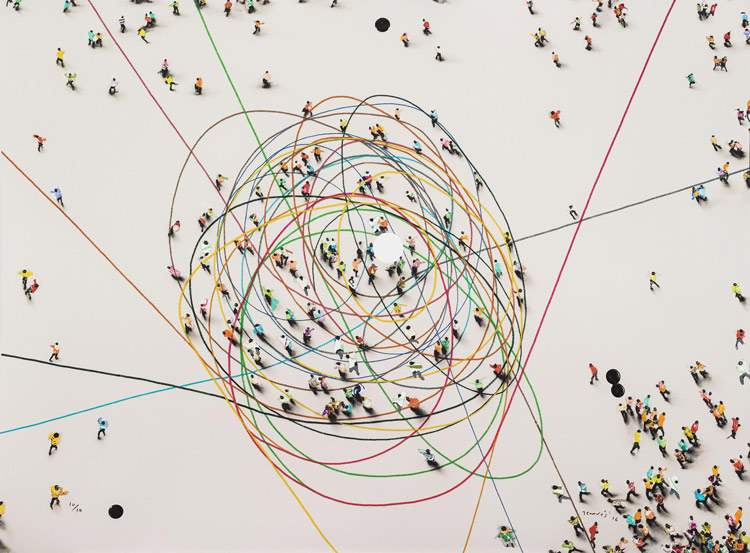
Juan Genovés, “Abaco”, Gliclee-papel Hahnemuhle Photo, 2016.
Also from Asturias, from Gijón this time, comes one of the faithful gallerists to Art Madrid, Aurora Vigil-Escalera, which directs new space as continuity to her thirty years of profession, initiated in 1984, as a member of the Van Dyck Gallery by the hand from his parents Alberto Vigil-Escalera and Ángeles Pérez. Consecrated art, artists of a long and medium career that are updated according to the concerns of the director, her discoveries and her own changes in the art sector, in definitive, experience and quality are the hallmarks of this gallery, an essential visit for many collectors. The artists with whom she participates in Art Madrid'18 are Pablo Armesto, Gorka García, Juan Genovés, Pablo Genovés, Rafa Macarrón, Chema Madoz, Ismael Lagares, David Rodríguez Caballero and Santiago Picatoste. An impressive portfolio.
And more news, because the new project of the Galician Art Gallery Luisa Pita was born as a continuity of the activity that the Bus Station Space Gallery, founded and directed by herself, had been developing in Santiago de Compostela since 2012. Focused now as a more ambitious cultural project, with its own and more personal meaning, this new exhibition space aims to be a meeting point for art between renowned and emerging artists. She works with, among other artists, Yolanda Dorda (a real discovery in the last edition of Art Madrid), Rebeca Plana and Maria José Gallardo (another of the favorites last year at the fair). For Art Madrid'18 she has selected works by Arturo Álvarez, Pierre Louis Geldenhuys and Christian Villamide.
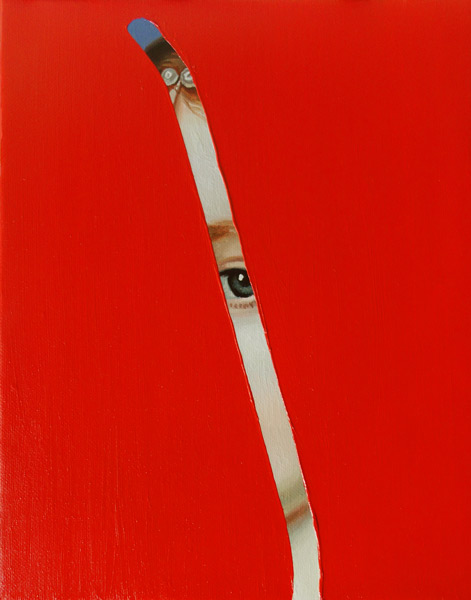
Lino Lago, “Rojo”, oil on linen canvas, 2017.
We finish with another Galician gallery, the Moret Art gallery in A Coruña, directed by Nuria Blanco and with a team of professionals specialized in the contemporary art market committed to emerging art. Moret Art uses many resources that have been incorporated into the sector in recent years, documentary supports, didactic activities, artistic meetings, technological resources designed around the exhibition project ... Everything to bring art, in all its forms, to one audience at a time more extensive and varied. Moret Art also carries out consulting projects related to the valuation and cataloging of works of art and antiques. With a taste for photography and for the new realism, they come to Art Madrid'18 with works by Xurxo Gómez-Chao, Miquel Piñeiro, Iván Prieto and Lino Lago, whose hyperrealist paintings are abruptly interrupted by the stain, or left barely imagining behind of relentless curtains of pure color, always playing with the expressive possibilities of painting with an almost irreverent attitude and pop in the hands of a master with a very refined pictorial technique.
To this group of women of art they join, for the first time in Art Madrid, the gallerists Mercedes Roldán and Soraya Cartategui, both based in Madrid, the Valencian gallery Shiras, with Sara Joudi in charge, and Nebo Art Gallery, directed in Ukraine by Valeriia Ivanova. In addition, Sofía Hernández, director of the Léucade de Murcia gallery participates for the second year in a row at the fair, as well as Arte Periférica, co-directed by Anabela Antunes, and the Zielinsky Gallery, with Carla Zerbes. In the One Project program we will have the presence of Bea Villamarín, director of the homonymous gallery in Asturias and the Brazilian Rv Cultura e Arte, directed by Larissa Martina, as well as Laura Clemente, co-director of Pantocrator Gallery. We can not forget some unconditional galleries like the Gallery BAT, where Mariam Alcaraz is in charge, Art Lounge, by Sofía Tenreiro da Cruz, and the Kreisler Gallery, co-directed by Gabriela Correa. Of all of whom we will talk to you later.