Art Madrid'26 – POETICS OF THE GAZE AND THE IDENTITY

BAT Alberto Cornejo, Moret Art, Zielinsky and Jorge Alcolea Galleries


If there is something especially captivating about the portrait genre, that it is the gaze. For some time the importance of the characters portrayed does not reside exclusively in symbols of power but in the ability to capture psychological essence achieved by the portraitist, being precisely the gaze that gives the portrayed greater psychic depth. In addition, when, the eyes of the portrayed figure look directly at the spectator, there is an astonishing tension, a kind of restlessness that requires dialogue, which exhibits provocation. The power of the gaze seems eternal as if it had a greater consistency able to expose the contained intimacies.
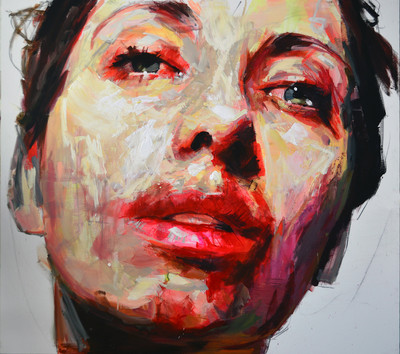
José Ramón Lozano

Sin Título (VI), 2019

Acrylic on canvas

170 x 190cm

However, if the gaze can reflect a person's state of mind in an exceptional way, it can also hide it, make it confusing and inaccessible to external eyes that try to penetrate it. To identify or not to identify, the gaze expresses at the same time unique beings for some, similar ones to others, transcendental or insignificant. Both from the moral and aesthetic standpoint, those portrayed who look at us, who look at us in reality from our contemplation of the present, create a direct tension with the past and identity. Always with a cryptic like air, as the portrait prooves what we shall never be, what we are at the time that the photograph was taken or the portrait was painted, that sense of Barthes’ "this has been", these images are predicting our end.
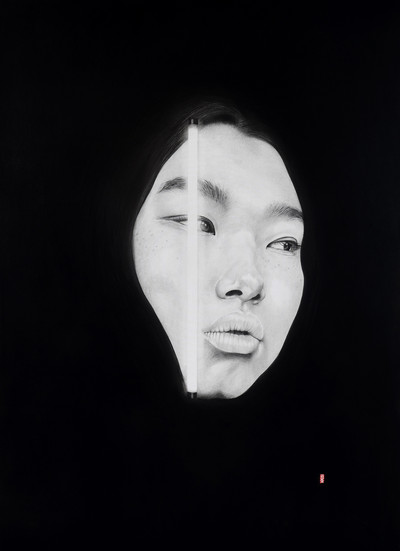
Lantomo

Dim light-dark sea 1, 2019

Graphite and pastel on paper glued to wood

100 x 73cm

Within the great proposal of the BAT Gallery Alberto Cornejo (Madrid) what precisely stands out is the portraiture genre. The women portrayed by José Ramón Lozano usually look at us very consciously, almost demanding that we contemplate and finish the story that they themselves have opened. They have something memorable, a turning point in a possible story of internalized solitude so often accompanied by pain. Very different are the portraits of Lantomo (Antonella Montes), more intimate, more reserved. While the use of graphite, watercolour and pastel is one of the reasons that explains that the figures acquire these characteristics, so is the fact that their characters do not always look at us, but are absorbed in their thoughts and do not require the empathy of the observer.
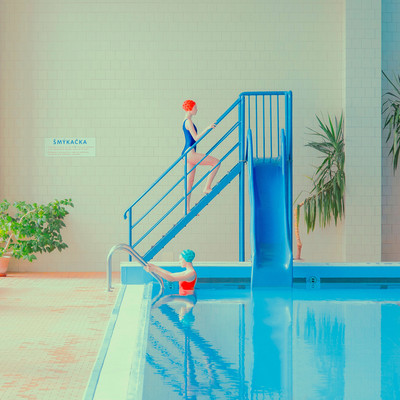
Mária Švarbová

No Diving, Smykacka, 2016

Photography

70 x 70cm

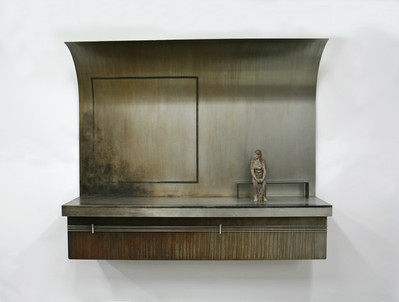
Marta Sánchez Luengo

Llegará, 2016

Bronze and iron

102 x 121cm

Another of the most outstanding portrait artists of our times is Mária Švarbová, a photographer from which the BAT gallery will present a selection of their individual and collective portraits. We attend the portrait of childhood and the beginning of adolescence in stages of meticulous harmony, of bodies so perfect and similar that touch the dreamlike fiction. On the other hand, the figures included by Marta Sánchez Luengo In their sculptures are much more than natural and close, they are realistic. In fact, their naturalistic way of modelling and the attitudes of their characters, as every day as reading a book, waiting for the underground or just walking around thinking, can certainly remind us of the realists from Madrid and especially of some pieces by the master Julio López Hernández. Leticia Felgueroso’s works could also relate to the realists because they share the passion for portraying the city of Madrid, although in the case of Felgueroso is through photography and intervened chromaticism.
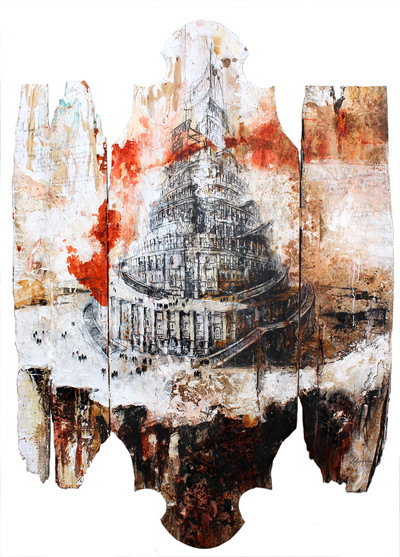
Gustavo Díaz Sosa

De la serie de Revelaciones y Encrucijadas, 2019

Técnica mixta sobre madera. Cara A

200 x 140cm

In this daily work proper of the great metropolises, the contemporary society is also exposed very well: multitudes of people who move on full of worries and anxieties, between haste, jams and "deadlines". This guided mass is a topic that Gustavo Díaz Sosa tends to reflect in series such as "Burócratas y Padrinos", "Huérfanos de Babel" or the most recent "Revelaciones y Encrucijadas". The imposed social behaviours also removed from natural impulses, is a subject that also concerns Rubén Martín de Lucas, of whom a selection of the series "The Garden of Fukuoka" is presented, work in which the Guest Artist of this edition confronts industrial and natural processes.

The BAT proposal closes with the all rounded shapes of the sculptures by Carlos Albert and Carlos Iglesias, Madrid successors of the Basque School of sculpture; the most fluid and sensual works in aluminium by Rafael Amarós; and the matter and lyrical abstractions of Fernando Palacios.
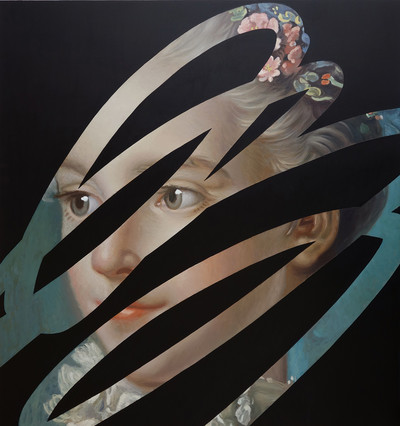
Lino Lago

Fake Abstract (F. Boucher), 2019

Oil on canvas

160 x 150cm

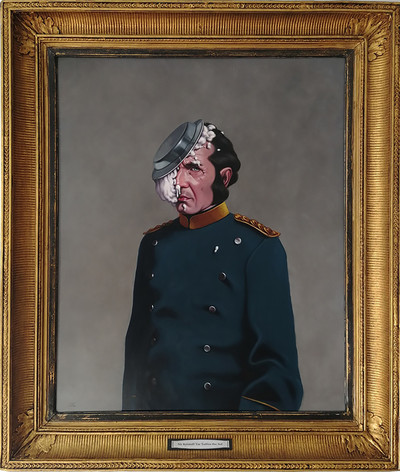
Daniel Sueiras

Sir Kristoff Tar Toffen the 3rd, 2019

Oil on board

93 x 80cm

Watch and reveal, play with what is hidden and what is shown, is a very particular feature of the Lino Lago portraits, an artist who participates in Art Madrid with the Moret Art gallery (A Coruña). This gallery will also present some of the latest works by Daniel Subeiras, such as the painting "Sir Kristoff Tar Toffee the 3rd" (2019), where the author introduces us to the new addition to his ingenious and extensive gallery of portraits, notable for its humorous component and by his masterful control of the oil-on-board technique. Along with the work of Subeiras, a selection of the sculptural work by Iván Prieto is presented: pieces made from its technical characteristic-ceramics after painted with acrylics-in which contemporary bodies, always defective, without abandoning the crave of an impossible and imposed perfection, they are exaggeratedly distorted to the point of reaching surrealistic, extravagant, more beautiful forms.
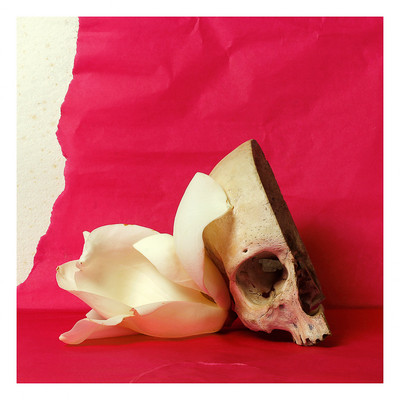
Xurxo Gómez-Chao

Magnolia y calavera (Tempus fugit), 2018

Photography. Mineral pigments on Ilford Prestige paper 270 g

100 x 100cm

Moret Art will also include in its proposal the pieces by Miguel Piñeiro, contemporary still lifes of icons from the culture of our time, especially surprising for the high degree of hyperrealism; and the photographs by Xurxo Gómez-Chao, of which two of his lines of work are presented: on the one hand, a set of the beautiful vanitas stagings, and on the other, his more mystery images of rooms, in which a kind of mist seems to have evaporated the previous presence.
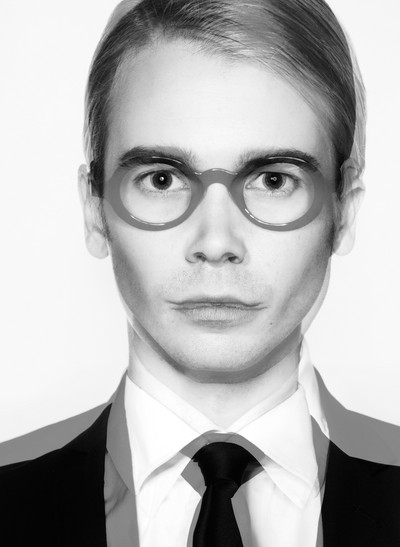
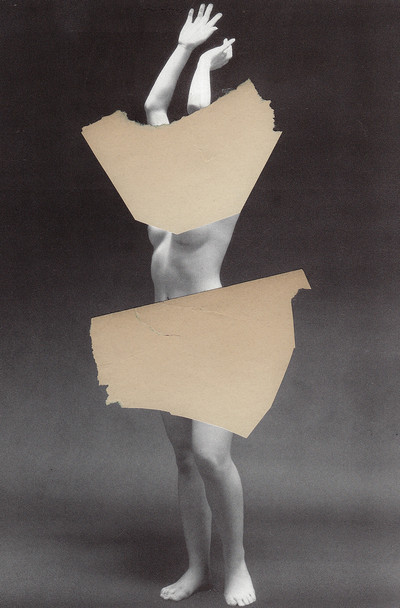
Pachi Santiago

Cerca desde lo masculino, 2012

Light box

42.5 x 32.5cm

Juan Fielitz

Desnudo III, 2018

Hahnemühle paper

120 x 74cm

Within the proposal of the Zielinsky Gallery (Barcelona) it is worth highlighting the work of Pachi Santiago, artist who offers the most explicit game around identity, gaze, codes of representation and appropriation, as we see in the broad project "Copying Claudia", in which the spectator can take part in the same feelings. The appropriation, manipulation and interest in the ways of portraying the human body, is something that he shares with the artist Juan Fielitz who, on the opposite, hides the faces or body parts that we would like to see from the portrayed. Thus, in these images collected in archives, the artist stripped the portrayed of his identity, offering in his final photomontages a poetic ensemble of enigmatic fragments.
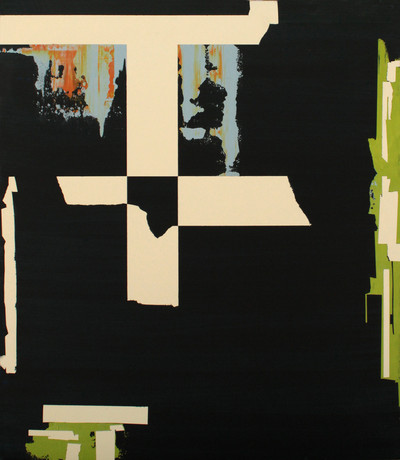
Yamandú Canosa

Vértice, 2016

Oil on wood

47.2 x 40cm

Zielinsky will also expose the photographs by Eduardo Marco, in which an attentive and contemplative look allows us to repair in the beauty that so often goes unnoticed in the big city; surreal and pop worlds, full of winks in which to recognize ourselves, by Joaquín Lalanne; and the cartographies by Yamandú Canosa, metaphors of our being, of our way of living: at the end portraits of emotions that explain our displacement.
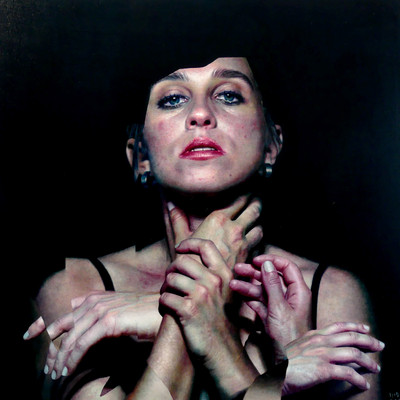
Eloy Morales

Figure 1, 2018

Oil on canvas

100 x 100cm

Some gazes are unique, such as those achieved by Eloy Morales in his huge portraits and self-portrait, that the Jorge Alcolea gallery will show. As the artist explains, for him "the important thing is to show through the work your way of seeing things and the way you present them to the spectator" always maintaining a deep concern for "the tremendous power of the image and its endless possibilities." Other gazes, equally interesting and perhaps more unfathomable, are those from the animal world, some like the bears that star in the latest works by Miguel Macalla.
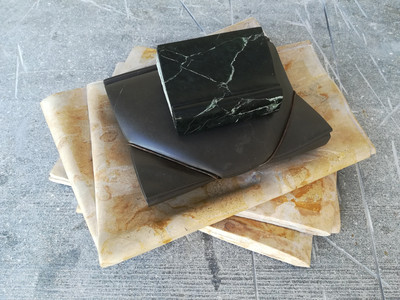
Isidre Tolosa

Diarios, carpeta y libros, 2018

Mármol de calatorao y hierro

11 x 30cm

Jorge Alcolea's proposal is completed with the urban and nocturnal portraits by Carlos Azañedo, those in which the postmodern city never stops never sleeps and each one of us is only "another one". Also in its stand you will be able to see the realistic sculptures by Isidre Tolosa, personal objects like books or diaries that, likewise, can be the best portraits of ourselves because of everything so personal that they reveal; and the paintings by Isabel Ramoneda, free and careless abstractions on paper accompanied by handwritten thoughts.

Multiple gazes for multiple identities; always open works, eternally expectant in front of the possible gaze of the spectator: these are some of the works that can be enjoyed in the new edition of Art Madrid.
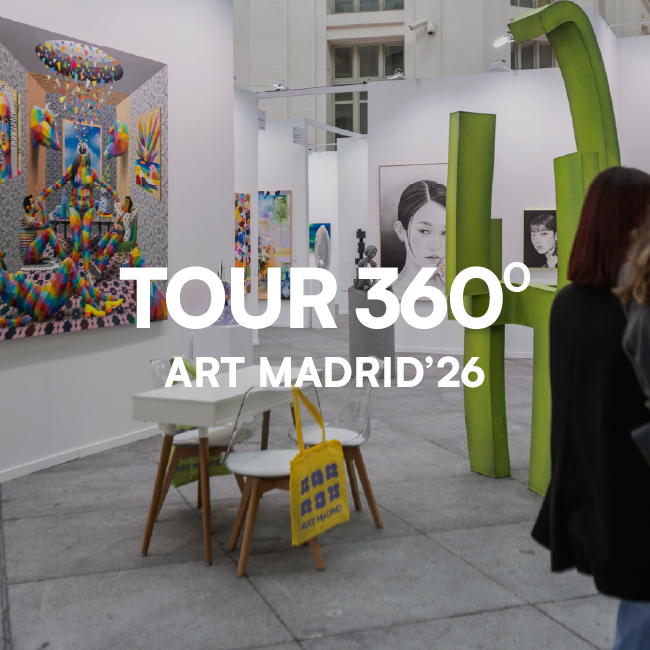
 

ART MADRID '26: 21 YEARS OF CONTEMPORARY ART


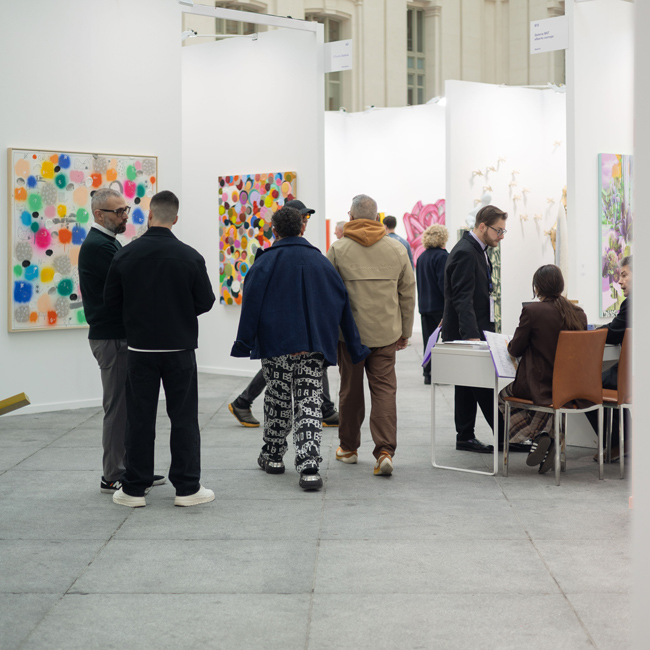
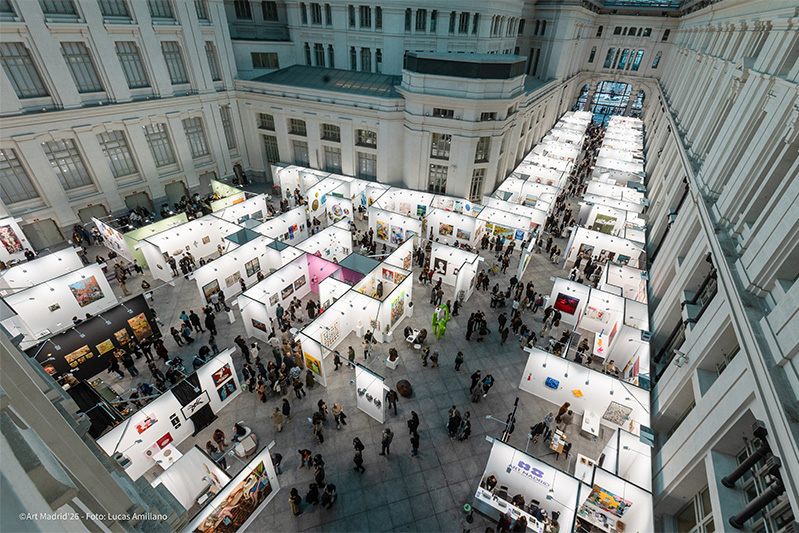
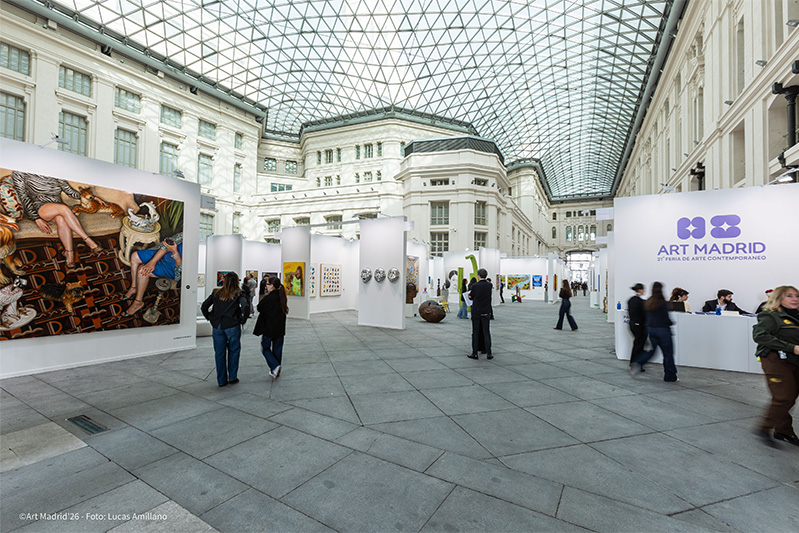
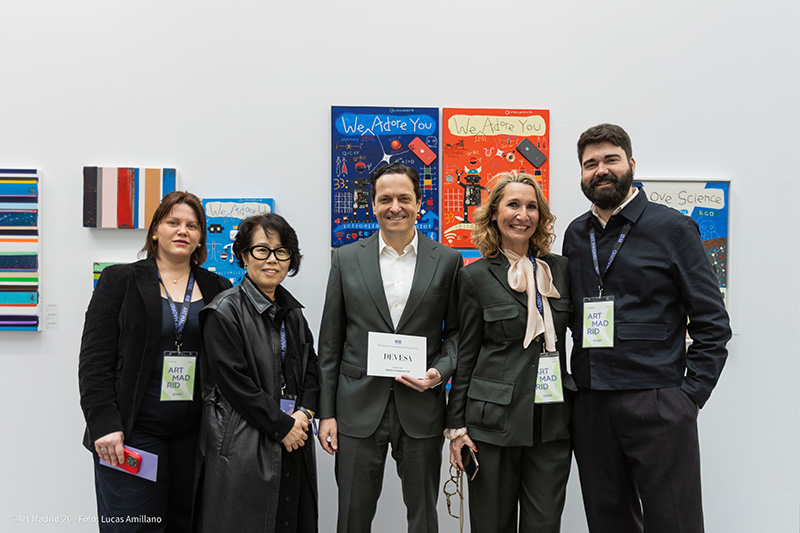
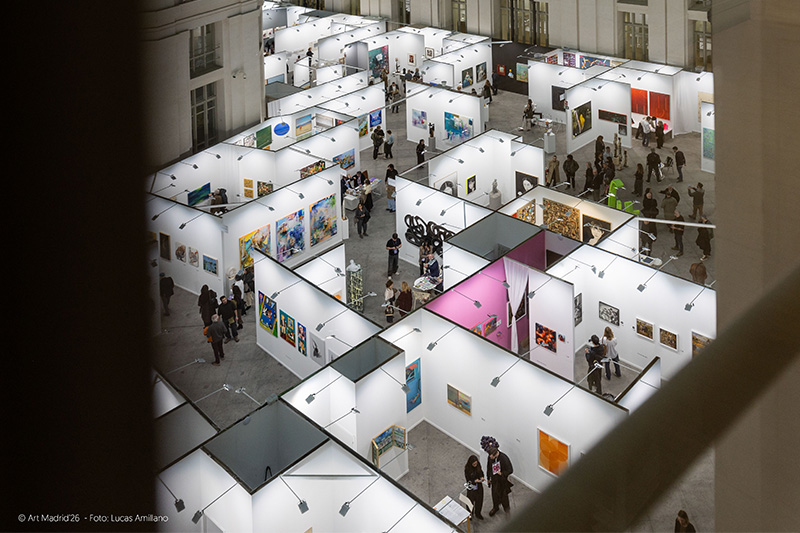
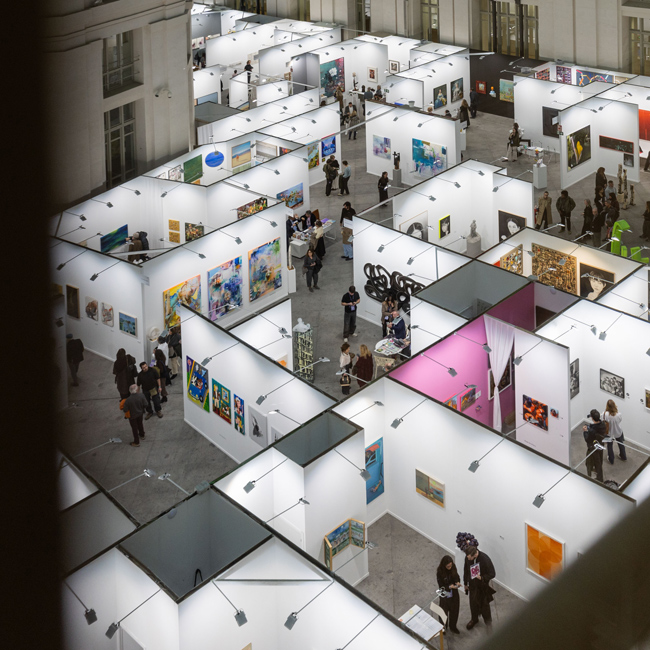
In 2026, Art Madrid will celebrate its 21st edition, further consolidating its position as a leading contemporary art fair in Spain. From 4 to 8 March, the fair will bring together thirty-five national and international galleries at the Galería de Cristal of the Palacio de Cibeles. Returning to its date during Madrid Art Week, Art Madrid reaffirms its pioneering role by expanding the fair calendar and offering an open and enriching dialogue in which diverse artistic proposals coexist.


Throughout its history, Art Madrid has established itself as a leading presence in the contemporary art scene. It is renowned for its commitment to promoting both emerging and established galleries, and for its dedication to making contemporary art accessible to a diverse range of audiences.

Far from being a fair curated under a single curatorial line, Art Madrid promotes diversity in its offering, respecting the identity of each exhibitor and promoting a plural creative ecosystem that reflects the richness and differences of the current art scene.


Art Madrid '25. Photo by Lucas Amillano


GALLERY PROGRAM: AN ACTIVE MAP OF CONTEMPORARY CREATION


The Gallery Program is at the heart of Art Madrid’26. For this edition, thirty-five national and international galleries will participate in a space that celebrates experimentation, hybrid languages, and the latest artistic production. The selection of proposals constitutes a representative mosaic of the aesthetics, discourses, and contemporary practices that are shaping the present of art in Europe.

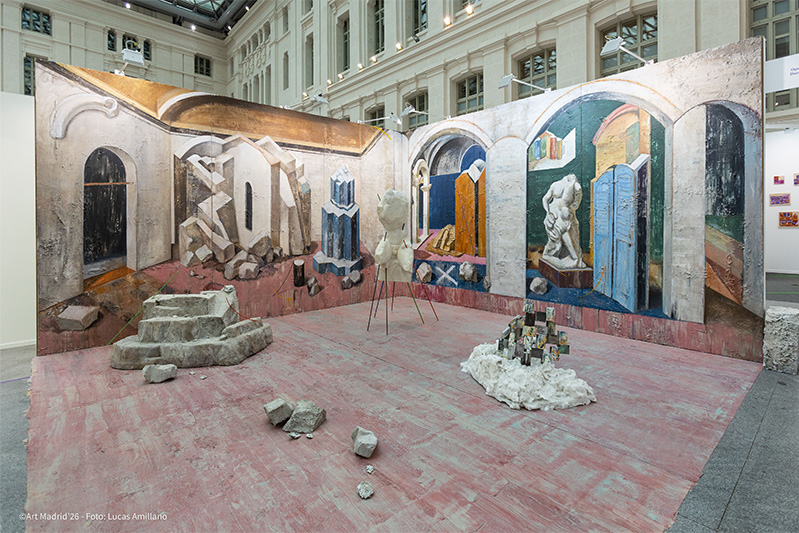
The Galería de Cristal of the Palacio de Cibeles will once again be transformed into a dynamic space where the exhibitions interact with each other, inviting the public to explore visual narratives that show the evolution of contemporary languages. Works that experiment with new media, formal investigations that reformulate traditional techniques, pieces that reflect on the links between technology and humanity, and poetic approaches that explore territory, identity, or memory make up a plural, stimulating journey open to multiple interpretations.

Art Madrid also continues to strive to become a platform for discovery, allowing both professionals and visitors to identify new voices and consolidate relationships with artists who are already emerging as leaders within the contemporary cultural landscape.


Art Madrid '25. Photo by Lucas Amillano


NATIONAL AND INTERNATIONAL EXHIBITORS

Thirty-five galleries are participating in this edition, twenty-seven of which are returning after finding the fair to be a favourable environment in which to strengthen connections, increase visibility and promote their artists' work on an international scene.

Twenty-six of these are Spanish galleries from various regions of the country: 3 Punts Gallery (Barcelona), Alba Cabrera Gallery (Valencia), Aurora Vigil-Escalera (Gijón), CLC ARTE (Valencia), DDR Art Gallery (Madrid), Est_ArtSpace (Madrid), g • gallery (Barcelona), Galería Arancha Osoro (Oviedo), Galería BAT alberto cornejo (Madrid), Galería Beatriz Pereira (Plasencia), Galería Carmen Terreros (Zaragoza), Galería Espiral (Noja), Galería La Mercería (Valencia), Galería Luisa Pita (Santiago de Compostela), Galería María Aguilar (Cadiz), Metro Gallery (Santiago de Compostela), Rodrigo Juarranz Gallery (Aranda de Duero), Sigüenza Gallery (Sigüenza), Gerhardt Braun Gallery (Palma de Mallorca | Madrid), Inéditad Gallery (Barcelona), Kur Art Gallery (San Sebastián), LAVIO (Murcia | Shanghai), Moret Art (A Coruña), Pigment Gallery (Barcelona), Shiras Galería (Valencia) and Uxval Gochez Gallery (Barcelona). This selection of galleries highlights the importance of the Spanish scene and its contribution to the development of the contemporary cultural ecosystem.


Art Madrid '25. Photo by Lucas Amillano


The nine international galleries participating in this edition are: Banditrazos Gallery (Seoul, South Korea), Collage Habana (Havana, Cuba), Galeria São Mamede (Lisbon, Portugal), Galerie ONE (Paris, France), KANT Gallery (Copenhagen, Denmark | Palma de Mallorca, Spain), Loo & Lou Gallery (Paris, France), Nuno Sacramento Arte Contemporânea (Ílhavo, Portugal), Trema Arte Contemporânea (Lisbon, Portugal) and Yiri Arts (Taipei, Taiwan). Their participation broadens the fair's international reach, promoting creative and conceptual exchange between diverse artistic perspectives.

In addition, eight new galleries have been added to the list of exhibitors:

Banditrazos Gallery (Seoul, South Korea), Est_ArtSpace (Madrid, Spain), g • gallery (Barcelona, Spain), Galería Beatriz Pereira (Plasencia, Spain), Galerie ONE (Paris, France), Galería Sigüenza (Sigüenza, Spain), Gerhardt Braun Gallery (Palma de Mallorca | Madrid, Spain) and KANT Gallery (Copenhagen, Denmark | Palma de Mallorca). These additions reinforce Art Madrid's commitment to continuous renewal and openness to spaces that are exploring new approaches to contemporary art.


Art Madrid '25. Photo by Lucas Amillano


PARALLEL PROGRAM: A REFLECTION ON THE ‘SPECIES’ OF SPACES


One of the great attractions of Art Madrid is its Parallel Program, which this time delves into the notions of: ‘Fragments, relationships, and imaginary distances.’ This approach turns the fair into an expanded space, where art, audience, architecture, and memory converge. Thus, the Parallel Program proposes a critical approach to the container of the event itself. Taking as a reference the reading of Species of Spaces by Georges Perec (Perec, Georges. Species of Spaces. Montesinos, 2004), it adopts a marked interest in the everyday, that which usually goes unnoticed, the infra-ordinary, giving each corner of the venue its own narrative value.

Another of the conceptual references of this edition is based on an analysis of Édouard Glissant's Poetics of Relation (Glissant, Édouard. Poetics of Relation; Prologue by Manuel Rebón. - 1st ed. - Bernal: Universidad Nacional de Quilmes, 2017.), which advocates the coexistence of differences and the importance of non-totalizing links, which are extrapolated to the art system, proposing an understanding of it as a network of exchanges and connections that respect the uniqueness of each cultural practice and actor.

‘Imaginary distances,’ understood as subjective journeys and affective cartographies traced by visitors, thus become the conceptual axis that articulates this program. This perspective transforms the Fair into an experience that goes beyond visual contemplation, turning it into a territory that can be collectively reconstructed, without losing sight of the paths travelled by the individuality of each voice.

In this edition, the Parallel Program encourages visitors to engage with the space and its projects, turning contemplation into an opportunity to question and interact with things that might otherwise go unnoticed in everyday life.


Art Madrid '25. Photo by Lucas Amillano


In the preview and during Art Week, Art Madrid'26 offers a range of experiences that allow the public to get closer to the creative process and practices of the participating artists. Among the returning initiatives are the Interview Program, Curated Walkthroughs, the third edition of Open Booth, dedicated to emerging creation, the presentation of Espacio Nebrija, a university project in collaboration with Nebrija University, alongside the fair’s established Performance Cycle.

In addition, the One Shot Collectors Program and the second edition of the Patronage Program are back. These initiatives seek to strengthen the bond between collectors, artists, and the public, promoting ethical, informed, and responsible practices in collecting and patronage.


Art Madrid '25. Photo by Lucas Amillano


Art Madrid'26 has established itself as a dynamic meeting place, where diverse experiences, discourses, and practices converge. Far from being a fair curated under a single curatorial line, Art Madrid promotes diversity as a structuring principle, respecting the identity of each exhibitor and fostering a plural creative ecosystem. This plurality is not merely formal, but translates into a network of practices, languages, and perspectives that reflects the complexity, richness, and tensions of the contemporary art scene, consolidating the fair as a catalyst for cultural relations, an observatory of emerging trends, and an international reference point for the Spanish art scene.

WELCOME TO ART MADRID'26