Art Madrid'26 – POP CULTURE, CONCEPTUAL ART AND STREET ART. GALERÍA HISPÁNICA CONTEMPORÁNEA

Hispánica Contemporánea (based in Madrid and Mexico), one of the veteran galleries in Art Madrid, proposes for this edition a proposal with national and international artists that could be framed within trends such as Pop Art, Conceptual Art, Activism and Neo-Pop in contrast and interaction with other more current artistic trends such as kinetic art, neo-figurative art and street art. Hispánica Contemporánea proposes in its stand a historical journey through purely contemporary discourses and aesthetics.

The pop culture will be very present at Hispánica's booth. We will see it in the pieces "Flat Depth " of the American artist Paul Rousso, who from a flat surface creates volumes, turning a flat object into a three-dimensional one. Rousso, using complex techniques and under a satirical and ironic approach, discards and wrinkles elements such as American dollar bills, candy wrappers and pages from magazines and newspapers, inflating them to extraordinary dimensions.
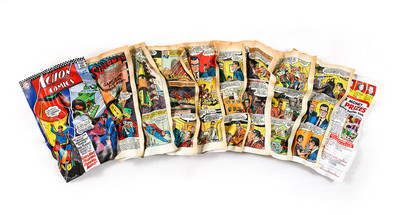
Paul Rousso

Action Comic Superman March, 2018

Mixed media

92 x 246cm

The artist (also American) Peter Anton, in the wake of Rousso, creates realistic and giant sculptures, but this time food is the protagonist, especially chocolate candies and other sweets. Anton exaggerates the size of food to give it a new meaning; his creative process begins by smelling, dissecting, feeling and deeply studying the food he is going to represent.

The Italian artist Fidias Falaschetti is concerned with other issues related to pop culture such as consumerism and the globalization of the media. Falaschetti, from an ironic and playful point of view, investigates in his work the relationship between digital and analog, appropriating materials and elements or characters from the past and transforming them into contemporary objects. An example of this is his iconic Disney characters in resin covered in aluminium.
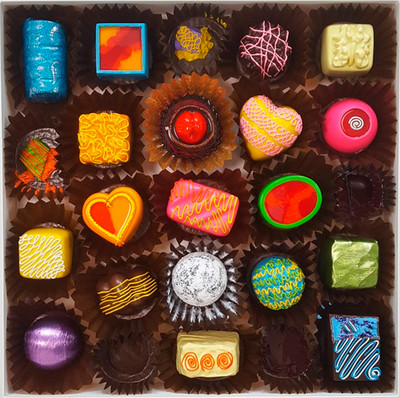
Peter Anton

Splendor Variety, 2017

Mixed technique

90 x 90cm

The sculptural installations by the American artist Rafael Barrios and the kinetic pieces in ceramics by Carlos Cruz Díez represent a turning point in the Hispánica booth. In the work of these two artists, both pioneers in their artistic tendencies although with different plastic discourses, color has a fundamental role.

Rafael Barrios plays with geometrical forms, volumes and colour, building his sculptures in a direction totally far from the orthodox, defying the laws of space and generating new perceptive alternatives with his "floating virtual works". Hispánica Contemporánea is the only gallery that represents Rafael Barrios in Spain.

The Venezuelan artist Cruz-Díez conceives color as an autonomous element, which evolves in space and time, without the help of form or support, in a continuous present. In his delicate ceramics of the series "Cromovela", works that we will be able to see in Art Madrid, we observe how the artist takes the kinetic art to its maximum expression in the land of the three-dimensionality.
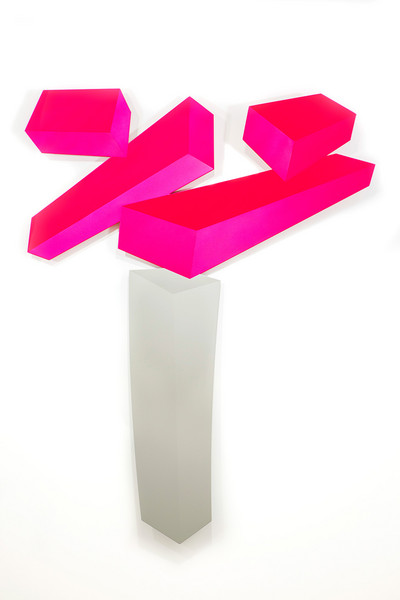
Rafael Barrios

Mural, 2015

Lacquered steel

160 x 126cm

Xavier Mascaró and Manolo Valdés, two artists with solid careers and with whom Hispánica has been working for years, will show at the Fair a selection of pieces that could be included within the neofigurative trend.

The pieces by Xavier Mascaró that Hispánica will present in Art Madrid, are a sample of the different lines of research with which the French artist has been working since his beginnings. It is worth mentioning that the artist has recently been included in the list of artists of the prestigious Opera gallery and we will be able to see in Art Madrid a selection of his famous sculptures in iron, bronze and corrugated copper combined with his pieces in enameled ceramics.

From the artist Manolo Valdés we will be able to see work on paper of his characteristic representations of elegant and sophisticated "Gentlemen " and "Ladies with pamela " accompanied by small format bronze sculptures.
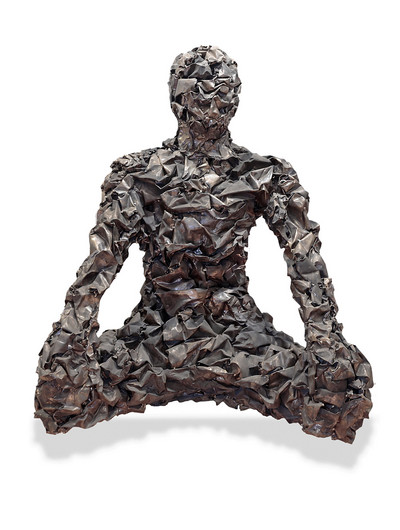
Xavier Mascaró

Guardián, 2012

Cobre corrugado

175 x 100cm

Mr.Brainwash, iconic street art artist, will bring "street art" to the stand walls. In his works we see again characteristic elements of the aesthetics of American pop culture fused with his personal style.

Exercising an absolute contrast with the work of the urban artist, we find the deep and symbolic paintings of the Basque artist Guillermo Fornés Through a very personal language, the artist wants to transmit "his expressive force, and at the same time, give the work the poetics and subtlety that make up his plastic identity. In this way, he always speaks of the emotion." His large canvases charged with symbolism, awaken timeless emotions and feelings.
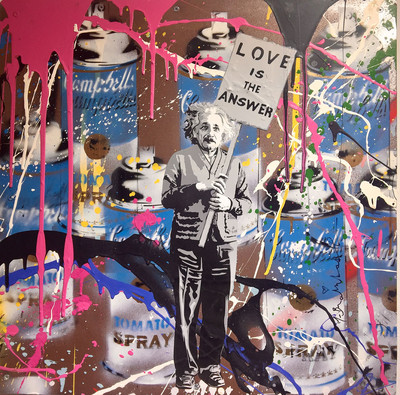
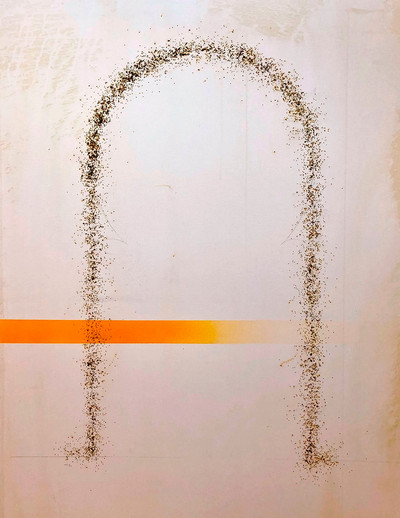
Mr. Brainwash

Einstein, 2016

Técnica Mixta sobre metal

50 x 50cm

Guillermo Fornés

Arch Light, 2018

Mixed media on canvas

146 x 114cm

Crowning the stand of Hispánica Contemporánea the monotypes of one of the most influential artists in contemporary conceptual art, the American Mel Bochner, who works exclusively with the gallery Hispánica in Spain and Mexico.

Bochner is, together with Joseph Kosuth, Art & Language, Lawrence Weiner, Douglas Houbler and Robert Barry, responsible for one of the artistic revolutions of the moment. Trained in an artistic environment (his father was an advertising sign painter), his interest has always been focused on the purely conceptual rather than the superficial. Influenced by his father, from an early age he became interested in strictly verbal information and the meaning of words. Little by little, Bochner begins to divest himself of the elements most closely linked to the pictorial (colour, plane, surface) in order to explore the possibilities of the linguistic universe. Later, he recovers colour in his works to make it an indispensable element in his work.
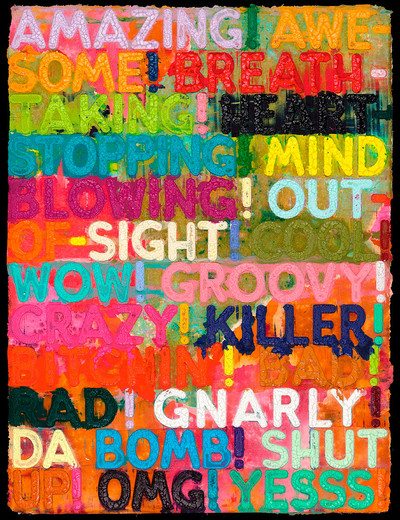
Mel Bochner

Amazing, 2018

Monotype with collage, engraving and reliefs on Twinrocker paper

158.8 x 119.4cm

In art works such as "Blah, Blah, Blah" or "Amazing", the semantics or meaning of the words, varies as we read them. The artist explores the duality between the solitary and private nature of writing and the way in which the final product is exposed openly to the public, bringing together an immense wealth of subjective gradations in language.


 

Daniel Barrio. Guest artist of the third edition of OPEN BOOTH. Courtesy of the artist.


DESPIECE. PROTOCOLO DE MUTACIÓN


As part of the Art Madrid’26 Parallel Program, we present the third edition of Open Booth, a space conceived as a platform for artistic creation and contemporary experimentation. The initiative focuses on artists who do not yet have representation within the gallery circuit, offering a high-visibility professional context in which new voices can develop their practice, explore forms of engagement with audiences, and consolidate their presence within the current art scene. On this occasion, the project features artist Daniel Barrio (Cuba, 1988), who presents the site-specific work Despiece. Protocolo de mutación.

Daniel Barrio’s practice focuses on painting as a space for experimentation, from which he explores the commodification of social life and the tyranny of media approval. He works with images drawn from the press and other media, intervening in them pictorially to disrupt their original meaning. Through this process, the artist opens up new readings and questions how meaning is produced, approaching painting as a space of realization, therapy, and catharsis.

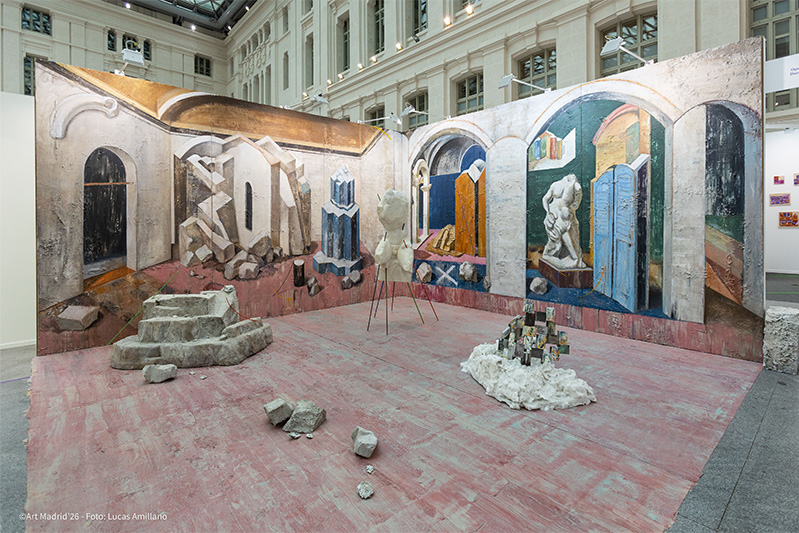
Despiece. Protocolo de mutación is built from urban remnants, industrial materials, and fragments of history, inviting us to reflect on which memories we inherit, which we consume, and which ones we are capable of creating. Floors, walls, and volumes come together to form a landscape under tension, where the sacred coexists with the everyday, and where cracks matter more than perfection.

The constant evolution of art calls for ongoing exchange between artists, institutions, and audiences. In its 21st edition, Art Madrid reaffirms its commitment to acting as a catalyst for this dialogue, expanding the traditional boundaries of the art fair context and opening up new possibilities of visibility for emerging practices.


Despiece. Protocolo de mutación emerges from a critical and affective impulse to dismantle, examine, and reassemble what shapes us culturally and personally. The work is conceived as an inseparable whole: an inner landscape that operates as a device of suspicion, where floors, walls, and volumes configure an ecosystem of remnants. It proposes a reading of history not as a linear continuity, but as a system of forces in permanent friction, articulating space as an altered archive—a surface that presents itself as definitive while remaining in constant transformation.


The work takes shape as a landscape constructed from urban waste, where floors, walls, and objects form a unified body made of lime mortar, PVC from theatrical signage, industrial foam, and offering wax. At the core of the project is an L-shaped structure measuring 5 × 3 meters, which reinterprets the fresco technique on reclaimed industrial supports. The mortar is applied wet over continuous working days, without a pursuit of perfection, allowing the material to reveal its own character. Orbiting this structure are architectural fragments: foam blocks that simulate concrete, a 3D-printed and distorted Belvedere torso, and a wax sculptural element embedded with sandpaper used by anonymous workers and artists, preserving the labor of those other bodies.

A white wax sculptural element functions within the installation as a point of sensory concentration that challenges the gaze. Inside it converge the accumulated faith of offering candles and the industrial residues of the studio, recalling that purity and devotion coexist with the materiality of everyday life. The viewer’s experience thus moves beyond the visual: bending down, smelling, and approaching its vulnerability transforms perception into an intimate, embodied act. Embedded within its density are sanding blocks used by artists, artisans, and laborers, recovered from other contexts, where the sandpaper operates as a trace of the effort of other bodies, following a protocol of registration with no autobiographical intent.

Despiece. Protocolo de mutación addresses us directly, asking: which memory do we value—the one we consume, or the one we construct with rigor? The audience leaves behind a purely contemplative position to become part of the system, as the effort of moving matter, documentary rigor, and immersive materiality form a body of resistance against a mediated reality. The project thus takes shape as an inner landscape, where floor, surface, and volume articulate an anatomy of residues. Adulteration operates as an analytical methodology applied to the layers of urban reality, intervening in history through theatrical and street advertising, architectural remnants, and administrative protocols, proposing that art can restore the capacity to build one’s own memory, even if inevitably fragmented.


ABOUT THE ARTIST

DANIEL BARRIO (1988, Cuba)

Daniel Barrio (Cienfuegos, Cuba, 1988) is a visual artist whose practice articulates space through painting, understanding the environment as an altered archive open to critical intervention. He studied at the Academy of Fine Arts of Cienfuegos (2004–2008), specializing in painting, and later at the Madrid Film School (ECAM, 2012–2015), where he studied Art Direction. His methodology integrates visual thinking with scenographic narrative.

His trajectory includes solo exhibitions such as La levedad en lo cotidiano (Galería María Porto, Madrid, 2023), Interiores ajenos (PlusArtis, Madrid, 2022), and Tribud (Navel Art, Madrid, 2019), as well as significant group exhibitions including Space is the Landscape (Estudio Show, Madrid, 2024), Winterlinch (Espacio Valverde Gallery, Madrid, 2024), Hiberia (Galería María Porto, Lisbon, 2023), and the traveling exhibition of the La Rioja Young Art Exhibition (2022).

A member of the Resiliencia Collective, his work does not pursue the production of objects but rather the articulation of pictorial devices that generate protocols of resistance against the flow of disposable images. In a context saturated with immediate data, his practice produces traces and archives what must endure, questioning not the meaning of the work itself but the memory the viewer constructs through interaction—thus reclaiming sovereignty over the gaze and inhabiting ruins as a method for understanding the present.