Art Madrid'26 – "VARIACIONES" BY VIRGINIA RIVAS AND "AVATARES" BY ROBERTO LÓPEZ, WITH DDR ART GALLERY

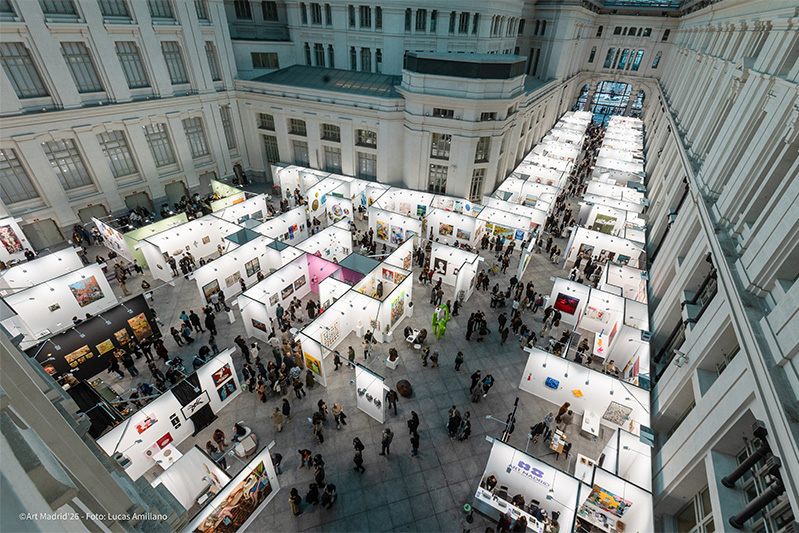
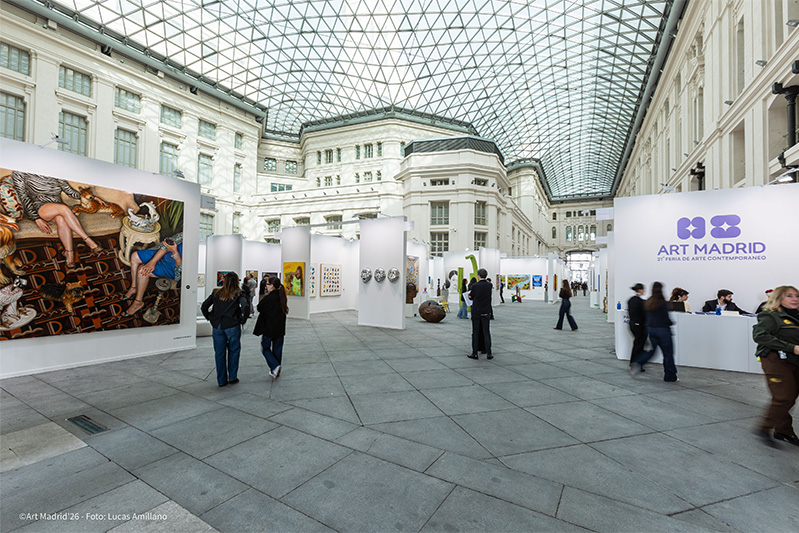
DDR Art Gallery is participating for the second consecutive year in the One Project program of Art Madrid. “Variaciones" by Virgina Rivas and "Avatares" by Roberto López can be seen at the Fair as part of the project "Salvajes. La cage aux fauves", curated by Fernando Gómez de la Cuesta.

The art works that the artist Virginia Rivas (Madrid,1981) will present in Art Madrid are part of a wide project called "Variaciones", in which the artist investigates about the color in our environment as well as the perception that we have of the same one depending on our emotional state and of the political and social situation of each one of us. Rivas analyzes our reality through colors.

The artist from Extremadura experiments with painting from a classical pictorial process, investigating forms and matter through abstraction and gesture. Rivas also relies on other artistic media such as photography in its various forms (polaroids, slides, etc.), video, light boxes or neon.
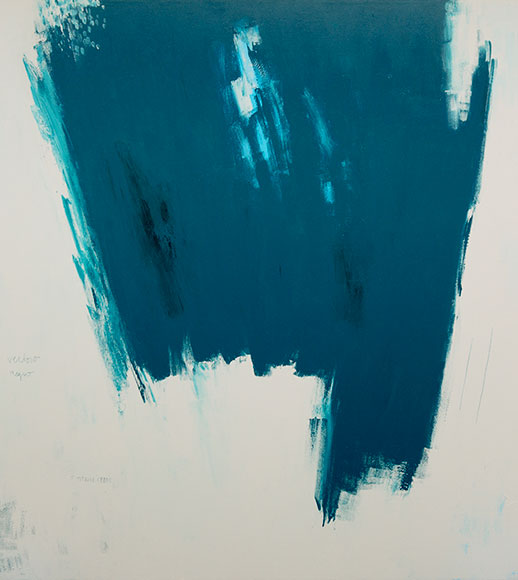
Virginia Rivas, Estudio AVNT, 2019

Virginia Rivas incorporates in some of her works small written texts, generally fragmented and sometimes practically illegible, but which are part of a narrative discourse that is totally intentional on the part of the artist, who integrates the graphics of the words as another plastic element of the composition. The expressiveness of the gesture, the colour, the light and the words are part of the abstraction inherent in her work, through which Rivas investigates intimacy and collectivity, establishing a fundamental game in which space and the spectator are indispensable.

The tandem of artists participating in Art Madrid with DDR Art Gallery is completed by Roberto López Martín (Madrid, 1982). "Los niños tele, el nuevo homo videns" includes a series of works with which he participates in "Salvajes". The artist works with different plastic languages that range from his studies in graphite and wax to his collages, present in another series such as "Fluffy Children". In Art Madrid, the artistic proposal is centred on his sculptures, known as "avatars" worked in fibreglass, resin and other materials.
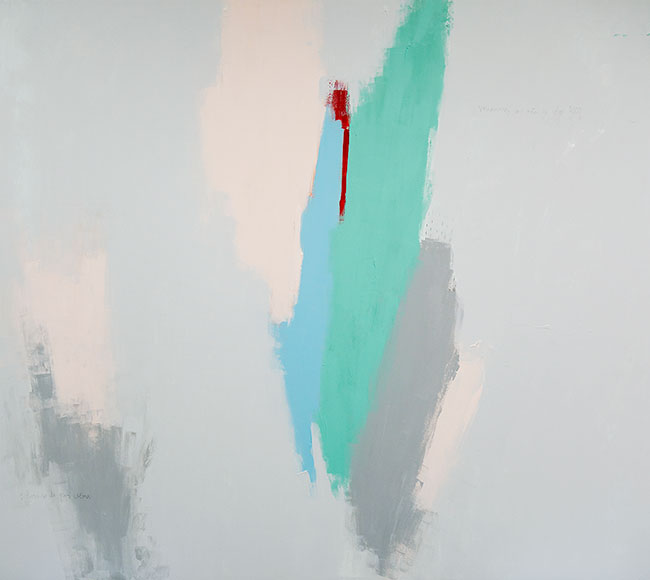
Virginia Rivas, Estudio GTCCR, 2019

In "Avatares", López Martín focuses on childhood, on the innocence of the child when he begins to create a relationship with the objects around him, giving his toys imaginary values and personalizing them in a subjective way. This relationship, according to the artist, "is distorted when corporations enter to participate establishing uses and forms of consumption on the different toys, making these pre-format a way to relate to the world of children".

Roberto López's sinister avatars fight against all manipulation by the toy industry and in his "ready made" pieces he reconstructs and assembles pieces he finds in the garbage or selects consciously using his sense of humor and his most perverse sensibility.
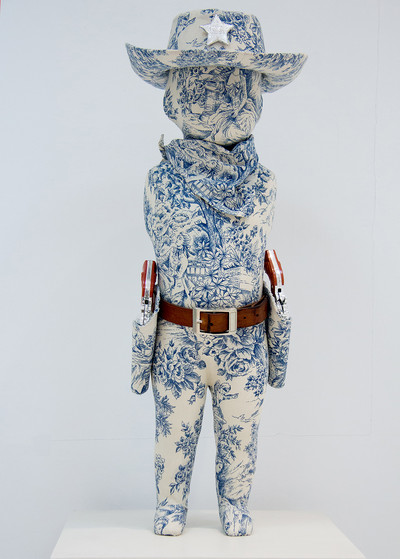
RLM

Avatar Cowboy, 2017

Tela sobre fibra de vidrio y resina

150 x 30cm

DDR Art Gallery focuses its efforts on promoting the work of both established and emerging Latin American artists. In the virtual space of DDR Art Gallery, we find works from almost all disciplines: photography, sculpture, collage, illustration and urban art. DDR Art Gallery were pioneers in the direct sale of contemporary art on the Instagram platform, and without a doubt, the presence both online and in social networks, is the basis of the project since its inception. Its main motto is: "If you're not on Google, you don't exist."
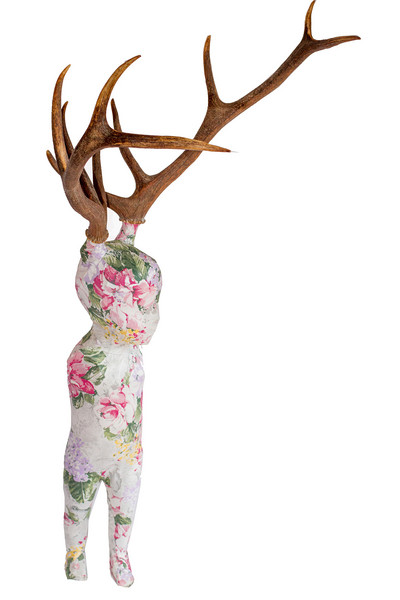
RLM

Avatar El Elegido, 2016

Tela sobre fibra de vidrio y resina

150 x 30cm

Since it was founded in 2006, the gallery maintains two lines to promote the work of its artists: online sales and attendance at national and international fairs, with a clear focus on the contemporary art market. A third line of promotion and sale is the space of Theredoom Gallery in Madrid, where DDR Art Gallery organizes individual and thematic exhibitions. In addition to Rivas and López Martín, DDR promotes the work of six other artists: Annita Klimt, David Delgado Ruiz, David Heras Verde, Evangelina Esparza, José A. Vallejo and Raúl Casassola.




ART MADRID’26 INTERVIEW PROGRAM. CONVERSATIONS WITH ADONAY BERMÚDEZ


The artistic practice of Chamo San (Barcelona, 1987) revolves around a poetics of attention, in which the seemingly insignificant acquires a singular reflective intensity. His works emerge from a persistent observation of everyday life, understood not as a narrative repertoire but as a field of shared experience. Within this framework, the minimal gesture becomes a form of sensitive knowledge, placing the viewer before scenes that are both recognizable and, at the same time, estranged by their temporal suspension.

The progressive shift toward a more atmospheric painting has allowed the environment to cease functioning as a mere support and become an active agent of meaning. Restrained color ranges and carefully constructed spaces generate a sense of stillness that evokes a pictorial tradition attentive to duration and waiting. The human figure—a constant presence in his work—is presented immersed in contexts that amplify its affective and existential dimension.

The silence permeating these images is not absence but condition; it constitutes a space of resonance in which the time of doing and the time of looking converge. Situated between compositional control and openness to the contingent, Chamo San’s work affirms painting as a territory where planning and accident coexist.


Bathtub. 2018. Ballpoint pen on notebook. 14 x 18 cm.


Many of your works show meticulous attention to the smallest gestures and seemingly trivial moments. What interests you about these micro-choreographies of everyday life?

The seed of my work always comes from the sketches I make from life in small notebooks that I can carry with me at all times. Later, I either transfer them to another format so I can work on them more calmly, or they become the final piece in themselves.

Composition, staging, and perhaps those micro-choreographies are what I allow myself to bring to the scene as an artist. For me, these everyday moments are the most direct and honest way to connect with the audience because—even though they are intimate—they reflect universal experiences.


Feet. 2023. Oil pastel on paper mounted on board. 30 x 30 cm.


In your pieces, the presence of sober tones seems to generate a particular type of atmosphere. How would you describe the way that atmosphere emerges during your work, and what role does it play in the overall construction of the image?

Atmosphere and colour are relatively recent additions to my work. Previously, I focused exclusively on the figures as the central element, and they were often left floating in a kind of void. It was when I realised the need to provide context—especially as I began working more closely from the notes in my notebooks—that I came to understand the importance of the environment for the character.

The human figure will always remain the main element for me, as it is through its representation that I find the greatest enjoyment. However, little by little, I have become interested in exploring what surrounds it. I see the creation of an environment and an atmosphere as essential in order to situate the figures within a more complete and fully constructed scene.


Mamant. 2025. Colored pencils on notebook. 14 x 18 cm.


Are the silences in your works inherited from real experiences, or do they emerge during the painting process?

The silences in my work are inherited from real experiences. When I capture those small moments of everyday life—which is essential for me—I tend to be focused and quiet. At the same time, I also believe that the contemplation of artworks naturally invites this kind of calm. In that sense, for a brief moment, both the artist—throughout the entire creative process—and the viewer, when engaging with the work, can meet in the same state of tranquillity and silence.


The Kiss. 2024. Oil pastel on notebook. 14 x 18 cm.


To what extent do you plan your works and how much space do you leave for the unexpected to happen?

Some of my works are very planned, even excessively so, with lots of sketches. On the other hand, I always have that starting point that appears in my notebooks, and I leave experimentation and the unexpected for the end. Although it's also true that when I've thrown myself into improvisation from the beginning, wonderful things have happened, so now I try to combine those two worlds as organically as possible.


Cinema. 2025. Ballpoint pen and oil pastel on notebook. 14 x 18 cm.


Although your work has shifted towards the pictorial—with an aesthetic closely linked to cinema—echoes of illustration can still be seen in your visual language. Which elements would you say remain, and which have undergone a radical transformation?

For me, illustration has been an intense learning process. I deeply admire artists who have combined commissioned illustration with studio work for galleries, such as Ramón Casas and James Jean. I believe these two worlds can connect on a technical level, but their language and purpose are fundamentally different.

The existence of a unique, original work allows for accidents to occur—things that are very unlikely to happen in illustration. It is this condition of uniqueness, and above all the intention behind it, that makes the two practices radically different.