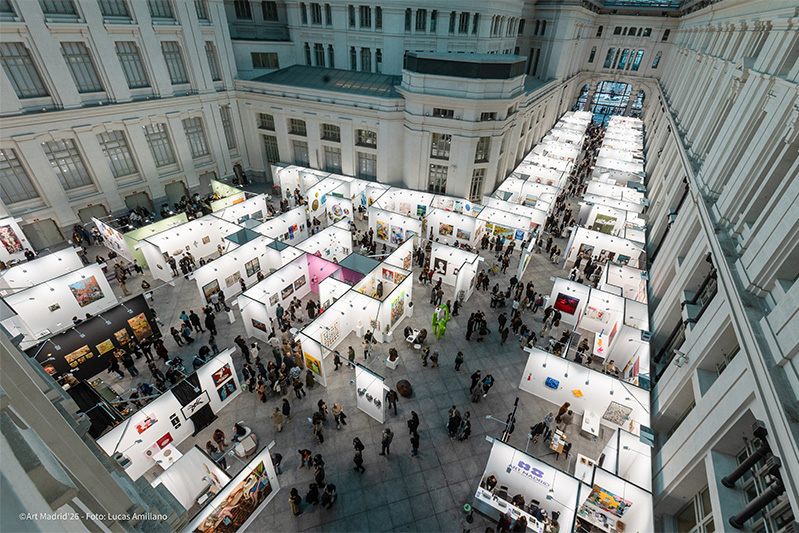
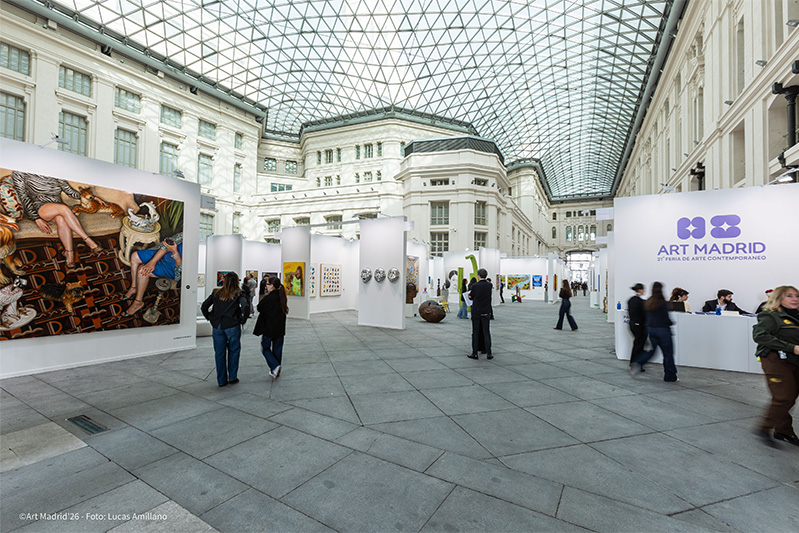
Art Madrid'26 – ATC GALLERY FIRST TIME IN ART MADRID FEATURING ARTISTS NICOLÁS LAIZ AND ALONA HARPAZ

Artists Nicolás Laiz Placeres and Alona Harpaz are on show for the first time in Art Madrid, within the Galería ATC from Tenerife, presenting a collection where the wild is created through a space configured by the incursion of the human being in it.

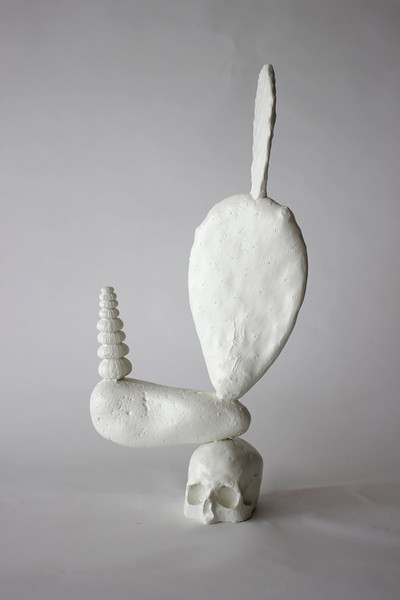
Harpaz merges, over flat coloured backgrounds, expressionists figures and self-portraits mixed with wildlife and flora made with vibrant colours. Therefore, in her paintings, we can see a mixture between the beautiful and the terrifying. On the other hand, Laiz Paredes sculptures, have Nature and Human Being as elements in a disappearance process, mixed with objects which configure the reason of that destruction itself, creating iconic, almost monochromatic, three-dimensional shapes.
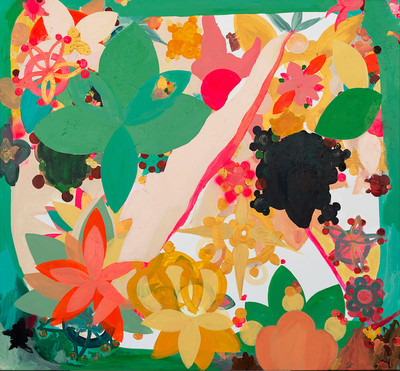
Alona Harpaz

I'm not here for your dream, 2019

Acrilico, spray y colores industriales sobre lienzo

140 x 150cm

Nicolás Laiz

Política Natural III, 2018

Resina, fibra de vidrio, aridos y pintura doble componente

80 x 30cm

Alona Harpaz (Tel Aviv, Israel, 1971) represents in her self-portraits botanic and animal patterns, applying a very personal and imaginative colour scheme, using a strong and vibrant brushstroke over, in many cases, merely decorative surfaces. In her work, colours exist by themselves, freely, but also as abstract well-mimicked elements or recognizable symbols. According to her, “perfectly beautiful paintings can also be dreadful”, and political commitment could be added to beauty and dreadfulness, as the critic Elke Buhruna points out. A sample of this could be seen in her work “Frequency Watchers”, which is a self-portrait of the artist riding a motorcycle, alluding to the 90s feminist movement in the United States, as Riot Grrrl and the Bikini Kill band, who combined feminism and pink lipstick. Therefore, her personality includes the political activism of her father (a Labour Zionist) and the artistic taste of her mother (a dancer).
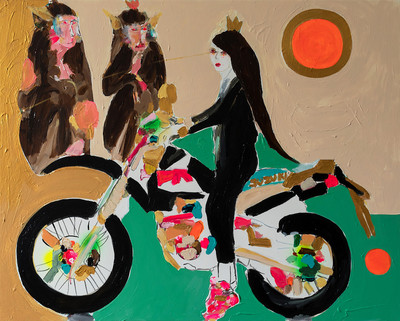
Alona Harpaz

Frequency Watchers, 2018

Acrilico, spray y colores industriales sobre lienzo

80 x 100cm

Nicolás Laiz Placeres (Lanzarote, 1975), in his three-dimensional pieces, creates a confluence using objects of nature and industrial or genuinely pollutant materials, making a dichotomy between them. From this seemingly simple fusion, the artist is able to send a deeply elaborated message, with a critic tone, to a society that has led to overproduction and extreme and dangerous consumerism and, at the same time, using miscellaneous objects from the Isle’s “topic” iconography: shells, rocks and prickly pears blends with plastic bottles, totems and cranial shapes, creating iconic figures with advertising motifs of the extreme natural disaster situation that the Earth is facing. Finally, in a display of constant irony, his sculptures function as magical shapes that heal our status quo.

In the cage, the Alona Harpaz paintings howl next to the totems and fetish which his space partner Nicolás Laiz Placeres has made, mainly from different identity elements of Canary Islands.
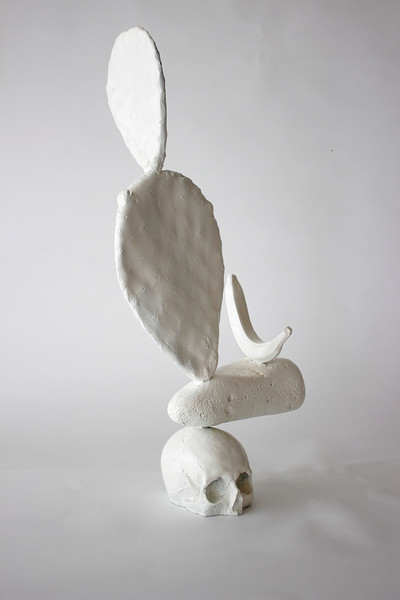
Nicolás Laiz

Política Natural I, 2018

Resina, fibra de vidrio, aridos y pintura doble componente

80 x 30cm

Galería ATC located in the heart of Santa Cruz de Tenerife, participates for the first time in Art Madrid with an unreleased project, dedicated to these two artists which is forming part of the One Project program, coordinated by the art critic and independent curator Fernando Gómez de la Cuesta, under the theme “Salvajes: la cage aux fauves”.

Galería ATC was founded in 2017 by Elle Przybyla (USA) and Juan Matos Capote (Spain) as a part of the Agencia de Tránsitos Culturales - est. in 2014 -, a platform for multidisciplinar artistic investigation and the promotion of contemporary art. The gallery has an annual program featuring various exposicions of spanish and international artists, working with different media: painting, sculpture, video, photography, installations and sound art. In addition to these expositions, the Gallery arranges performances, conferences and other activities. From Canary Islands, Galería ATC grows dynamic relationships between the fringe and the cultural production centres. Their roots in Spain and USA and their imminent connection to Africa, allow them to operate as a cultural intersection space. Their program reflects the commitment to support artists with plenty of voices and in different moments of their careers.

Galería ATC will present, within the One Project project of Art Madrid, unseen art works by the artists Alona Harpaz and Nicolás Laiz Placeres.




ART MADRID’26 INTERVIEW PROGRAM. CONVERSATIONS WITH ADONAY BERMÚDEZ


The painting of Daniel Bum (Villena, Alicante, 1994) takes shape as a space for subjective elaboration, where the figure emerges not so much as a representational motif but as a vital necessity. The repetition of this frontal, silent character responds to an intimate process: painting becomes a strategy for navigating difficult emotional experiences—an insistent gesture that accompanies and alleviates feelings of loneliness. In this sense, the figure acts as a mediator between the artist and a complex emotional state, linking the practice of painting to a reconnection with childhood and to a vulnerable dimension of the self.

The strong autobiographical dimension of his work coexists with a formal distance that is not the result of conscious planning, but rather functions as a protective mechanism. Visual restraint, an apparent compositional coolness, and an economy of means do not neutralize emotion; instead, they contain it, avoiding the direct exposure of the traumatic. In this way, the tension between affect and restraint becomes a structural feature of his artistic language. Likewise, the naïve and the disturbing coexist in his painting as inseparable poles, reflecting a subjectivity permeated by mystery and unconscious processes. Many images emerge without a clearly defined prior meaning and only reveal themselves over time, when temporal distance allows for the recognition of the emotional states from which they arose.


The Long Night. Oil, acrylic, and charcoal on canvas. 160 × 200 cm. 2024.


The human figure appears frequently in your work: frontal, silent, suspended. What interests you about this presence that seems both affirmative and absent?

I wouldn’t say that anything in particular interests me. I began painting this figure because there were emotions I couldn’t understand and a feeling that was very difficult for me to process. This character emerged during a very complicated moment in my life, and the act of making it—and remaking it, repeating it again and again—meant that, during the process, I didn’t feel quite so alone. At the same time, it kept me fresh and connected me to an inner child who was broken at that moment, helping me get through the experience in a slightly less bitter way.


Santito. Acrylic and oil on canvas. 81 × 65 cm. 2025.


There is a strong affective dimension in your work, but also a calculated distance, a kind of formal coldness. What role does this tension between emotion and restraint play?

I couldn’t say exactly what role that tension plays. My painting is rooted in the autobiographical, in memory, and in situations I have lived through that were quite traumatic for me. Perhaps, as a protective mechanism—to prevent direct access to that vulnerability, or to keep it from becoming harmful—that distance appears unconsciously. It is not something planned or controlled; it simply emerges and remains there.


Night Painter. Acrylic on canvas. 35 × 27 cm. 2025.


Your visual language oscillates between the naïve and the unsettling, the familiar and the strange. How do these tensions coexist for you, and what function do they serve in your visual exploration?

I think it reflects who I am. One could not exist without the other. The naïve could not exist without the unsettling; for me, they necessarily go hand in hand. I am deeply drawn to mystery and to the act of painting things that even I do not fully understand. Many of the expressions or portraits I create emerge from the unconscious; they are not planned. It is only afterwards that I begin to understand them—and almost never immediately. A considerable amount of time always passes before I can recognize how I was feeling at the moment I made them.


Qi. Acrylic on canvas. 81 × 65 cm. 2025.


The formal simplicity of your images does not seem to be a matter of economy, but of concentration. What kind of aesthetic truth do you believe painting can reach when it strips itself of everything superfluous?

I couldn’t say what aesthetic truth lies behind that simplicity. What I do know is that it is something I need in order to feel calm. I feel overwhelmed when there are too many elements in a painting, and I have always been drawn to the minimal—to moments when there is little, when there is almost nothing. I believe that this stripping away allows me to approach painting from a different state: more focused, more silent. I can’t fully explain it, but it is there that I feel able to work with greater clarity.


Crucifixion. Acrylic on canvas. 41 × 33 cm. 2025.


To what extent do you plan your work, and how much space do you leave for the unexpected—or even for mistakes?

I usually feel more comfortable leaving space for the unexpected. I am interested in uncertainty; having everything under control strikes me as rather boring. I have tried it on some occasions, especially when I set out to work on a highly planned series, with fixed sketches that I then wanted to translate into painting, but it was not something I identified with. I felt that a fundamental part of the process disappeared: play—that space in which painting can surprise even myself. For that reason, I do not tend to plan too much, and when I do, it is in a very simple way: a few lines, a plane of color. I prefer everything to happen within the painting itself.