Art Madrid'26 – PIGMENT GALLERY: FROM THE MOST MODERN FIGURATION TO THE PUREST ABSTRACTION

The Barcelona gallery Pigment Gallery is participating for the first time in Art Madrid with a selection of works ranging from the most modern figuration to the purest abstraction. Pigment participates in the fair with five local artists and one Italian artist based in Barcelona. They are: Aurelio San Pedro, Marta Fàbregas, Adalina Coromines, Rosa Galindo, Rosanna Casano and Alberto Udaeta.

The multidisciplinary artist Aurelio San Pedro (Barcelona, 1983), uses different media and techniques both traditional and digital to express himself. In Art Madrid, Aurelio San Pedro will present works belonging to his series "Libros" which he tells a story about the concept of time by using as signs of his compositions book songs, pages, covers and cut-out words, structuring them within a surface which he achieves the final sculptural piece. In this way, the artist creates his own symbology and artistic imagery.

Each book he uses does not contain just a story, it is full of experiences and memories of the author himself or of the characters in the story told, and in many cases of the artist himself. The artist plays with time, conveying his experiences through fragments of books with variable times, using repetition, gathering and order to symbolize the concept of the archive.
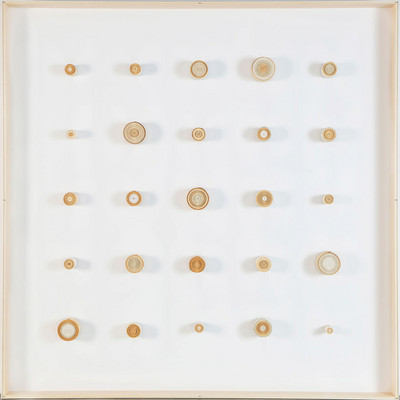
Aurelio San Pedro

Aquellas historias le cambiaron, 2000

Técnica mixta con papel de libro

100 x 100cm

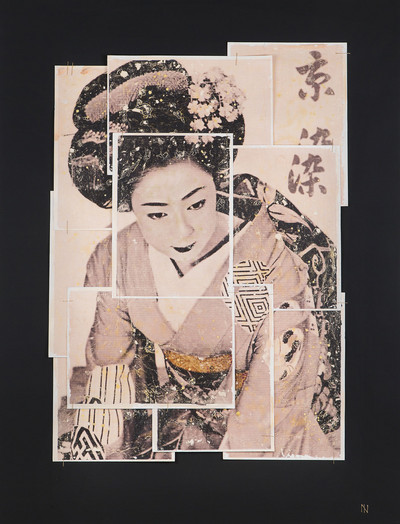
Marta Fàbregas

Colonitzada nº55, 2019

Fotografía antigua, mix media sobre papel de acuarela sobre tela

130 x 100cm

The concept of time is also used in the work of Marta Fàbregas (Barcelona, 1974). In her series "Colonizadas" she rescues photographs of 19th century women from different social and working environments who have been subdued simply because they are women. All of them, in one way or another, were colonised by society, which took away their identity, their future, their desires and their dreams. Marta Fàbregas gives visibility to women who never had it.

Fàbregas uses photography as the basis of her work, but she alters it through the technique of transphotography by combining photographs from digital archives with precious fabrics, using collage techniques, inks, gums, which she manages to create textured surfaces. These fabrics are attached to the image by means of digital retouching, complemented by collages and transphotography.
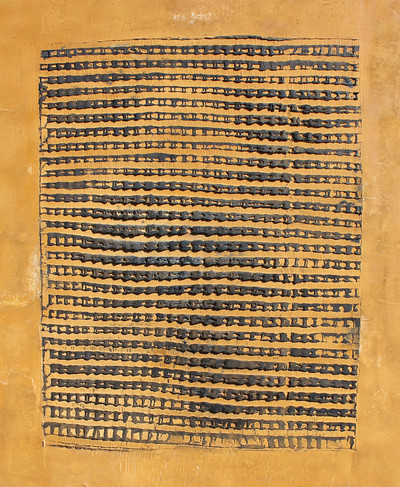
Adalina Coromines

Grècia, 2019

Mixed media

183 x 153cm

Adalina Coromines (Barcelona, 1963) by means of different techniques in which natural pigments, earth, sand and ecological materials in general are found, creates a suggestive work, where the sensation of the passage of time is transmitted by the appearance of the piece already aged, being the textures and the patinas the elements that contribute those effects of illusory wear that the artist manages to transmit, and that coexist in her inner world. The big formats of her works help the viewer to enter into the deepest mysticism of the artist.

Coromines intervenes the materials used in her art work, texturing them with different tools, some of them coming from her own inventiveness, and she manages to create bas-reliefs that give depth to his work, in which large horizontal wooden boards are superimposed on metal ones. A beauty achieved through modesty and simplicity.
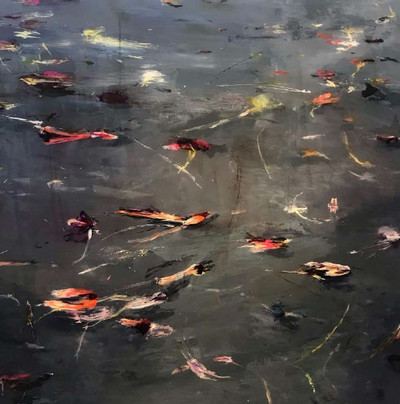
Rosa Galindo

lagon 3, 2019

Tecnica mixta sobre plexigas

150 x 150cm

The dream images of the artist Rosa Galindo (Barcelona, 1962) transport us to an imaginary territory of delicate organic forms that she achieves by playing with different research processes, mainly with the technique of reverse Plexiglas painting. This plastic material allows to obtain transparencies and opacities in which the color vibrates of a special form in its gestural brushstrokes, managing with it to create a fictitious atmosphere where it manifests his philosophy on the place of the world in which the humanity must be located.

His works lead us to a world of meditation and personal reflection through the weightless sensation that the organic forms superimposed on his colorful backgrounds arouse.
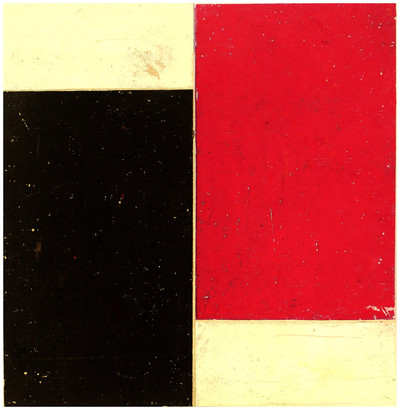
Rosanna Casano

Atrio, 2019

Oil on paper

47 x 46cm

Rosanna Casano (Marsala, Italy, 1968), settled in 1989 in Barcelona, the city where she forged her artistic career. In Casano's work geometric forms, symmetry and patterns predominate, some of her pieces remind us of architectural structures ordered with simple forms, others start from more organic forms that tend to be figurative.

“In my work, different ways of composing coexist that are complementary. There is a tendency to order by means of construction and form, structuring a space, geometry creates a place where I think I am what I feel. And there is a tendency to leave the matter that I express, open or uniform, organic or mineral matter, where perhaps I think I feel what I am.”
Alberto Udaeta

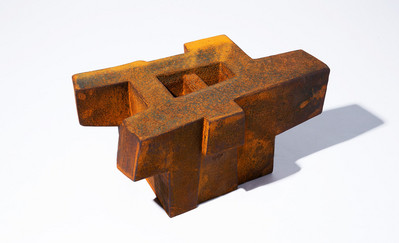
Yunque de la memoria, 2014

Grey iron

15 x 31cm

Alberto Udaeta

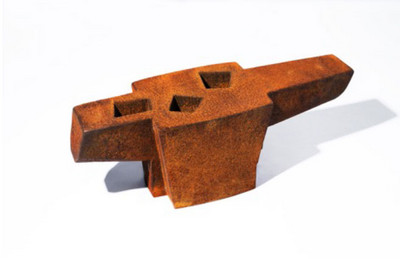
Anvil of water 722, 2014

Grey iron

18 x 50.5cm

The wrought iron sculptures by Alberto Udaeta (Barcelona, 1947) are based on experience and history. Using traditional techniques, some of which are typical of craftsmanship, the artist creates delicate structures based on assembled geometric elements that fit together. Udaeta seeks the splendour of forms through matter.

The artist condenses in his trajectory his formation and experience as an industrial engineer and his more profound investigation in the field of iron sculpture, experimenting with cast iron in the workshop he set up in Barcelona in 1982 in a former cork factory. ”The metals, fumes and gases that clutter workshops and foundries have partially spoiled my sense of smell, which is why I remember with nostalgia the smells I perceived as a child, when I returned to my great-grandmother's farm in the car. Fabulous smells of earth, water, freshly mown grass and also of horses, stones and snakes. But above them all there is still the bright, sharp, metallic smell of the edge of the dalle, very similar to that of my iron sculptures".


 

ART MADRID '26: 21 YEARS OF CONTEMPORARY ART


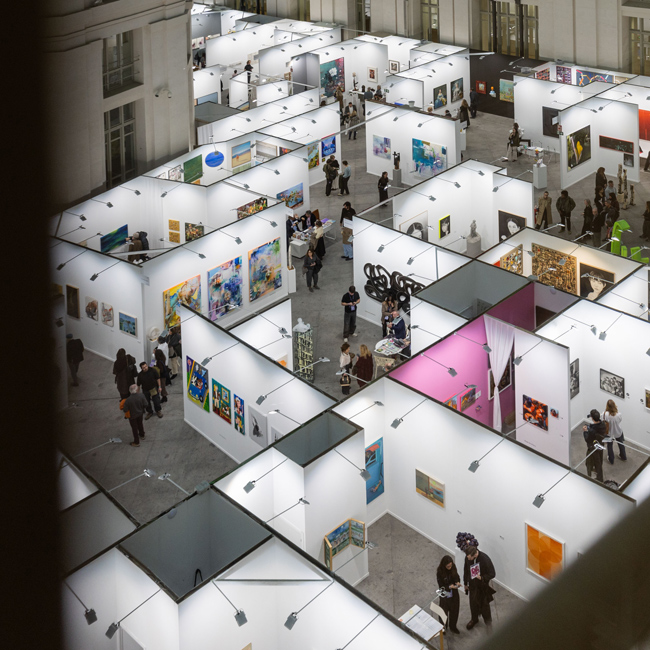
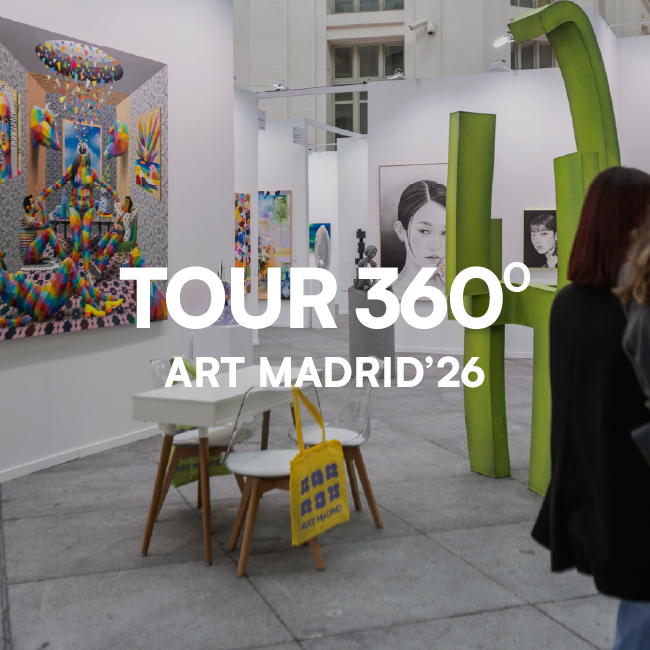
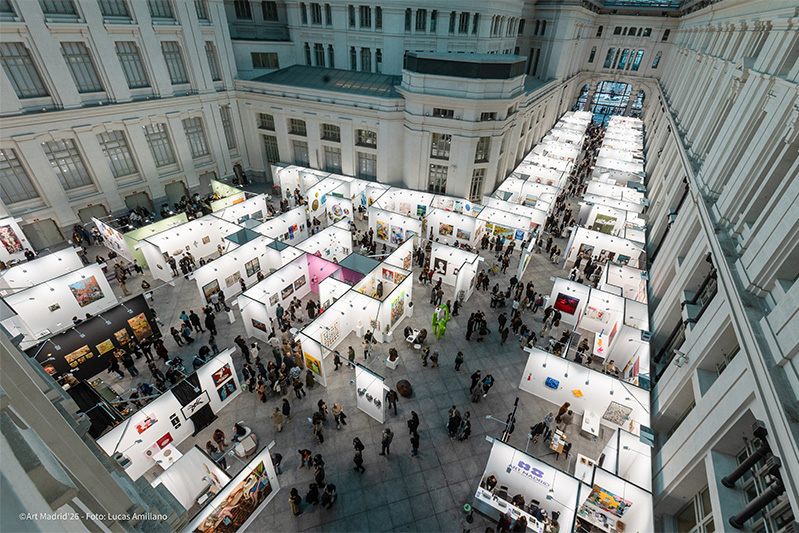
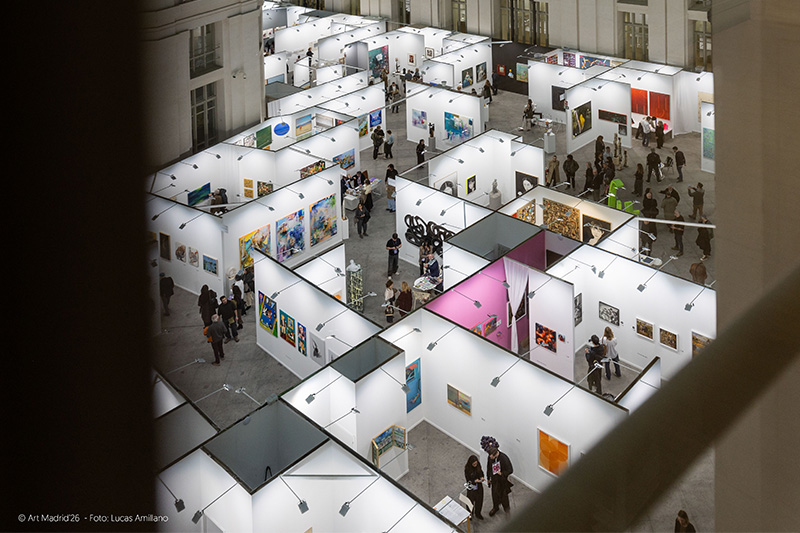
In 2026, Art Madrid will celebrate its 21st edition, further consolidating its position as a leading contemporary art fair in Spain. From 4 to 8 March, the fair will bring together thirty-five national and international galleries at the Galería de Cristal of the Palacio de Cibeles. Returning to its date during Madrid Art Week, Art Madrid reaffirms its pioneering role by expanding the fair calendar and offering an open and enriching dialogue in which diverse artistic proposals coexist.


Throughout its history, Art Madrid has established itself as a leading presence in the contemporary art scene. It is renowned for its commitment to promoting both emerging and established galleries, and for its dedication to making contemporary art accessible to a diverse range of audiences.

Far from being a fair curated under a single curatorial line, Art Madrid promotes diversity in its offering, respecting the identity of each exhibitor and promoting a plural creative ecosystem that reflects the richness and differences of the current art scene.


Art Madrid '25. Photo by Lucas Amillano


GALLERY PROGRAM: AN ACTIVE MAP OF CONTEMPORARY CREATION


The Gallery Program is at the heart of Art Madrid’26. For this edition, thirty-five national and international galleries will participate in a space that celebrates experimentation, hybrid languages, and the latest artistic production. The selection of proposals constitutes a representative mosaic of the aesthetics, discourses, and contemporary practices that are shaping the present of art in Europe.

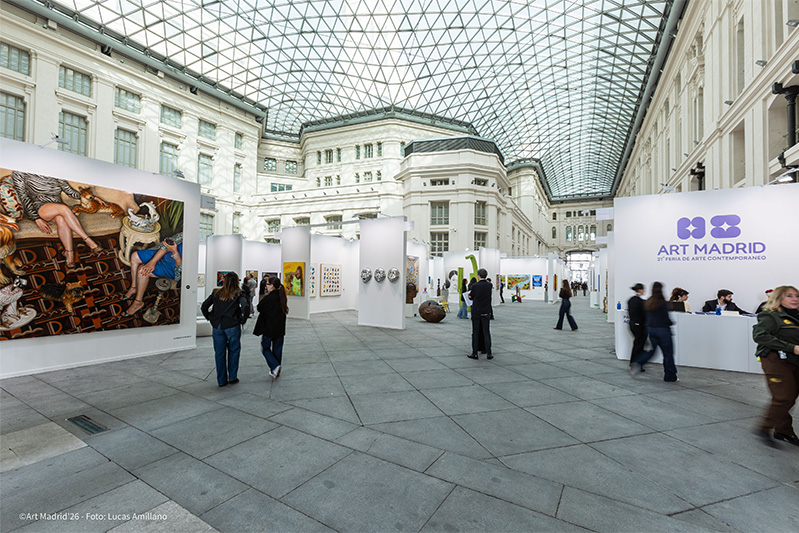
The Galería de Cristal of the Palacio de Cibeles will once again be transformed into a dynamic space where the exhibitions interact with each other, inviting the public to explore visual narratives that show the evolution of contemporary languages. Works that experiment with new media, formal investigations that reformulate traditional techniques, pieces that reflect on the links between technology and humanity, and poetic approaches that explore territory, identity, or memory make up a plural, stimulating journey open to multiple interpretations.

Art Madrid also continues to strive to become a platform for discovery, allowing both professionals and visitors to identify new voices and consolidate relationships with artists who are already emerging as leaders within the contemporary cultural landscape.


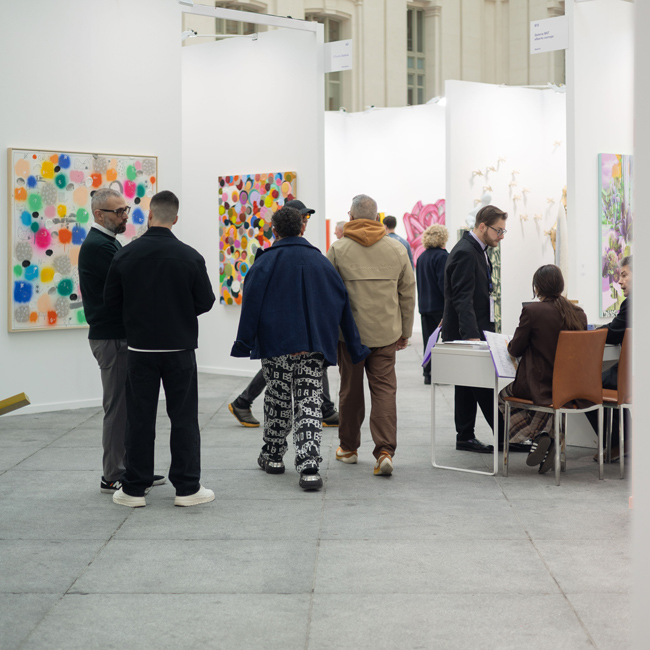
Art Madrid '25. Photo by Lucas Amillano


NATIONAL AND INTERNATIONAL EXHIBITORS

Thirty-five galleries are participating in this edition, twenty-seven of which are returning after finding the fair to be a favourable environment in which to strengthen connections, increase visibility and promote their artists' work on an international scene.

Twenty-six of these are Spanish galleries from various regions of the country: 3 Punts Gallery (Barcelona), Alba Cabrera Gallery (Valencia), Aurora Vigil-Escalera (Gijón), CLC ARTE (Valencia), DDR Art Gallery (Madrid), Est_ArtSpace (Madrid), g • gallery (Barcelona), Galería Arancha Osoro (Oviedo), Galería BAT alberto cornejo (Madrid), Galería Beatriz Pereira (Plasencia), Galería Carmen Terreros (Zaragoza), Galería Espiral (Noja), Galería La Mercería (Valencia), Galería Luisa Pita (Santiago de Compostela), Galería María Aguilar (Cadiz), Metro Gallery (Santiago de Compostela), Rodrigo Juarranz Gallery (Aranda de Duero), Sigüenza Gallery (Sigüenza), Gerhardt Braun Gallery (Palma de Mallorca | Madrid), Inéditad Gallery (Barcelona), Kur Art Gallery (San Sebastián), LAVIO (Murcia | Shanghai), Moret Art (A Coruña), Pigment Gallery (Barcelona), Shiras Galería (Valencia) and Uxval Gochez Gallery (Barcelona). This selection of galleries highlights the importance of the Spanish scene and its contribution to the development of the contemporary cultural ecosystem.


Art Madrid '25. Photo by Lucas Amillano


The nine international galleries participating in this edition are: Banditrazos Gallery (Seoul, South Korea), Collage Habana (Havana, Cuba), Galeria São Mamede (Lisbon, Portugal), Galerie ONE (Paris, France), KANT Gallery (Copenhagen, Denmark | Palma de Mallorca, Spain), Loo & Lou Gallery (Paris, France), Nuno Sacramento Arte Contemporânea (Ílhavo, Portugal), Trema Arte Contemporânea (Lisbon, Portugal) and Yiri Arts (Taipei, Taiwan). Their participation broadens the fair's international reach, promoting creative and conceptual exchange between diverse artistic perspectives.

In addition, eight new galleries have been added to the list of exhibitors:

Banditrazos Gallery (Seoul, South Korea), Est_ArtSpace (Madrid, Spain), g • gallery (Barcelona, Spain), Galería Beatriz Pereira (Plasencia, Spain), Galerie ONE (Paris, France), Galería Sigüenza (Sigüenza, Spain), Gerhardt Braun Gallery (Palma de Mallorca | Madrid, Spain) and KANT Gallery (Copenhagen, Denmark | Palma de Mallorca). These additions reinforce Art Madrid's commitment to continuous renewal and openness to spaces that are exploring new approaches to contemporary art.


Art Madrid '25. Photo by Lucas Amillano


PARALLEL PROGRAM: A REFLECTION ON THE ‘SPECIES’ OF SPACES


One of the great attractions of Art Madrid is its Parallel Program, which this time delves into the notions of: ‘Fragments, relationships, and imaginary distances.’ This approach turns the fair into an expanded space, where art, audience, architecture, and memory converge. Thus, the Parallel Program proposes a critical approach to the container of the event itself. Taking as a reference the reading of Species of Spaces by Georges Perec (Perec, Georges. Species of Spaces. Montesinos, 2004), it adopts a marked interest in the everyday, that which usually goes unnoticed, the infra-ordinary, giving each corner of the venue its own narrative value.

Another of the conceptual references of this edition is based on an analysis of Édouard Glissant's Poetics of Relation (Glissant, Édouard. Poetics of Relation; Prologue by Manuel Rebón. - 1st ed. - Bernal: Universidad Nacional de Quilmes, 2017.), which advocates the coexistence of differences and the importance of non-totalizing links, which are extrapolated to the art system, proposing an understanding of it as a network of exchanges and connections that respect the uniqueness of each cultural practice and actor.

‘Imaginary distances,’ understood as subjective journeys and affective cartographies traced by visitors, thus become the conceptual axis that articulates this program. This perspective transforms the Fair into an experience that goes beyond visual contemplation, turning it into a territory that can be collectively reconstructed, without losing sight of the paths travelled by the individuality of each voice.

In this edition, the Parallel Program encourages visitors to engage with the space and its projects, turning contemplation into an opportunity to question and interact with things that might otherwise go unnoticed in everyday life.


Art Madrid '25. Photo by Lucas Amillano


In the preview and during Art Week, Art Madrid'26 offers a range of experiences that allow the public to get closer to the creative process and practices of the participating artists. Among the returning initiatives are the Interview Program, Curated Walkthroughs, the third edition of Open Booth, dedicated to emerging creation, the presentation of Espacio Nebrija, a university project in collaboration with Nebrija University, alongside the fair’s established Performance Cycle.

In addition, the One Shot Collectors Program and the second edition of the Patronage Program are back. These initiatives seek to strengthen the bond between collectors, artists, and the public, promoting ethical, informed, and responsible practices in collecting and patronage.


Art Madrid '25. Photo by Lucas Amillano


Art Madrid'26 has established itself as a dynamic meeting place, where diverse experiences, discourses, and practices converge. Far from being a fair curated under a single curatorial line, Art Madrid promotes diversity as a structuring principle, respecting the identity of each exhibitor and fostering a plural creative ecosystem. This plurality is not merely formal, but translates into a network of practices, languages, and perspectives that reflects the complexity, richness, and tensions of the contemporary art scene, consolidating the fair as a catalyst for cultural relations, an observatory of emerging trends, and an international reference point for the Spanish art scene.

WELCOME TO ART MADRID'26