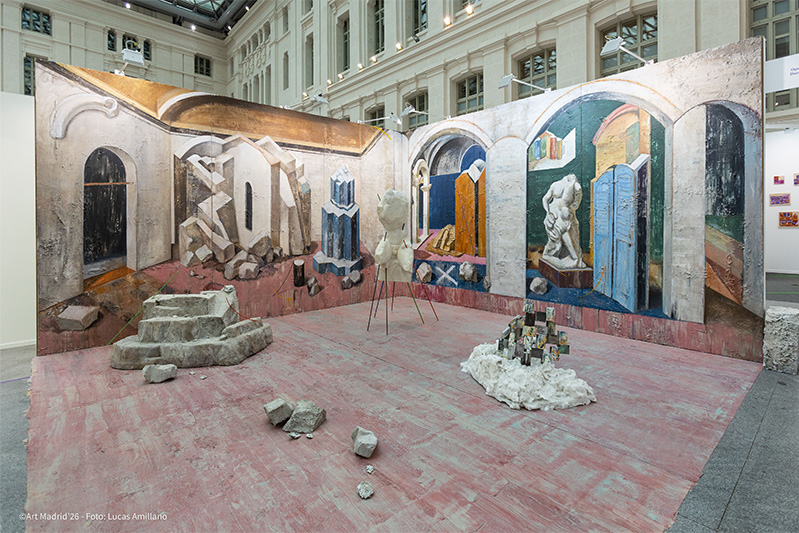
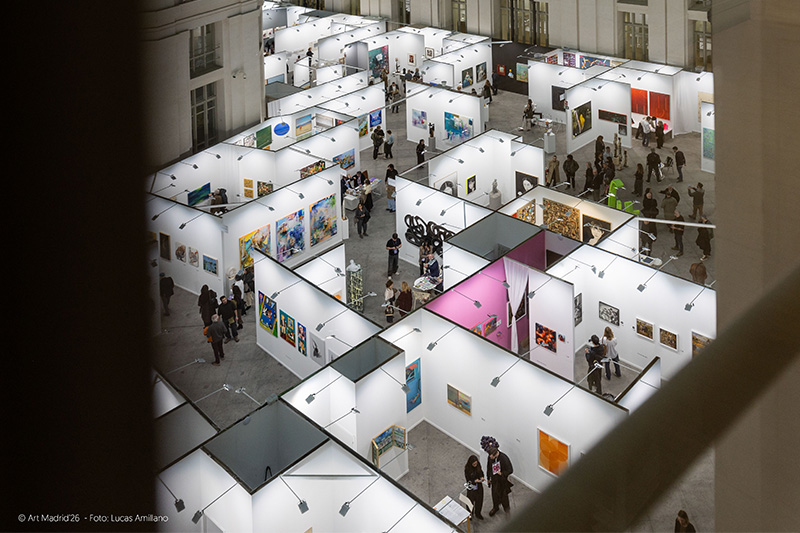
Art Madrid'26 – ART MADRID-PROYECTOR’20: THE MOST EXCLUSIVE AND COMPLETE PROGRAM

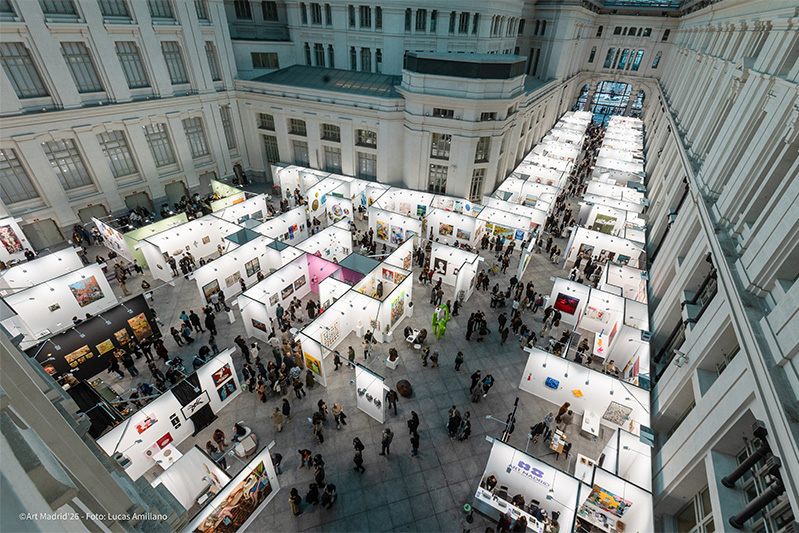
Art Madrid’20 turns this edition into a celebration of the latest and more dynamic contemporary art. On the occasion of the 15th anniversary, we have prepared an intense program of activities program of activities since February 12th and that extends during the five days of the fair. In collaboration with the video art platform PROYECTOR and under the curatorship of its director Mario Gutiérrez Cru, the program also has the MediaLab Prado and Sala Alcalá 31 spaces.

As a newness and on the occasion of this very festive edition, Art Madrid will have this year its own stand dedicated exclusively to video-creation, action art and performance. An immersive experience in the most complete artistic paradigm.


The program of activities will begin next February 12th in Medialab Prado with the masterclass (from 17:30 to 20:30) of Patxi Araújo under the title of All Prophets are Wrong. The artist will share his creative experience, the paths explored in communication and his production process incorporating technology without losing the burden of speech.Then as an opening the interactive work of Patxi, Sherezade will be projected on the facade of MediaLab Prado. This work proposes a game with the public through the random generation of sentences and phrases according to the position of the spectator in the front square of the facade.

During the next two days, the master classes of Olga Diego will be held in this space with El vuelo como materia viva and Lois Patiño with Tiempo e imagen. Olga Diego stages a practical, unique and exclusive meeting for the public: work on the construction of the concepts of Flight, Art and Action through the installation that will be part of his performance at the fair. An intimate experience between the artist, creation and the audience.

To close this cycle of masterclasses Lois Patiño proposes an approach to video art and feature film through his work and the treatment that is made of these universals, reflecting on time, image and contemplative experience.
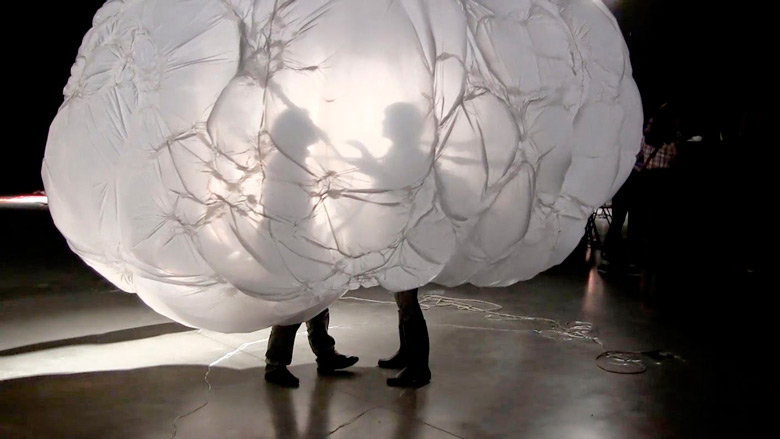
Olga Diego, "The bubble woman show". Photo: Carolina Diego

For its part, the auditorium of Sala Alcalá 31, will host on Thursday 20th the meeting with professionals De la imagen fija al New Media . They will discuss the evolution of the image in contemporary culture and the impact it currently has for the creators and the society that enjoys and consumes it. The experts will make a tour of the still image, the video art or moving image and its multiple visions until reaching the new media. Rafael Doctor, historian, independent curator and cultural manager, critic and curator Karin Ohlenschläger, today director of activities of Laboral Centro de Arte y Industrial Creación, and Berta Sichel, cultural agent and curator who today directs Bureauphi Art Agency, all moderated by Miguel Álvarez-Fernández.

Finally, in this cycle of previous activities, Art Madrid organizes on Saturday, February 22nd, a visit to the artist Eduardo Balanza's workshop, in which we will have the opportunity to know his creative space and approach one of his last pieces “B71”, which combines sound and technology with an impressive result. B71 organ is an instrument that works activated by vibrating speakers on plates capable of connecting to meteorological data websites, works in manual and automatic mode, generating its own sounds. The visit will also end with performance in petit committee.
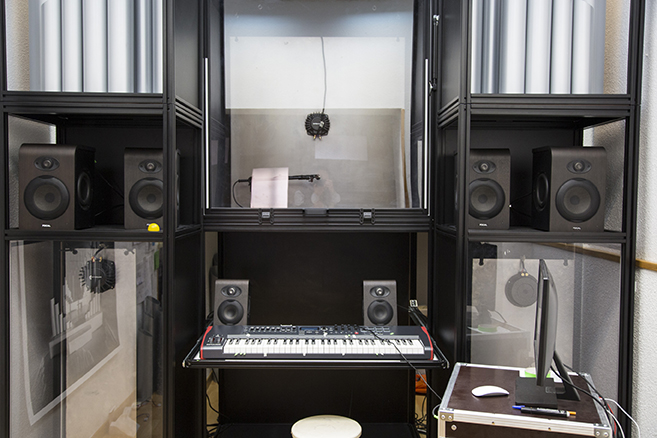
Eduardo Balanza, "B71"

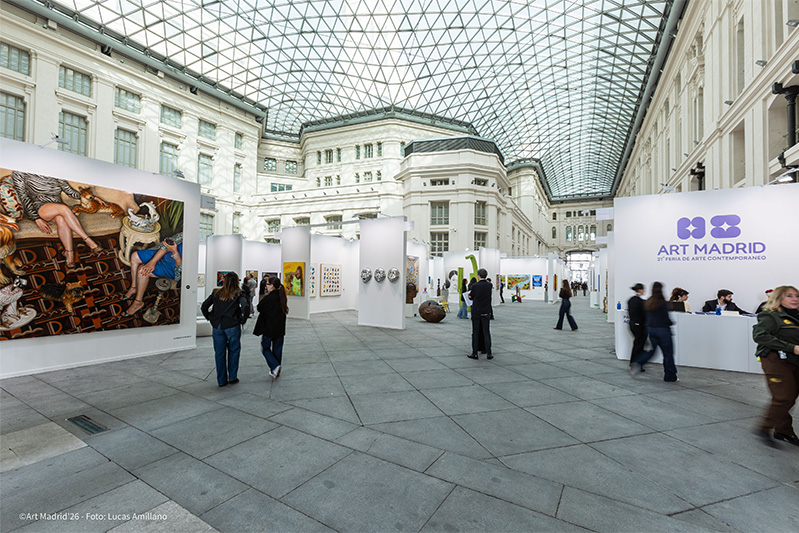
Art Madrid wants to accommodate less visible artistic disciplines that, however, house some of the most groundbreaking and contemporary languages. An own stand inside the fair, from February 26th to March 1st, will be dedicated to moving image and contact with more ephemeral manifestations such as installation or performance.

Every day at the fair, we will enter the video art thanks to the screenings of a selection of award-winning pieces and finalists from the main international festivals dedicated to the moving images. Mario Gutiérrez Cru presents an international tour of Argentina, Colombia, France, Greece, Mexico, the Netherlands, Morocco, Peru and Portugal.

Among its goals, this programming is to promote dialogue and understanding of the new working methods that the authors follow in the field of video creation and the action art. For this, every afternoon at 5:00 p.m. we will attend the presentation and meeting with an outstanding artist from the field of video creation: Abelardo Gil-Fournier, Fernando Baena, Mario Santamaría y Maia Navas will star in this space where he will introduce his work and then proceed to the visualization of a selection of his most recent work on the screen.
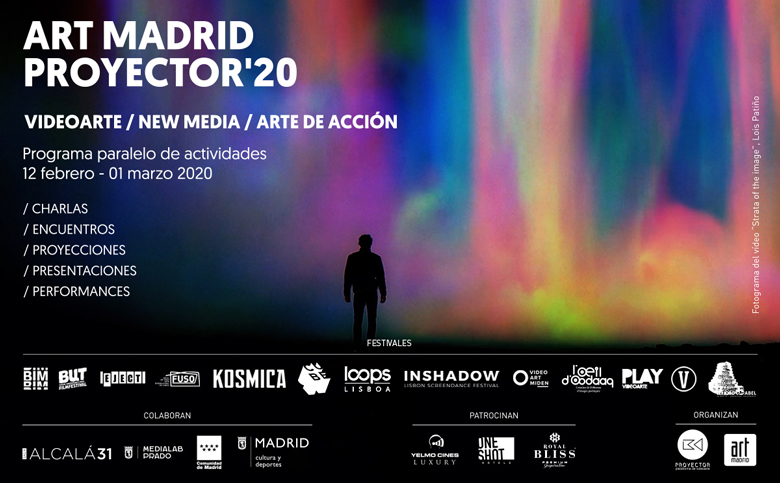
To end this art festival, we will have an exclusive experience every evening at 8:00 p.m: live audiovisual performances by artists with great international recognition. Iván Puñal, Olga de Diego, Eunice Artur con Bruno Gonçalves y Arturo Moya con Ruth Abellán.


ART MADRID’26 INTERVIEW PROGRAM. CONVERSATIONS WITH ADONAY BERMÚDEZ


The work of Julian Manzelli (Chu) (Buenos Aires, Argentina, 1974) is situated within a field of research in which art adopts methodologies close to scientific thinking without renouncing its poetic and speculative dimension. His practice is structured as an open process of experimentation, in which the studio functions as a laboratory: a space for trial, error, and verification, oriented less toward the attainment of certainties than toward the production of new forms of perception. In this sense, his work enters into dialogue with an epistemology of uncertainty, akin to philosophical traditions that understand knowledge as a process of becoming rather than closure.

Manzelli explores interstitial zones, understood as spaces of transit and transformation. These ambiguous areas are not presented as undefined but as potential—sites where categories dissolve, allowing the emergence of hybrid, almost alchemical configurations that reprogram the gaze. Geometry, far from operating as a normative system, appears tense and destabilized. His precarious constructions articulate a crossing between intuition and reason, play and engineering, evoking a universal grammar present in both nature and symbolic thought. Thus, Manzelli’s works do not represent the world but rather transfigure it, activating questions rather than offering closed answers.


Avícola. Escultura magnética. Madera, imanes, laca automotriz y acero. 45 x 25 cm. 2022.


Science and its methods inspire your process. What kinds of parallels do you find between scientific thinking and artistic creation?

Science and art are two disciplines that I believe share a great deal and are undoubtedly deeply interconnected. I am interested in that point of intersection, and although they are often placed in opposition, I think they share a common origin. Both involve a continuous search, a need for answers that stems from curiosity rather than certainty, and that often—or in many cases—leads both artists and scientists into uncomfortable, uncertain positions, pushing them out of their comfort zones. I believe this is a fundamental and very compelling aspect shared by these two disciplines, which in some way define us as human beings.

In this sense, both share experimentation as a core axis of their practice. Trial and error, testing, and the entire process of experimentation are what generate development. In my case, this applies directly to the studio: I experience it as a laboratory where different projects are developed and materials are tested. It is as if one formulates a hypothesis and then puts it to the test—materials, procedures, forms, colors—and outcomes emerge. These results are not meant to be verified, but rather, in art, I believe their function is to generate new modes of perception, new ways of seeing, and new experiences.


Receptor Lunar #01. Ensamble de Madera Reciclada torneada. 102 x 26 x 26 cm. De la serie Fuerza orgánica. 2023.


You work within the interstices between the natural and the artificial, the figurative and the abstract. What interests you about these ambiguous zones, and what kinds of knowledge emerge from them?

I have always been quite restless, and that has led me to immerse myself in different fields and disciplines. I believe there is a special richness in interstitial spaces—in movement back and forth, in circulation between media. These spaces have always drawn my attention: ambiguous places, hybrid zones. There is something of an amphibious logic here—amphibians as entities that carry and transmit information, that share, that cross boundaries and membranes. In my case, this is closely linked to what I understand as freedom, especially at a time marked by categorization, labeling, and a profound distortion of the very concept of freedom.

On another level, more metaphysical in nature, it is within the mixture—within that blending—that the living energy of creating something new appears, which is undoubtedly a fundamental aspect of what it means to be human. It is as if “one thing becomes something else outside the mold.” This interaction is necessary to break structures, to build new ones, to transmute—to undergo something almost alchemical. I believe fixation is the enemy. In a way, ambiguity is what allows us to reprogram our gaze and generate new points of view.


De la serie Naturaleza orgánica. Madera torneada recuperada de podas de sequía y rezagos de construcción. 2025.


Movement, repetition, and sequence appear as visual strategies in your work. What role does seriality play in the generation of meaning?

Movement, repetition, and sequence are very present in my work. I have a long background in animation, and in some way that interest begins to filter into the other disciplines in which I work. Thus, movement also appears in my visual art practice.

Seriality is a way of thinking about time and of introducing a certain narrative and sense of action into the work, while at the same time conditioning the viewer’s experience. It invites the viewer to try to decipher repetition as a kind of progression. I am particularly interested in more abstract forms of narrative. In this type of narrative, where there is no clear figuration, repetition begins to establish a pulse, a “beat” that marks the passage of time. What is interesting, I think, is the realization that repetition is not exactly duplication, and that what seems identical begins to mutate over time, through rhythm, or through its own unfolding history.


De la serie Naturaleza orgánica. Madera torneada recuperada de podas de sequía y rezagos de construcción. 2025.


You work with geometric and constructive systems. What role does geometry play as a symbolic language within your practice?

Geometry is present in my work in multiple forms and dimensions, generating different dynamics. Generally, I tend to put it into crisis, into tension. When one engages closely with my works, it becomes clear that constructions based on imprecise and unstable balance predominate. I am not interested in symmetry or exactness, but rather in a dynamic construction that proposes a situation. I do not conceive of geometry as a rigid system.

I believe this is where a bridge is established between the intuitive and the rational, between playfulness and engineering—those unexpected crossings. At the same time, geometry functions as a code, a language that connects us to a universal grammar present in nature, in fractals, and that undoubtedly refers to symbolism. It is there that an interesting portal opens, where the work begins to re-signify itself and becomes a process of meaning-making external to itself, entirely uncertain. The results of my works are not pieces that represent; rather, I believe they are pieces that transfigure and, in doing so, generate questions.


WIP. Madera torneada recuperada de podas de sequía y rezagos de contrucción. 2022.


To what extent do you plan your works, and how much space do you leave for the unexpected—or even for error?

In terms of planning, it depends greatly on the project and even on the day. Some projects, due to their scale or complexity, require careful planning, especially when they involve the participation of other people. In many cases, planning is undoubtedly essential.

That said, in the projects I do plan, I am always interested in leaving space for improvisation, where chance or the unfolding of the process itself can come into play. I believe this is where interesting things begin to emerge, and it is important not to let them pass by. Personally, I would find it very boring to work on pieces whose outcome I already know in advance. For me, the realization of each work is an uncertain journey; I do not know where it will lead, and I believe that is where its potential lies—not only for me, but also for the work itself and for the viewer’s experience.