Art Madrid'26 – THE 14th EDITION OF ART MADRID IS COMING: KNOW THE PARTICIPATING GALLERIES

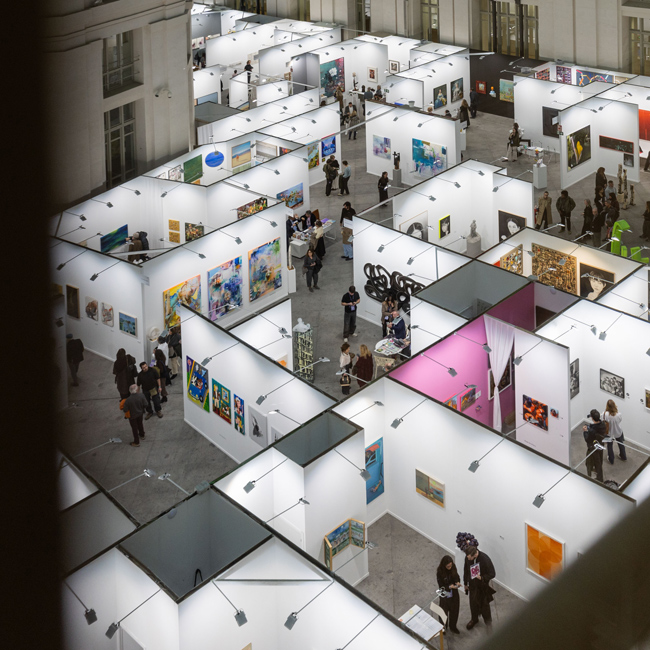
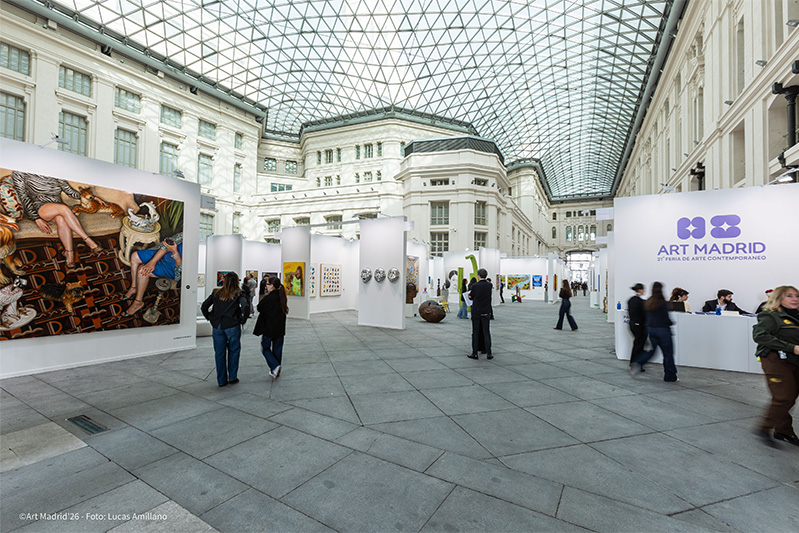
Art Madrid celebrates its fourteenth edition from February 27 to March 3, 2019, in the Crystal Gallery of CentroCentro Cibeles, with the participation of more than 40 national and international galleries that will show the works of nearly 200 artists, both creators emerging as consolidated. With an outstanding foreign presence, which this year reaches 40% and reaffirms the confidence placed in the fair by the international context, 26 national and 16 foreign exhibitors from 13 countries, from Spain to Germany, France, Portugal, Lithuania, Argentina, Brazil, Cuba, Mexico, Peru, South Africa or Taiwan, and including the incorporation of 10 first-time participating galleries.
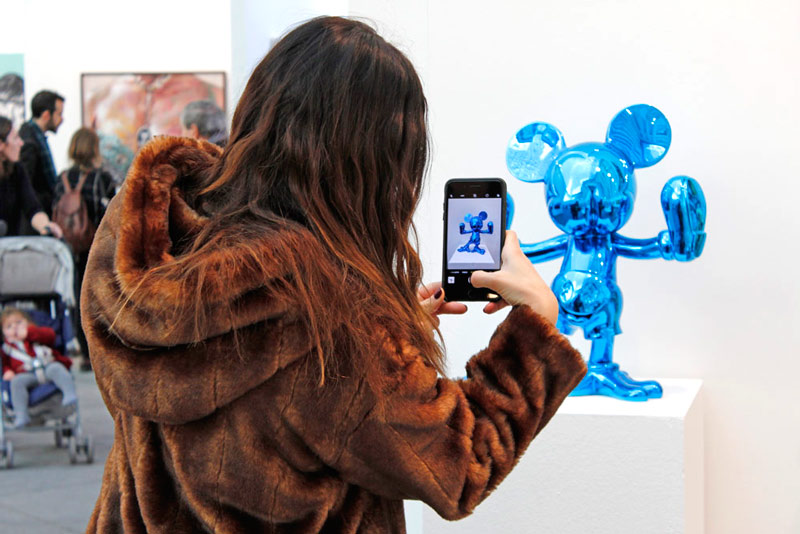
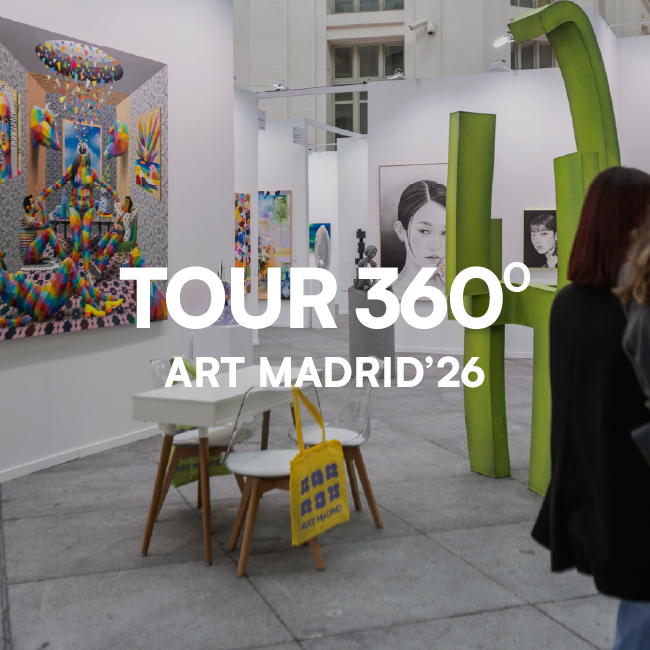
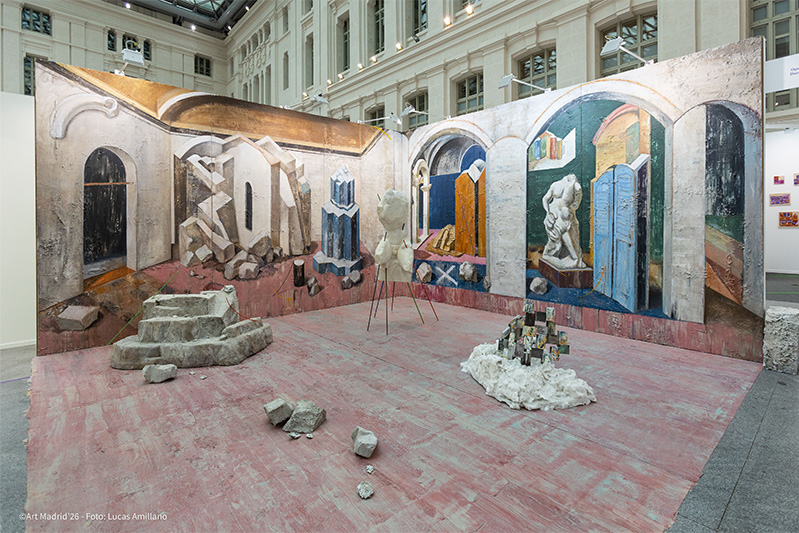
Galería Hispánica’s booth at Art Madrid, photo by Sara Ortega.

This year, the wide and varied proposal of Art Madrid stands out for its increasingly international character and for a more contemporary artistic selection. Also, the fair reinforces its ongoing commitment to young creators and the most current forms of creation, as proven by the high number of artists under 40 (63), the choice of Rubén Martín de Lucas as Guest Artist or the Parallel Program main theme. In fact, the fair has developed a large set of educational and cultural activities that this year revolve around a very current and booming artistic genre, which we will soon announce.
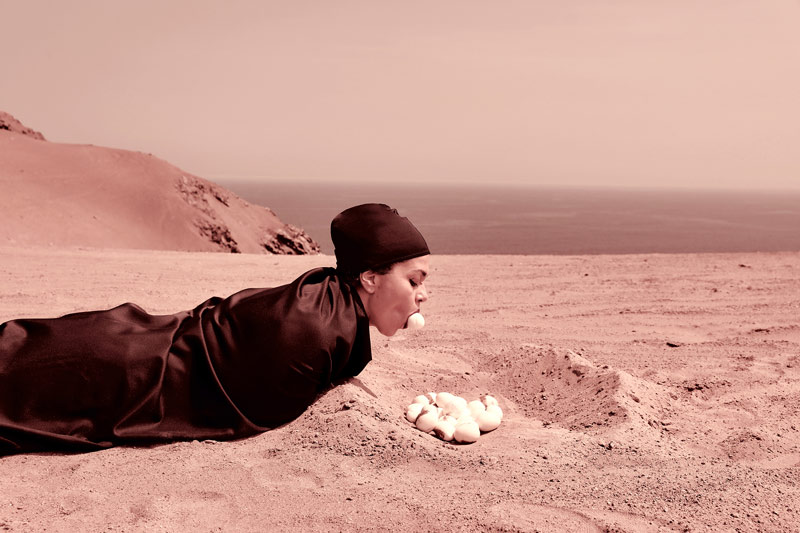
Carolina Bazo, “Patrones”, photography, 2017. O-Art Project.

In the General Program, a large number of national galleries participate again, such as Madrid's Kreisler, Marita Segovia, Alberto Cornejo BAT, Fucking Art Gallery, Contemporary Hispanic (also based in Mexico City), Jorge Alcolea and Montsequi. From Asturias the galleries directed by Aurora Vigil-Escalera (Gijón), Bea Villamarín (Gijón) and Arancha Osoro (Oviedo) are returning participants too, while from Galicia, Luisa Pita (Santiago de Compostela) and Moret Art (A Coruña) also return to the fair. From the northern part of the Peninsula, Galería Espiral (Noja, Cantabria), Rodrigo Juarranz (Aranda de Duero, Burgos) and MH Art Gallery (Bilbao), as well as the newly participating Kur Art Gallery (Guipúzcoa), are joining us this year. From Valencia the new proposals of Alba Cabrera Gallery and Shiras Gallery are presented, as well as those of the galleries that are coming from Barcelona: 3 Punts, Miquel Alzueta and Zielinsky. In addition, the Galería Cornión (Gijón) and Víctor Lope Arte Contemporáneo (Barcelona), which is also present in the One Project programme, are being premiered at the Crystal Gallery.
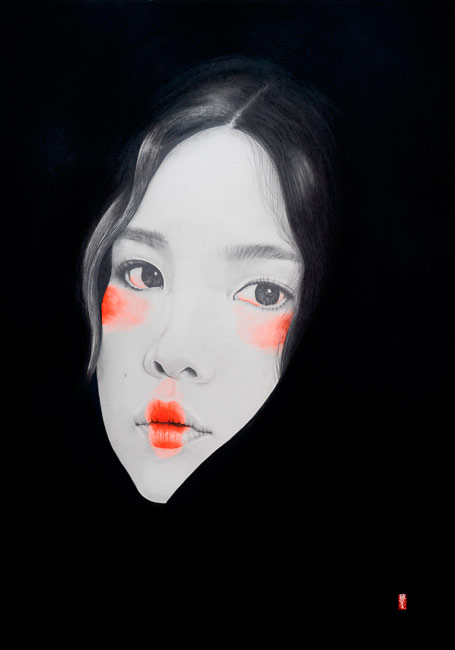
Lantomo, “Darkness 06 Doll”, graphite, pastel and watercolor on paper, 2018. Galería BAT Alberto Cornejo.

Among the foreign participating galleries from the General Program, the Portuguese representation is highlighted with Art Lounge (Lisbon), Paulo Nunes-Arte Contemporânea (Vila Franca de Xira) and the newly incorporation of the São Mamede Gallery (Lisbon/Porto). Also participating for the first time are the French Galerie Barrou Planquart (Paris), the North American Lola & the Unicorn (New York), the South African Oda Gallery (Franschhoek) and the Peruvian art collective O-Art Project (Lima). The renewed selections of the German Schmalfuss (Berlin) and Robert Drees (Hannover), the French Norty Mécénat (Carrières-sur-Seine), the Taiwanese Yiri Arts (Taipei) and the Cuban Collage Habana (Havana) have return this edition as well.
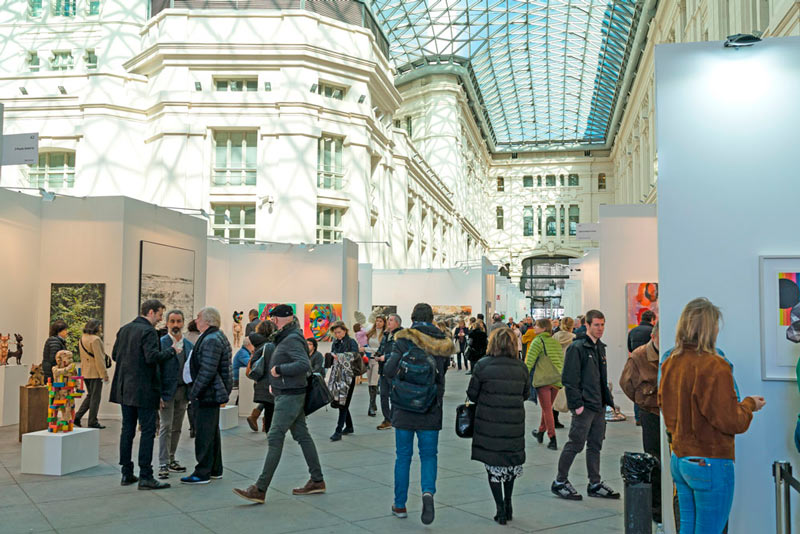
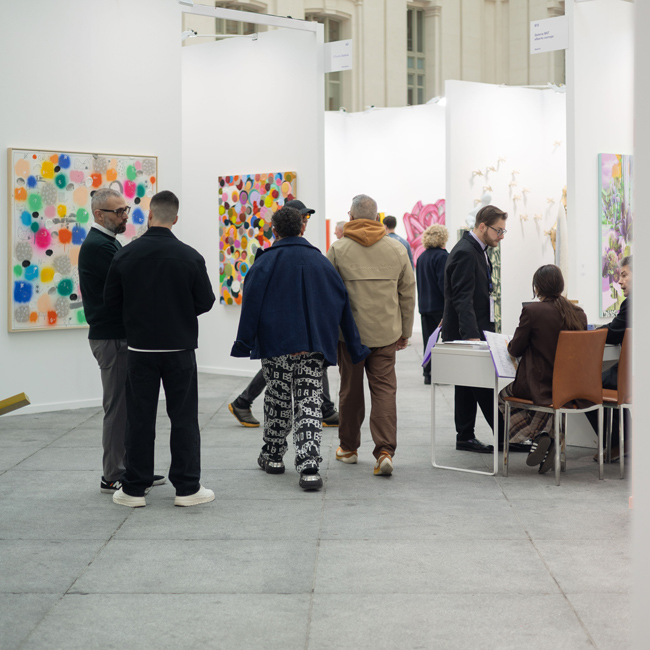
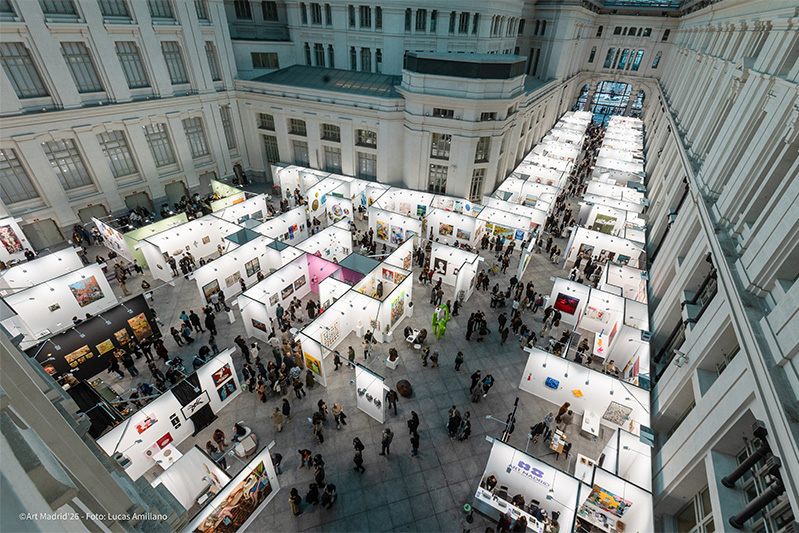
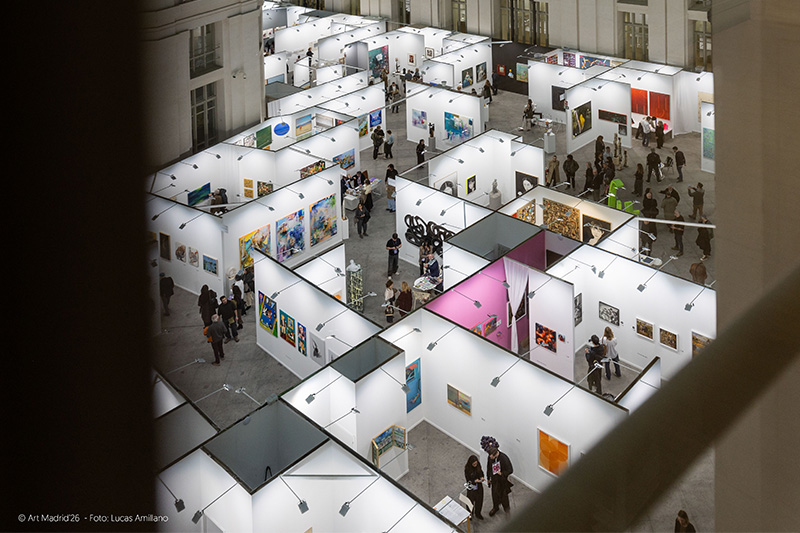
View of Art Madrid, photo by Julia Mateo.

One more year, Art Madrid also features the One Project program. The project, designed to support and promote young artists whose careers are in an initial or intermediate state, takes place in a collective exhibition in a solo show format. This year, one of the great updates of the program is the incorporation of Nerea Ubieto, art critic and curator who presents a new proposal leaded only by female artists. This choice, as stated by Ubieto, is based “on the eagerness to level an unstable balance in which female participation in art fairs is still today unfair”.
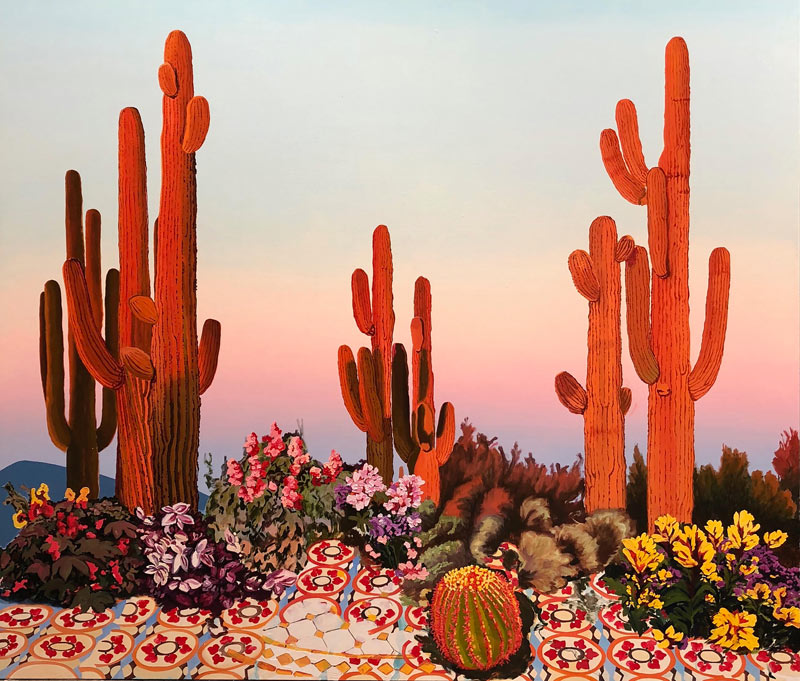
Alejandra Atarés, “Cactus naranjas”, oil and acrylic on linen, 2018. Víctor Lope Arte Contemporáneo.

Under the title "Ficciones, máscaras y paisajes: el color como telón de fondo", 7 artists feature specific proposals for the fair, which, as the curator explains, invite us to build our own universes. In the program, the international presence is again highlighted, and the pieces by Rūta Vadlugaitė (with Contour Art Gallery, Vilna), Virginia Rivas (DDR Art Gallery, Madrid), Mara Caffarone (Granada Gallery, Comuna), Nuria Mora (About Art, Lugo), Sofia Echeverri (Flux Zone, Mexico City), Manuela Eichner (RV Cultura e Arte, Salvador) and Alejandra Atarés (Víctor Lope Arte Contemporáneo, Barcelona) will be revealed at the fair.
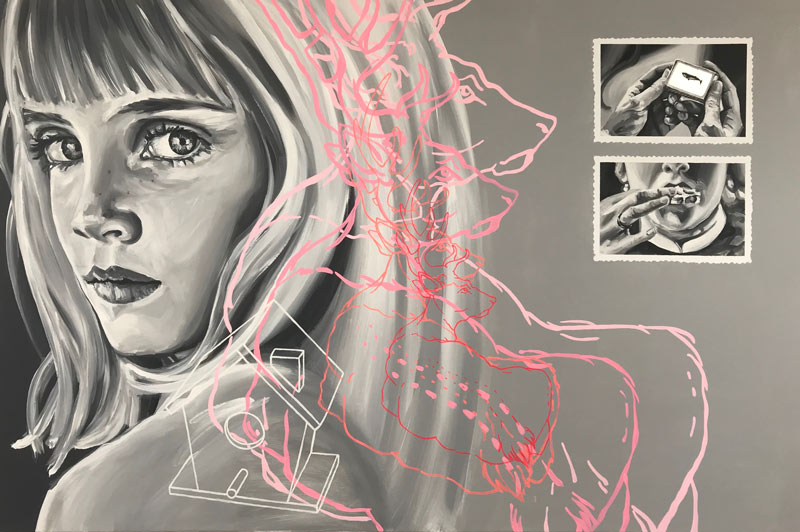
Pepa Salas Vilar, “Desiderare con l’anima”, mix media on canvas, 2018. Galerie Robert Drees.

in this edition, as the Selection Committee assures, the proposals are highlighted because of the increasing quality, the more rigorous selection, the growing international character and the ability to reveal the new possibilities in the world of creation. Also, they are articulating fully contemporary and well-connected discourses, drawing something of the map of our time, in contemporary art. We invite you to stay tuned to our news section where, little by little, we will present all the programs in detail. We await you in Art Week!


LIST OF GALLERIES

General Program

3 Punts Galeria (Barcelona)

Alba Cabrera Gallery (Valencia)

Arancha Osoro (Oviedo)

Art Lounge Gallery (Lisbon)

Aurora Vigil-Escalera (Gijón)

Bea Villamarín (Gijón)

Collage Habana (Habana)

Galería Cornión (Gijón)

Galería Espiral (Noja, Cantabria)

Galería Hispánica Contemporánea (Madrid / Mexico City)

Galería Jorge Alcolea (Madrid)

Galería Kreisler (Madrid)

Galería Luisa Pita (Santiago de Compostela)

Galería Marita Segovia (Madrid)

Galería Miquel Alzueta (Barcelona)

Galeria Paulo Nunes Arte Contemporânea (Vila Franca de Xira, Portugal)

Galería Rodrigo Juarranz (Aranda de Duero, Burgos)

Galeria São Mamede (Lisbon/Porto)

Galería Zielinsky (Barcelona)

Galerie Barrou Planquart (Paris)

Galerie Robert Drees (Hannover)

Kur Art Gallery (Guipúzcoa)

Lola & the Unicorne (New York)

MH Art Gallery (Bilbao)

Montsequi Galería de Arte (Madrid)

Moret Art (A Coruña)

Norty Mécénat (Paris)

O-Art Project (Lima, Peru)

Oda Gallery (Franschhoek, South Africa)

Schmalfuss Berlin (Berlin)

Shiras Galería (Valencia)

Víctor Lope Arte Contemporáneo (Barcelona)

Yiri Arts (Taipei, Taiwan)


One Project Program

About Art Gallery (Lugo)

Contour Art Gallery (Vilna, Lithuania)

DDR Art Gallery (Madrid)

Flux Zone (Mexico City)

Granada Gallery (Comuna, Argentina)

RV Arte e Cultura (Salvador, Brazil)

Víctor Lope Arte Contemporáneo (Barcelona)


The circle as critical device and the marker as contemporary catalyst


POSCA, the Japanese brand of water-based paint markers, has established itself since the 1980s as a central instrument within contemporary artistic practices associated with urban art, illustration, graphic design, and interdisciplinary experimentation. Its opaque, highly pigmented, fast-drying formula—compatible with surfaces as diverse as paper, wood, metal, glass, and textiles—has enabled a technical expansion that extends beyond the traditional studio, engaging public space, objects, and installation practices alike.


In this context, POSCA operates as more than a working tool; it functions as a material infrastructure for contemporary creation. It is a technical device that enables immediacy of gesture without sacrificing chromatic density or formal precision. Its versatility has contributed to the democratization of languages historically associated with painting, fostering a more horizontal circulation between professional and amateur practices.

This expanded dimension of the medium finds a particularly compelling conceptual framework in The Rolling Collection, a traveling exhibition curated by ADDA Gallery. The project proposes a collective investigation of the circular format, understood not merely as a formal container but as a symbolic structure and a field of spatial tension.


Historically, the circle has operated as a figure of totality, continuity, and return. Within the framework of The Rolling Collection, the circular format shifts away from its classical symbolic charge toward an experimental dimension, becoming a support that challenges the hegemonic rectangular frontality of the Western pictorial tradition. The absence of angles demands a reconsideration of composition, balance, and directional flow.

Rather than functioning as a simple formal constraint, this condition generates a specific economy of visual decisions. The curved edge intensifies the relationship between center and periphery, dissolves internal hierarchies, and activates both centrifugal and centripetal dynamics. The resulting body of work interrogates the very processes through which images are constructed.


Following its 2025 tour through Barcelona, Ibiza, Paris, London, and Tokyo, a selection of the exhibition is presented at Art Madrid, reinforcing its international scope and its adaptability to diverse cultural contexts. The proposal for Art Madrid’26 brings together artists whose practices unfold at the intersection of urban art, contemporary illustration, and hybrid methodologies: Honet, Yu Maeda, Nicolas Villamizar, Fafi, Yoshi, and Cachetejack.

While their visual languages vary—ranging from graphic and narrative approaches to chromatic explorations charged with gestural intensity—the curatorial framework establishes a shared axis: a free, experimental, and distinctly color-driven attitude. In this sense, color functions as a conceptual structure that articulates the works while simultaneously connecting them to the specific materiality of POSCA.


The marker’s inherent chromatic vibrancy engages in dialogue with the formal assertiveness of the circle, generating surfaces in which saturation and contrast take center stage. The tool thus becomes embedded within the exhibition discourse, operating as a coherent extension of the participating artists’ aesthetic vocabularies.

One of the project’s most significant dimensions is the active incorporation of the public. Within the exhibition space—activated by POSCA during Art Madrid’26—visitors will be invited to intervene on circular supports installed on the wall using POSCA markers, thereby symbolically integrating themselves into The Rolling Collection during its presentation in Madrid.


This strategy introduces a relational dimension that destabilizes the notion of the closed artwork. Authorship becomes decentralized, and the exhibition space transforms into a dynamic surface for the accumulation of gestures. From a theoretical standpoint, the project may be understood as aligning with participatory practices that, without compromising formal coherence, open the artistic dispositif to contingency and multiplicity.

The selection of POSCA as the instrument for this collective intervention is deliberate. Its ease of use, line control, and compatibility with multiple surfaces ensure an accessible experience without diminishing the visual potency of the outcome. In this way, the marker operates as a mediator between professional practice and spontaneous experimentation, dissolving technical hierarchies.


The title itself, The Rolling Collection, suggests a collection in motion—unfixed to a single space or definitive configuration. Its itinerant nature, combined with the incorporation of local interventions, transforms the project into an organism in continuous evolution. Within this framework, POSCA positions itself as a material catalyst for a transnational creative community. Long associated with urban scenes and emerging practices, the brand reinforces its identity as an ally of open, experimental, and collaborative processes.

POSCA x The Rolling Collection should not be understood merely as a collaboration between a company and a curatorial initiative; rather, it constitutes a strategic convergence of tool, discourse, and community. The project proposes a reflection on format, the global circulation of contemporary art, and the expansion of authorship, while POSCA provides the technical infrastructure that makes both individual works and collective experience possible.